To avoid these ads, REGISTER NOW!

PEX Spacing and Planning Future Equipment

12husky

Well-known member
Joined
Feb 23, 2014
Messages
91
I am currently planning a 36x48x12 pole building in Maryland. It will be used for a mix of wood and metal fabrication as a hobby for now and hopefully part time when I retire in the future.

I seem to rearrange my current spot quite frequently and attach certain equipment to the concrete floor (lathe, mill, grinders, work bench, etc). I really want to put PEX in the concrete of the new shop even if I don't utilize it for a few years, but am worried I will drill into it when setting equipment in the future. The standard seems to be 1/2" PEX with 12" spacing. At 24" spacing I would feel more confident about knowing where it is or being able to locate it with a FLIR camera from work. Will the spacing make the system ineffective, should I upsize the PEX, etc?

Thanks,

~Matt
 
To avoid these ads, REGISTER NOW!

homebuilt burner

Well-known member
Joined
Dec 8, 2014
Messages
1,763
Location
central Wisconsin
The pex is generally fastened to the foam board at the bottom of the concrete. So most people make a point to use short anchors. For example if you pour 4 inches of concrete and the pex is a the bottom, the longest anchor I would use would be 3" and you should have a 1/2" of space between the pex and the bottom of the anchor.

It would still make me nervous to drill into the concrete. But, people do it all the time.
 

akpolaris

Well-known member
Joined
Jun 14, 2010
Messages
214
Location
Seward, Ak
I poured 6 inches of mud and never use an anchor over 4". Additionally Since I laid it out along the same lines as the rebar it is fairly easy to guesstimate where the pex is at.
 

Modoc

Well-known member
Joined
Jan 25, 2014
Messages
167
Location
SE Oregon
Take pictures when you have it all laid out, make a drawing on graph paper with measurements from anchor points along the sill plate, and marks on the sill plate center to center of each loop. also take the graph paper and layout your shop with the equipment that you have over the pex loops. This should help with your dilema.
 

Crazy68Dart

Well-known member
Joined
Apr 10, 2010
Messages
484
Location
NE Ohio
I took many, many, pictures. In my case, on 6x6 mesh grid, you can measure off pretty easily. My slab is also relatively thick, so that gives some room for error with the anchors. Also in a few areas laid down a tape measure, photos of the starting point, and end point. Make sure your starting point is a reference that will never move.
 

BadgerBoilerMN

Well-known member
Joined
Aug 4, 2011
Messages
837
Location
Minneapolis
I perform a heat load using Wrighsoft and produce a CAD drawing for the record. As for PEX spacing, the heat load dictated the minimum spacing and design water temperature. In the garage side of my shop I was able to heat the room with one perimeter loop at one and two feet from the outside wall, strategically place in front bench but out of the field where a lift may be anchored in future.

Tube spacing can effect efficiency, comfort and may accommodate equipment placement without significantly compromising either.
 

tdkkart

Well-known member
Joined
Jun 17, 2006
Messages
6,887
Location
Eastern Iowa
You don't even need a FLIR, you can find it easily with just an IR temp gun, just sweep it across the floor, you'll find the hot spot easily.

Pour some rubbing alcohol in a line across the floor, it will evaporate over the tubes first.

OMG!!! did i say to use something flammable recklessly!?!?!?!
Yes I did, I said pour a LINE of it, not 10 gallons.........
 
OP
1

12husky

Well-known member
Joined
Feb 23, 2014
Messages
91
Thanks for all of the ideas. If I go with the wider spacing, should I go from 1/2" to 3/4" so I can get more BTUs into the slab without pushing the water too fast?
 

tdkkart

Well-known member
Joined
Jun 17, 2006
Messages
6,887
Location
Eastern Iowa
True, but the OP mentions access to one. Given that, I really see no need for debate here. Turn system on, look at FLIR, locate tube. Done.

Sorry, I always assume that people other than the OP may be reading these posts looking for ideas. Not everyone has access to a FLIR, so I offered up a couple alternatives to accomplish the same goal.

Sorry for intruding.....
 

rlitman

Well-known member
Joined
Oct 18, 2010
Messages
24,651
Location
Long Island
Sorry, I always assume that people other than the OP may be reading these posts looking for ideas. Not everyone has access to a FLIR, so I offered up a couple alternatives to accomplish the same goal.


Sorry for intruding.....


There is nothing wrong with that. We always have to balance the two ways of responding. Giving the OP the best answer, or providing the best answer for future readers (because, of course, we always suggest using the option of searching, before asking).

While I had quoted you, my response above was intended more for the OP, to try to keep him on the former path. However, it is the latter path, where I often see the more wild brainstorming give birth to some of the best and most original ideas.
 
To avoid these ads, REGISTER NOW!

BadgerBoilerMN

Well-known member
Joined
Aug 4, 2011
Messages
837
Location
Minneapolis
Thanks for all of the ideas. If I go with the wider spacing, should I go from 1/2" to 3/4" so I can get more BTUs into the slab without pushing the water too fast?

That is not how it works.

You use 3/4" to run longer loop lengths and use smaller manifolds.

There is not appreciable difference in output and you wouldn't need it if there was.

My shop is 100% 1/2" PEX.

Design by internet is not the best option.

If you open the garage door in cold weather you can feel the tube placement with your hand in a <6" slab.
 

wagspe208

Well-known member
Joined
Apr 29, 2011
Messages
94
Thanks for all of the ideas. If I go with the wider spacing, should I go from 1/2" to 3/4" so I can get more BTUs into the slab without pushing the water too fast?
Here is the big question, and dozens of answers.
I used 5/8, 12" spacing. 5/8 is not common, except in radiant heat apps. Fittings are hard to find locally.... Many people say it does not exist. Whatever...
Point is...
I used Blueridge
http://www.blueridgecompany.com/
they had everything I needed INCLUDING advice. I bought all my stuff from them, they provided drawings for loops, etc. It was easy. EXCELLENT customer service also.
Wags

I could have bought pumps a little cheaper. BUT, the time they spent on the phone with me was invaluable.
Oh. FOAM UNDER AND AROUND PERIMETER
 

BadgerBoilerMN

Well-known member
Joined
Aug 4, 2011
Messages
837
Location
Minneapolis
The use of 5/8" PEX is a more a matter of specific application. You may run a bit longer loops to the same affect as 1/2" saving manifold space and cost. You may run glycol for snow melting where 1/2" would present too much head for common pumps. 5/8" PEX will cost a bit less than 3/4" PEX and bend a closer radius should you need a narrow tube spacing.

With all these "advantages" I still use 1/2 and 3/4" PEX most of the time.

As mentioned, 5/8" fittings can be hard to find and naturally cost more so it often pays to stick with the more common sizes especially if you are adding plumbing and use dual-approved PEX for heating and plumbing.

As for Blueridge; Wag is right, you can't go wrong with Dan and his crew.
 

wagspe208

Well-known member
Joined
Apr 29, 2011
Messages
94
For MY (I am no expert by any means, and do not imply I am) application it was actually cheaper to run 500' lengths of 5/8 as opposed to ?? lengths of 1/2" by the time you added tubing cost and additional manifold costs.
Your results may vary.
Wags
 

Attachments

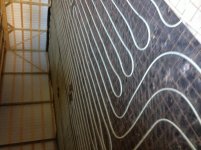
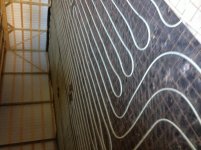
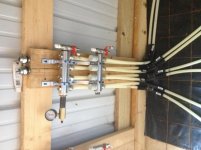
  • radiant manifold.jpg
    radiant manifold.jpg
    147.9 KB · Views: 70
  • radiant tube.jpg
    radiant tube.jpg
    146 KB · Views: 52

BadgerBoilerMN

Well-known member
Joined
Aug 4, 2011
Messages
837
Location
Minneapolis
You can save more by ignoring the 12" center non-sense and space according to heat loss instead of on-line advice.

It is rare for 5/8" tubing to be a money saver in light commercial heating designs. I have been doing this for a few decades and used 1/2" in my 40 x 60 pole shed. Sheds of this size with one or two zones--I have 4--would be better off with 3/4" PEX for the same reasons wag argues.

The intended use of the building, heat load, PEX pattern, spacing and heat source should all be considered when designing radiant slab heating systems.

Nice looking work wag.
 
OP
1

12husky

Well-known member
Joined
Feb 23, 2014
Messages
91
Thanks for all of the replies. For a DIY guy, is there an online program or resource where I can play with layouts, tubing sizes, heat needs, etc?
 

A_Pmech

Well-known member
Joined
May 8, 2007
Messages
8,002
Location
IL
For the most part, there's no good reason to bolt your lathe or milling machine to the floor.
 

wagspe208

Well-known member
Joined
Apr 29, 2011
Messages
94
I just took the advice of blueridge Dan. They also sent me tubing layout. Fortunately, my building was only 2 zones. One is 50 x 40, the other is 50 x 36. It worked out good to use 500' loops, which did not require the use of any 5/8 fittings.
I'd check blueridge website. They have a lot of info. I did not price compare after I talked to them due to their help.
Knowledge is pricele$$ IMO!
Wags

Again, I took all advice from Blueridge. Locals all had 10 different ideas on how to do it, and no experience, or little experience.
 

Attachments

  • radiant tube.jpg
    radiant tube.jpg
    146 KB · Views: 34
Last edited:
OP
1

12husky

Well-known member
Joined
Feb 23, 2014
Messages
91
I was given about 2,000 feet of 1/2" Pex-al-pex that didn't end up being used on a job, but unfortunately it sat outside for a few months. Is there a way to test if it was compromised by the UV exposure?
 

BadgerBoilerMN

Well-known member
Joined
Aug 4, 2011
Messages
837
Location
Minneapolis
Which PAP is it? How many months? Which months? Altitude? Longitude?

Most PAP is greatly over-engineered for the low temperatures and pressures presented by a typical slab-on-ground radiant heating system.
 
OP
1

12husky

Well-known member
Joined
Feb 23, 2014
Messages
91
Which PAP is it? How many months? Which months? Altitude? Longitude?

Most PAP is greatly over-engineered for the low temperatures and pressures presented by a typical slab-on-ground radiant heating system.


KITEC IPEX and it was outside in Maryland for the last 6 months
 
To avoid these ads, REGISTER NOW!
Top Bottom