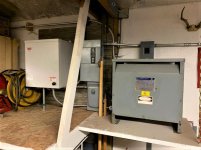
Hey there, I also have a PP, I think its the 20hp model. I sort of forgot a few of the details but I think its wired with #2 awg although I've yet to trip the 60A breaker which feeds it. Be very aware that the PP still allows downstream/output voltage on 2 legs even though the contactor is OFF. So lock the input single phase breaker if you ever do any work on the distribution system. I learned this by creating an unanticipated arc in a junction box ....thankfully not thru me, but serious enough to recall that detail.
The big advantage of the PP other than having utility-quality 3ph in my opinion is that if you ever relocate, you simply take down the unit, demo the conduit and now your 3ph is ready to go in a new location after conduit and wiring is restored but that is Easy compared to dealing with a Utility. Contrast that to paying $5k to 15k to the Utility to run it to your shop which is fixed to only one location. The PP is based on VFD technology after charging up a DC bus but they've figured out how to sink power back to the grid when a downstream load is suddenly disconnected.
I built an old school fuse-block circuit protection/distribution panel for it. There's a 60A path with #6 awg which is direct-wired to 2 different machine tools, also with a local wall-mounted disconnect. This also feeds a 2nd fuse block which is fused for 30A service and that goes on many branches to a series of twistlock receptacles which go hot all at the same time. One learning was I didn't put enough ground lugs inside and had to jump to a 2nd distribution block. Make sure you label wires and make diagrams otherwise you'll forget down the road if you want to make changes.
All of the 3ph wiring runs in PVC conduit in the attic spaces. Nice since I can reconfigure it all just by moving conductors around. I drop vertically down thru T-condulet bodies either exterior to the wall in finished spaces or i went inside the wall cavity in the new shop. There's a large 2" Trunk Line and the branches are either 3/4 or 1" trade size.
I setup an icecube relay and a 3-way-4-way circuit so that I have 4 spots throughout the shop that can all either energize the PP or turn it off. The 120vac - 800T indicator shows the status since some parts are remote.
I kind of wish I would have mounted the PP in the attic. Originally its irritating transistor buzz was a little nerve wracking. My Dad, on the other hand could not even tell it was running. Fast forward about 7 years and I'm on the same path, I can hear it but its just a background noise now.
Relative to your question about the heavy box, definitely need to find studs, I would either send strut channel feet directly to the floor, or threaded rods to the trusses or ceiling joists. Its possible to use 45-degree braces but the wall is going to take on the large bending load if you don't outboard-support it. I'd take a look at GRK-RSS screws sold at Home D for some supremely strong screws when connecting to wood.


Couple shots of the trunk line.

That small conduit on the right is just a loose piece..not sure why that's there, I was probably using it as a push-stick for some low-voltage wires...oh well, the one going out at a 45 is 100% functional.

Not sure if this cryptography can be decoded but its the diagram for the control circuit. It can be expanded ad-infinitum by adding more 4-way switches between "2" and "3" and repeating the pattern. It has to start and end with a 3-way.

The PP is expecting a dry contact to be closed and not a 120vac signal, so there's an ice cube relay which hides in a 4" square box and the 120vac energizes its coil, the NO contact is what starts and stops the PP.

Original was just a maintained ON-OFF button but it became insufficient with the expansion of the shop.

Adapting the coverplate to 30mm/800T pilot light. Filed the slot for the anti-rotate ring.

Sorry this is probably more than you wanted. I hold no certifications so take that with a grain of salt, I'm prone to go off-script but have worked in automotive assembly, powertrain and battery plants and deal with industrial equipment daily for the last 20 years. I'm really a toolmaker/machinist/mechanic but had to get into this electrical gig in order to power my machines

Enjoy the PP. Its a fantastic device