To avoid these ads, REGISTER NOW!

pilot holes?

waltmcq

Well-known member
Joined
Nov 22, 2006
Messages
252
Location
PT
How big to you have to drill before you should do a pilot hole?
I was drilling 1/4" hole in a 1/4" flat stock mild steel today. I figured I could get away with it but decided to drill a pilot first, I only had a dozen holes to do so it wasn't that big a deal.
What about you?
 
To avoid these ads, REGISTER NOW!

Chris83

Well-known member
Joined
Jan 18, 2010
Messages
299
Location
Langley, BC
I personally like to drill a 1/8th hole before I drill any size hole. I guess after buying a decent set of bits I didn't want to wreck them like I would with a cheap bit
 

sberry

Banned
Joined
Jun 18, 2005
Messages
35,747
Location
Brethren, Michigan
I almost automatically punch a 1/8 or so hole before drilling any other size. I grab up bits at a flea mkt every summer from a vendor for under a buck, USA and they really cut well. I drill a lot of holes, almost all by hand and 8 or 10 bits last a year, rarely use lube.
 

Brad54

Well-known member
Joined
Jun 13, 2006
Messages
4,646
I must do something wrong. I ALWAYS have a chattering, grabby bit at best and a smoked or broken bit at worse when I start with a pilot hole. I know everyone says you should have one, but I always drill a much cleaner hole without a pilot.

-Brad
 

Kevin54

MEMBER EMERITUS
Joined
Jan 12, 2005
Messages
29,341
Location
Urbana, Ohio
How big to you have to drill before you should do a pilot hole?
I was drilling 1/4" hole in a 1/4" flat stock mild steel today. I figured I could get away with it but decided to drill a pilot first, I only had a dozen holes to do so it wasn't that big a deal.
What about you?

You are fine just drilling that size of hole in 1/4" mild steel without a pilot. If it was 1" or thicker I would drill a pilot hole. I normally use a 1/4" drill AS a pilot hole if I am going to drill a large hole through steel.
 

djjsr

Well-known member
Joined
Sep 4, 2006
Messages
4,796
Location
In the cornfields
I drill pilot holes when accuracy is important. Also I have a set of bits that have a pilot tip. These things work really well but I don't know how I'm going to sharpen them so I don't use them regularly.

382851516.jpg


382852390.jpg


I've also used these split points and they work well.

382852391.jpg
 
Last edited:

rsanter

Well-known member
Joined
Dec 22, 2007
Messages
18,514
Location
visalia ca
the purpose of the pilot hole is to reduce heat and speed the drilling process because of the non-cutting center on most drill bits.
split tip bits mostly negate the need for this in most drill bits

bob
 

Flathead Youngin'

Well-known member
Joined
Apr 3, 2006
Messages
493
Location
Southern Ohio
mine ALWAYS do this...i use good quality bits, new ones, used ones, usa, oil, no oil, slow speed, fast speed, drill dr., etc.....and i still burn off the edge of my bits......

i love to work metal but i hate drilling holes!!!!!:mad:

I must do something wrong. I ALWAYS have a chattering, grabby bit at best and a smoked or broken bit at worse when I start with a pilot hole. I know everyone says you should have one, but I always drill a much cleaner hole without a pilot.

-Brad
 

MotoDave

Well-known member
Joined
Jul 1, 2009
Messages
505
Location
Ventura, CA
On really big stuff (1/2"+) I'll do a pilot, or if I am drilling hard steels. Otherwise I hit it first with a center drill, then just go ahead with the full size drill bit. Having a drill press really helps to ensure you'll get a nice round hole with no chatter.

If it really needs to be accurate I'll use a center drill, then a regular bit slightly undersize, then a reamer.
 

bimmer1980

Well-known member
Joined
Feb 5, 2009
Messages
2,104
Location
York, PA
I was just drilling some holes this weekend for a 7/16" bolt. I started with a 1/8" pilot hole, then a nice sharp 3/8" drill bit and finished with a 7/16" unibit. I like the unibit, as it gives a nice smooth hole and I can chamfer the top of the hole with the next size bigger.
 

CraigFL

Well-known member
Joined
Nov 1, 2005
Messages
704
Location
Panama City, FL
The technical problem is that starting holes with a bit requires the bit tip to be very sharp. Even so, shape is important because the cutting speed is slower as you get closer to the tip and the chips aren't removed as efficiently. As the bit gets bigger, the tip grind shape becomes more important because the requirement for central strength is high and chip movement up the flutes is more difficult. Using a pilot bit just makes it easier on a bit.
 

sberry

Banned
Joined
Jun 18, 2005
Messages
35,747
Location
Brethren, Michigan
Makes it easier on the operator too if its done by hand, so much less pressure needed.
mine ALWAYS do this...i use good quality bits, new ones, used ones, usa, oil, no oil, slow speed, fast speed, drill dr., etc.....and i still burn off the edge of my bits......
Technical things about drilling can be taught but there is a certain feel you learn over time for the right combination of speed and pressure. When I was a kid drilling used to be a big deal, now its instinctual and matter of fact. The new class of battery drill has made it better and easier than ever.
 

MXtras

Well-known member
Joined
Aug 17, 2005
Messages
1,356
Location
On the Right Coast
The most common problem with drilling a hole is folks overspeed the 'bit'. If the 'bit' is making noise, it's making heat. If it's making chips, it's making a hole. Make a good chip. Alter the speed and pressure to keep the chip production quiet and consistent.

I rarely use a pilot and rarely use coolant. The chips carry most of the heat away. Oil is needed only to lubricate the flutes to keep the chip moving - it does NOTHING to lubricate the cutting edge. It lubricates the sides if the drill is mis-aligned and it lubes the flutes.

Pilot holes are really not needed if you are using a split point drill as mentioned by rsanter. You can make any drill a split point with a sharp edged wheel and a little practice.

Sorry to wander off track.

Scott
 

sberry

Banned
Joined
Jun 18, 2005
Messages
35,747
Location
Brethren, Michigan
I don't use coolant because most of the time I don't want the mess and it doesn't bother me to take a minute or 2 to sharp a bit. I am not much worried about them as I have about a thousand, snagged up a couple pails at auctions.
 

Jack Olsen

Super Moderator
Staff member
Joined
Mar 22, 2009
Messages
6,678
Location
Los Angeles
Half-inch hole through one-inch plate after 1/8" pilot, a couple drops of 3-in-1 Oil as lubricant:

FirstHole1265696935.jpg


BigDrill1265696956.jpg


I may be the least-qualified guy to offer any advice here, but I was amazed at how much easier drilling steel is with a low-rpm drill. I have a cheapo 0-550 rpm model from Harbor Freight that cost me $39, and it's just about impossible to burn out a bit when the drill is turning that slowly.

I wrote about it recently in this thread, which might have some information that's helpful, since a lot of more-experienced guys commented.
 

rsanter

Well-known member
Joined
Dec 22, 2007
Messages
18,514
Location
visalia ca
I drill pilot holes when accuracy is important. Also I have a set of bits that have a pilot tip. These things work really well but I don't know how I'm going to sharpen them so I don't use them regularly.

382851516.jpg


382852390.jpg


I've also used these split points and they work well.

382852391.jpg

those dewalt bits are the old B&D 'bullet' bits.
to sharpen the center part you teat it like any other drill bit of the size.
to sharpen the outer portion you need to take your grinding wheel and use a stone dresser to dress the surface at an angle. this will allow you to sharpen it without touching the center pilot.
this used to be on their website

bob
 

arkangel06

Banned
Joined
Jan 31, 2009
Messages
4,642
Location
ontario
only when accruacy counts or when im drilling holes over 1/2dia or in plate over 1/2'' to ensure a stright hole.
 
Last edited:

Ign

Well-known member
Joined
Jul 7, 2006
Messages
12,769
Location
Butte Peak ND
I may be the least-qualified guy to offer any advice here, but I was amazed at how much easier drilling steel is with a low-rpm drill. I have a cheapo 0-550 rpm model from Harbor Freight that cost me $39, and it's just about impossible to burn out a bit when the drill is turning that slowly.

Not really. 550 is pretty fast for a 1/2 bit. But in hand drills it doesn't matter that much. I use cheap bits in hand drills and plan to sharpen them often. It's difficult to know actual RPM w a hand drill, and cheap ones don't modulate well so it's hard to maintain a constant speed other than WOT. You can certainly get a feel and look for good chips, but if I'm hand drilling I want to get it done, so I'm happy to sacrifice bit life for speed.

As to the original question, I usually use a pilot hole for anything larger than 1/2" or 9/16". But if accuracy is at all important I'll center drill first to keep the bit from walking at the start.
 
To avoid these ads, REGISTER NOW!

Vernmotor

Well-known member
Joined
Jan 12, 2008
Messages
1,318
Location
Mt.vernon oh
The most common problem with drilling a hole is folks overspeed the 'bit'. If the 'bit' is making noise, it's making heat. If it's making chips, it's making a hole. Make a good chip. Alter the speed and pressure to keep the chip production quiet and consistent.
Agree 100%
 

regguy1

Well-known member
Joined
Dec 15, 2009
Messages
4,055
Location
On Mount Olympus with Zeus
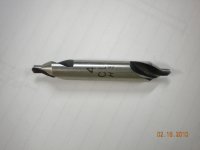
When you feel the need for a pilot hole consider a center drill, you get a pilot hole and a countersunk area above it that prevents the second regular bit from "walking" . They're mainly used for lathe work but can be used for other purposes.
 

Attachments

  • DSCN0639.jpg
    DSCN0639.jpg
    169.5 KB · Views: 20

wreckercologist

Well-known member
Joined
May 17, 2009
Messages
1,813
Location
cyber-tool hell
The size of the web (the center part of the drill) is what you should look at when judging how big of a pilot hole to drill. The bigger the pilot is in relation to the finished size, the more likely the finish drill will chatter. If you have the horsepower to push the drill, use as small of a pilot hole as possible.

Like others have stated, speeds & feeds are very important too.

I don't use much coolant or cutting oil at work unless I'm drilling a hardened double frame on a truck, and in that case, HSS won't last so we end up using carbide tipped roto-broaches.

Drilling holes is an learned skill, and takes time to develope. :beer:
 

OccupantRJ

Well-known member
Joined
May 15, 2009
Messages
11,081
Location
Eastern North Carolina
If you will take a larger drill size and look straight on at the center of it with it pointing at you, you will see that the web is rather wide. Then imagine this web as a rotating spot of that diameter. Other than a scraping action, you are essentially trying to push a steel rod of that diameter through a piece of steel when you are drilling. That is why a pilot drill makes it easier to drill. As a machinist I rarely ever drill a hole through most materials without a pilot drill, due to the required hole location accuracy. This becomes more important as the number of holes in a bolt pattern increases. A simple way around this for most people is to drill your first hole, bolt on your part, then spot drill the remaining required holes with a drill the size of the bore you are trying to go through. Then remove part, pilot drill, then drill the holes to the needed size. This will save you much heart ache, over-drilling, and rat-tail file usage. Best pilot drill for field work I have used is a 5/32" polished flute stub length. They cut relatively fast, and the short length will let you push harder with less chance of bowing or breaking the drill while in action.

Center drills are also known as combined drill and countersinks, and are available in various degrees of countersink angle. Most countersunk head bolts have an 82* angle.

RJ
 

35mastr

Well-known member
Joined
Dec 6, 2007
Messages
2,534
Location
Norcal
I normally just chuck up the bit that I need in the Old Powermatic. Lube and hit the power feed. This is after a good center punch.

But can drill any size hole on the fly.
 

Mustanger

Well-known member
Joined
Feb 14, 2010
Messages
105
Location
VA
Drilled a lot of holes in car sheet metal. When I used a pilot, always seemed to work better and look neater in the end. Never used cutting oil, but buy 1/8" bits a couple of times a year.
 

bmxr4life87

Well-known member
Joined
Mar 21, 2009
Messages
872
Location
Bixby Oklahoma
i typically use 1/8 or #30 as i have an ample supply of dormer cobalt from my short lived aircraft time and it really saves wear and tear on my nice drill bit set plus if im drilling something really hard its nice to have that hole already there
 

Brad54

Well-known member
Joined
Jun 13, 2006
Messages
4,646
For everyone who has had problems with bits walking or skating, that's what ***** punches and center punches are for.
These two punches have different tips--one is very sharp, the other more blunt (but still pointed). The sharp punch sets the center of your hole, while the more blunt one opens up the divot from the first punch.
Set the tip of your bit in there, and it won't skate.

I'm in the habit of double-punching ever hole I drill.

-Brad
 

wineslob

Well-known member
Joined
Oct 22, 2009
Messages
233
Location
The Northstate
A pilot hole should be the size of the width of the tip (web) of the drill that will be used for the finished hole.
Use the correct speed for the drill and cutting fluid/soluble oil. Which is, cutting speed (for steel) 100 X 4 divided by the dia of the cutter. So a 1/2 " bit in mild steel would be 800 rpm with a 3/32" pilot.
 

Kevin54

MEMBER EMERITUS
Joined
Jan 12, 2005
Messages
29,341
Location
Urbana, Ohio
When you feel the need for a pilot hole consider a center drill, you get a pilot hole and a countersunk area above it that prevents the second regular bit from "walking" . They're mainly used for lathe work but can be used for other purposes.

A center drill IS NOT mainly for lathe work. It is to "center" up a starting hole for a drill if you want an exact location. Also a center drill does not create a pilot hole unless the pilot of the center drill is long enough to go through the metal that you are drilling.
The purpose of a pilot hole is to give clearance on the larger drill that you are going to be using. If you look at a large drill bit, at the very tip. you do not have very much cutting edge or land. The larger the bit the less that you have. By drilling a pilot hole you bypass that area.
Most people want to grab the right size drill and horse it through whatever they are drilling. That is fine for a smaller hole. But for a large hole one really would save time by drilling it two or even three times. For instance, if you have to put a 1" diameter hole into a piece of 1" thick steel, start out with a 1/4" hole for your pilot hole. then step it up. You would be surprised as to how much faster the larger drill goes through.
And the proper way to do it would be to spot the hole with a center punch first, then center drill it to the proper size for your lead drill, then lead drill (pilot drill) the hole, then open it up with the larger drill.
 

nate379

Banned
Joined
Feb 2, 2009
Messages
7,279
Location
Palmer, AK
My brother wrote a paper in college on proper hole making (he went to school for metal work/weldng/machining). I'll see if I can find it again and post it up.

I don't normally use a pilot unless the hole is 1/2" or larger or I'm drilling in fairly thick materials.

As a guide though, you don't want your pilot hole to be any larger than the tip of the bit you are going to use.
 

OccupantRJ

Well-known member
Joined
May 15, 2009
Messages
11,081
Location
Eastern North Carolina
Ever noticed that it seems to be impatient types who can't be bothered with a pilot hole, then get pissed 'cause their sh*t won't bolt up? I get some of my best entertainment from watching impatient people try to work, especially when they are trying to use a dull drill.
 
To avoid these ads, REGISTER NOW!
Top Bottom