ticklechicken
Well-known member
I finished my install three weeks ago and wanted to give a report. First, the shop details:
The install was easy. I found the manual to be surprisingly good. I was nervous about cutting the lines and making my own flares, but that was easy. I used a cheap $25 tool from Lowes. Bending the copper lines was a nervous process, but the copper seemed to be much more durable than all the warnings would leave you to believe.
I installed the inside units so that the bottoms were 8'2" above the floor. This gives me the ability to place typical lumber against the wall if I need to. This placed the top of the unit pretty close to the ceiling, but it was within the specs in the manual.
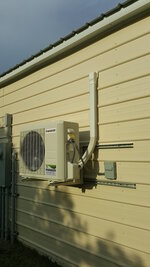
For the outside units, I used the Pioneer wall brackets. Many posts on GJ complain that they're too flimsy, but they survived 80 mph winds during Irma last week so I'd say they're strong enough. I used unistrut to attach the brackets to the building. My posts are 5' on center, so I had to use two 6' pieces for each outside unit.
There was no specific instructions for routing the inner/outer signal wiring when you get near the outside unit. The pictures I've seen show the wiring exiting the flexible line cover and running to the electrical connection at the top of the outside unit. I didn't do it this way. I kept the cable in the flexible cover all the way to the refrigerant line connection at the unit bottom. Then I cut a hole and ran the cable in flexible conduit up to the top connection point. It wasn't that much extra work, and I like the way it looks.
I installed two of the 18k ++ (SEER 21) units. I considered doing a dual head unit, but I thought the install wouldn't look as nice. I didn't want refrigerant lines running all over. It's also nice to have a little redundancy if one of the units fails. I picked these up at the high seer distribution center near Miami. They were helpful and walked me through the install process. They also gave me the name of an a/c guy near me who works with these units. That was helpful, as the guy came out one evening and evacuated/charged both units for only $100.
I had a lot of trouble trying to decide how much cooling I needed for my building in my climate in Florida. There wasn't much useful information on the web. It takes about 50 minutes to lower the shop temp by 10°. I lowered the set point to the minimum, and the shop was down to 70° pretty quickly. I stopped the test then, but it could have got colder. It was in the mid 90's outside during this test. Next, I left the a/c's off for a few days, and then turned only one of them on with a setpoint of 75°. It was in the low 90's outside, and the single unit got it to 75° inside. Bottom line is that you don't need this much cooling in a well insulated shop. It is nice to have the quick cool capability though.


- Carolina Carports metal building
- 24 x 45 x 10
- 1,080 sf
- Closed cell foam (2" on walls, 3" on ceiling)
- 3/4" plywood walls on furring strips
- Insulated roll-up garage door
- No windows
The install was easy. I found the manual to be surprisingly good. I was nervous about cutting the lines and making my own flares, but that was easy. I used a cheap $25 tool from Lowes. Bending the copper lines was a nervous process, but the copper seemed to be much more durable than all the warnings would leave you to believe.
I installed the inside units so that the bottoms were 8'2" above the floor. This gives me the ability to place typical lumber against the wall if I need to. This placed the top of the unit pretty close to the ceiling, but it was within the specs in the manual.
For the outside units, I used the Pioneer wall brackets. Many posts on GJ complain that they're too flimsy, but they survived 80 mph winds during Irma last week so I'd say they're strong enough. I used unistrut to attach the brackets to the building. My posts are 5' on center, so I had to use two 6' pieces for each outside unit.
There was no specific instructions for routing the inner/outer signal wiring when you get near the outside unit. The pictures I've seen show the wiring exiting the flexible line cover and running to the electrical connection at the top of the outside unit. I didn't do it this way. I kept the cable in the flexible cover all the way to the refrigerant line connection at the unit bottom. Then I cut a hole and ran the cable in flexible conduit up to the top connection point. It wasn't that much extra work, and I like the way it looks.
I installed two of the 18k ++ (SEER 21) units. I considered doing a dual head unit, but I thought the install wouldn't look as nice. I didn't want refrigerant lines running all over. It's also nice to have a little redundancy if one of the units fails. I picked these up at the high seer distribution center near Miami. They were helpful and walked me through the install process. They also gave me the name of an a/c guy near me who works with these units. That was helpful, as the guy came out one evening and evacuated/charged both units for only $100.
I had a lot of trouble trying to decide how much cooling I needed for my building in my climate in Florida. There wasn't much useful information on the web. It takes about 50 minutes to lower the shop temp by 10°. I lowered the set point to the minimum, and the shop was down to 70° pretty quickly. I stopped the test then, but it could have got colder. It was in the mid 90's outside during this test. Next, I left the a/c's off for a few days, and then turned only one of them on with a setpoint of 75°. It was in the low 90's outside, and the single unit got it to 75° inside. Bottom line is that you don't need this much cooling in a well insulated shop. It is nice to have the quick cool capability though.