All pipe is tube but not all tube is pipe. It all boils down to how is the material measured and categorized. Tubing is typically measured by the OD and the wall thickness, and usually will be within a few thou if what it is called. So a 1" tube with a 16ga wall will be dang close to 1" OD with a 16ga wall.
Pipe on the other hand is a system where multiple components are designed to interface with each other. It helps to think of the pipe sizes as gages instead of any sort of dimension, as 1" pipe doesn't measure 1" anywhere on it. The ID will be close, but it is still oversize. So think of it is #1 gage pipe instead of 1". Pipe is standardized under the NPS system, called the Nominal Pipe Size. Which is basically a fancy way of saying "eh, it's close to 1" so we'll call it 1". Back in the early days of iron pipe the ID was very very close to being on inch sizes, and over time has drifted to what we have now. Kinda like how a 2x4 isn't 2 anythings by 4 anythings nowadays, even though it used to be.
Pipe wall thickness is measured by a ratio of diameter to wall thickness called a schedule. The bigger the schedule, the thicker the wall for a given pipe size. Schedule 40 is standard wall, sch. 80 is heavy, sch. 10 is light. They go way up and way down in schedule, but at no point does the OD change. This is so threading tools, fittings and so on can be used on multiple different schedules. Pipe is often used to carry a product of some sort, but it is not what it is exclusively used for. Tubing is also used to convey liquids and gases, and pipe can be used in structural or other applications.
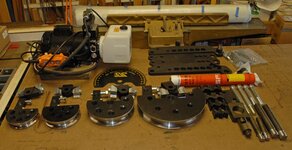
Bending tubing/pipe is a complex and tool intensive process to do well. It doesn't really matter what you're trying to bed, what matters is that you have the correct tooling to make the bends. Different benders and tools are optimized for different material sizes, thicknesses and bend radiuses. Good tube working equipment is expensive because it is hard to make good bends without good, dedicated tooling.
When you're making a bend, you're simultaneously stretching the outside of the radius and compressing the inside. All the while, the sidewalls are attempting to collapse. If the wall is too thin, you'll collapse the tube. If the dies don't support the side walls you'll collapse the tube. If you try to bend a tighter radius than the tooling is designed for you'll collapse the tube. It all has to be used in harmony together to get the desired result.
All this to say there really isn't a way to get nice consistent bends on a large variety of tube geometry with one tool. Each radius uses either a unique die or special adjustable dies on expensive equipment. The cheap hydraulic benders do an OK job of putting an offset kink in sch. 40 pipe, but they're pretty **** at doing much else.
What you have is either 1-5/8" x 16ga tube or 1-1/4 x sch 5 pipe. Neither of which is going to bend nicely without the right tool. I was trying to bend 1-1/2" x 16ga ss tube the other day in my JDSquared bender with the correct dies and it still wanted to kink after about 45 degrees on a 5.5" CLR, and this was because 16ga wall was too light to be bent at that radius with that tool. I can't see you getting good bends out of the pipe you have without spending some coin on nice tools or really going through a lot of effort.
This is all for BENDING mind you, ROLLING is a whole nother can of worms. That's effectively bending an infinite number of tiny bends on a variable radius die to make a gradual hoop or arc. You can sometimes get a shape easier on thin wall by rolling gradually and sneaking up on it vs a hard bend. Depends on your part and desired geometry.