To avoid these ads, REGISTER NOW!

Planning Oversized Detach Build

kingDIY

Member
Joined
Dec 13, 2019
Messages
18
Location
Missouri
Hi All, Brand new member long time lurker.

In the planning stages of a build and I as curious as the best way to handle a ' below grade ' situation. Looking at about a 6'8' difference.

Tall foundation walls and backfill?

Raise area with fill ?

Size would be 24.5 w x 32 L max peak height 16'.

Experience/input/advice appreciated, it is after all, how to learn. :bounce:
 
To avoid these ads, REGISTER NOW!

MushCreek

Well-known member
Joined
Jan 14, 2015
Messages
9,783
Location
Upstate South Carolina
If you're going to put part of it under ground, treat it like a basement. On my basement, we put a perimeter drain all the way around, then a pipe to carry any run-off down the hill. I used peel and stick waterproofing. I put dimple board over the membrane to protect it and create a drainage plane so water doesn't sit against the wall. I backfilled with gravel, capped with geotextile and topsoil. The gravel promotes good drainage. I carefully sloped the topsoil away from the foundation wall. Lastly, My roof has big overhangs (30") and gutters, so there's never any water splashing up against the foundation walls. Yes, it's a lot of work/expense. Yes, my basement is completely dry.

BTW- My basement (and the rest of the house) is ICF, which makes a very tight, well-insulated structure. Probably too expensive for an outbuilding, though.

Why is your building 24.5' wide? What are you going to build it out of? Sheet goods like plywood are 4', so you'd be 6" short. If I'm using sheet goods, I usually plan a couple inches less, just in case there's a slight screw-up somewhere along the way. Plan around your materials. My house is an 'odd' 33'4" x 43'4" because that's how the ICF worked out.
 

ConCretin

Well-known member
Joined
Jan 20, 2011
Messages
3,378
Location
Central Maine
It’s probably more expensive to build into a hill than on flat ground but if that’s what you’ve got to work with, it’s not all that difficult. My shop and garage are built this way which gave rise to name of my build thread, The Concrete Underground. One benefit of the design is that it makes the space a little easier to heat and cool because more of the envelope is protected by the earth and it’s constant temp.

Mush creek has covered an important element of the design, which is water management both subsurface and surface. This relates directly to the second area of concern; ensuring your foundation can withstand the lateral forces from the soils behind it. This isn’t too hard to do but is even easier if those soils are dry. If you or your builder lack experience in this area, some professional design help would be a good investment.

Good luck with your build and please keep us updated.
 
Last edited:

matt_i

Well-known member
Joined
Mar 14, 2008
Messages
10,728
Location
SE Michigan
The old way of placing the drain tile involved putting it down and then covering with rock. I think they fill solid with clay fines in 10-20 years that way.

Enter geotextile and silt-socks. I would investigate & use those to their full potential.

As above, treat it like a basement in terms of waterproofing. And figure out how to grade the soil away from the building. Dont let the downhill end in the plane of your wall. Cut it back more and create a swale that diverts stormwater around.
 
OP
K

kingDIY

Member
Joined
Dec 13, 2019
Messages
18
Location
Missouri
If you're going to put part of it under ground, treat it like a basement. On my basement, we put a perimeter drain all the way around, then a pipe to carry any run-off down the hill. I used peel and stick waterproofing. I put dimple board over the membrane to protect it and create a drainage plane so water doesn't sit against the wall. I backfilled with gravel, capped with geotextile and topsoil. The gravel promotes good drainage. I carefully sloped the topsoil away from the foundation wall. Lastly, My roof has big overhangs (30") and gutters, so there's never any water splashing up against the foundation walls. Yes, it's a lot of work/expense. Yes, my basement is completely dry.

BTW- My basement (and the rest of the house) is ICF, which makes a very tight, well-insulated structure. Probably too expensive for an outbuilding, though.

Why is your building 24.5' wide? What are you going to build it out of? Sheet goods like plywood are 4', so you'd be 6" short. If I'm using sheet goods, I usually plan a couple inches less, just in case there's a slight screw-up somewhere along the way. Plan around your materials. My house is an 'odd' 33'4" x 43'4" because that's how the ICF worked out.

Good info regarding treating it like a basement. The house is walkout and never has a drop of water in it. It was built in '88 and I would have been just a little tyke then and not there to see how it was done, LOL.

The reason for the 6" is I am trying to squeeze every last ounce of sq. foot allowance out of the building code. The house is 3,154 sq. ft. which is calculated by measuring the outside perimeter of the house, including the garage. I am allowed to add the basement but no 2nd above ground level, which does not apply to me since I only have ground level and basement. This is how the city calculates gross floor area. Code states I am allowed a max of 25% of gross floor area of the principal residence. 3,154x.25=788.5 sq ft. If I did 24x32 I yield 768 sq ft and I loose 16 sq ft. I have had quite the long dialogue with the building inspector just to get to this point and I really do not want to loose that 16 sq. ft. LOL I know there is going to be some waste there but at this point, I don't really care. I am resourceful and I am certain I will find some way to utilize those materials elsewhere.

I am going to source a lot of the materials on my own and the sheer amount of labor I am saving doing this myself far outstrips the material waste. You are correct in planning around your materials and normally that is how I would proceed.
 
OP
K

kingDIY

Member
Joined
Dec 13, 2019
Messages
18
Location
Missouri
It’s probably more expensive to build into a hill than on flat ground but if that’s what you’ve got to work with, it’s not all that difficult. My shop and garage are built this way which gave rise to name of my build thread, The Concrete Underground. One benefit of the design is that it makes the space a little easier to heat and cool because more of the envelope is protected by the earth and it’s constant temp.

Mush creek has covered an important element of the design, which is water management both subsurface and surface. This relates directly to the second area of concern; ensuring your foundation can withstand the lateral forces from the soils behind it. This isn’t too hard to do but is even easier if those soils are dry. If you or your builder lack experience in this area, some professional design help would be a good investment.

Good luck with your build and please keep us updated.

I only made it 20 pages into your build and was hooked. I will have to finish it up on a day where I have the time to follow it from start to finish. Fascinating. I will post some pics up of what I am working with.
 
OP
K

kingDIY

Member
Joined
Dec 13, 2019
Messages
18
Location
Missouri
The old way of placing the drain tile involved putting it down and then covering with rock. I think they fill solid with clay fines in 10-20 years that way.

Enter geotextile and silt-socks. I would investigate & use those to their full potential.

As above, treat it like a basement in terms of waterproofing. And figure out how to grade the soil away from the building. Dont let the downhill end in the plane of your wall. Cut it back more and create a swale that diverts stormwater around.

OK, makes sense to me
 
OP
K

kingDIY

Member
Joined
Dec 13, 2019
Messages
18
Location
Missouri
Pics

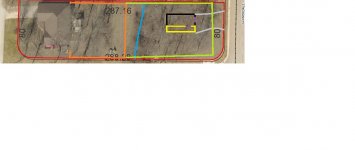
Arial view of property. L of pic is West R is East
 

Attachments

  • Space View.jpg
    Space View.jpg
    77.1 KB · Views: 47
Last edited:
OP
K

kingDIY

Member
Joined
Dec 13, 2019
Messages
18
Location
Missouri
Facing West from boundary street on the East end looking down into the area to work with. Ideally, I want to tuck things into the corner nearest where I stand. I have a 20' setback from the property line on the South side ( left in this pic ) and a 5' on the right side ( right side of pic). You can basically make out the property lines by following the fence. The gravel road will be a paved street within about a year or less and on the other side of it is a huge storm basin. The basin covers about 8-10 acres and there will obviously never be homes built there. It is where all the water from about 200 acres funnels into and then on out. My portion of the wet weather creek goes into this.

https://www.dropbox.com/s/1bynqmbipp2vsgo/20191214_104603.jpg?dl=0
 
OP
K

kingDIY

Member
Joined
Dec 13, 2019
Messages
18
Location
Missouri
This is standing just outside the back of the fence facing East down into the drainage area. The water that comes out of the single drain runs down the street you see for about a mile or so and the surrounding neighborhood above it. We have seen biblical rains here over the summer and never once did water get outside the confines of the creek bed. The creek itself runs about 6-8" deep and between 6-8' wide. If we get 2-3" of rain in a few hours that creek will run for about 24-36 hours then it completely dries up. The area just above it, where I plan to build has never gotten soft nor have I seen water in it. As you continue North the grade intensifies so essentially I have the focus point of all the water. This makes me lean towards a foundation wall plus massive boulders built up to the wall itself.

https://www.dropbox.com/s/1mt5ajk2sr1q1xo/20191214_104306.jpg?dl=0


Up close of said drain from East neighborhood

https://www.dropbox.com/s/aa5etqx8lebcjbx/20191214_104638.jpg?dl=0
 
To avoid these ads, REGISTER NOW!
OP
K

kingDIY

Member
Joined
Dec 13, 2019
Messages
18
Location
Missouri
I need to add something here. If I were to sell that adjoining lot that consists of the " back " of my property you could build a home on it. As you progress North there are homes built in a similar grade to what I have if not more severe. When you look at this, it appears like its a storm basin but it isn't. The roadbed for Cloverdale raised the area considerably and it has far more than adequate run-off. The challenge I have here is doing this in such a manner as to not have sinkage or foundation issues down the road. It is a challenge which I am fully cognizant and aware of but, the wife and I really do not wish to move as the area in which we live is growing so fast that it would mean a 40 minute drive to town vs 15 or less. Plus, owning a half acre in my area with a garage is a gold mine because a lot of people do not have the opportunity to get there hands on a second lot much less build a garage on one. Currently we have an attached 2 car and while it works, it has its limits. I can barely fit a '17 Ram 1500 in it and forget the '07 Ram 2500. I am tired of that. a 20 x 20 isn't much smaller than a 24.5 x 32 but tell that to the guy having to work in the 20 x 20. :)


That was probably more information than necessary but it explains what I am trying to do here.
 

3onthetree

Well-known member
Joined
Nov 14, 2018
Messages
191
From your first post, my answer on whether to "dig-in" vs "raise grade" would depend on the elevation you need the drive access to be. Of course in-fill brings more difficulties, as does water and loads from a partial dug "basement."

Now looking at your additional posts and descriptions, it seems you want to build a "basement" garage on the additional lot, because you say you won't have an extra assessment for an above grade "framed" building that's only 25% the size of your house?

First, if two individual properties you would need to have the them joined together into one single plat. They surely will not allow just a garage to be built without a house on an individual lot in a planned subdivision. That would probably require a variance, and to be successful you would have to argue that an empty lot (albeit a "garage", but one without a house) will fit in with the character of the neighborhood. Just looking at the closeness of the houses and lot sizes and that both of your lots are on a corner, just an individual "basement garage" might be a hard sell.

Secondly, if you can build it, you need to avoid the creek with the building and a driveway. The soil within the creekbed is usually more unstable and organic. So, from the satellite photo, if you were to mirror a house to the back lot the same distance from the curb as yours is from your street, that is where the buildable portion of the lot is (not to mention setbacks). That would mean you need a separate curb cut, which circles back to the variance, which will seem like a single garage separated from the house (visually and physically by the creek), which might fail a variance.
 

3onthetree

Well-known member
Joined
Nov 14, 2018
Messages
191
Maybe you're talking about building it on your main lot next to the house, I'm really not sure, a lot of pics of the creek. How about a sketch with what you are proposing on the satellite image?
 
OP
K

kingDIY

Member
Joined
Dec 13, 2019
Messages
18
Location
Missouri
From your first post, my answer on whether to "dig-in" vs "raise grade" would depend on the elevation you need the drive access to be. Of course in-fill brings more difficulties, as does water and loads from a partial dug "basement."

I need to talk to a concrete guy I know does foundations and see what he says. In the researching I have done so far I have seen this done two ways.

1. You have fill brought in to " raise the site to grade then build on that.
2. You build the foundation and have one heck of a stem wall if you will, fill in the area inside the stem will bringing that up to the level of grade you want your floor to be. Which what I am seeing is going to require fill on the outside of those walls anyway so I am really not gaining any cost savings.


Now looking at your additional posts and descriptions, it seems you want to build a "basement" garage on the additional lot, because you say you won't have an extra assessment for an above grade "framed" building that's only 25% the size of your house?

No, I can see where you would see that. I do not want a basement garage. The 25% is the square foot allowance I am allowed to have for an accessory building based off how the city calculates sq. ft. of the house. 3,154 sq ft ( house) x 25%= 788 sq ft. ( accessory building ). Its a ridiculous code if you ask me but it works like this. I have a walkout basement. I am allowed to count the square footage of the basement, plus the main level and the garage in my total " gross " sq. ft. number which is the baseline for the accessory building. The part about the 2nd story talk was nothing more than over explanation of how the code works.

First, if two individual properties you would need to have the them joined together into one single plat. They surely will not allow just a garage to be built without a house on an individual lot in a planned subdivision. That would probably require a variance, and to be successful you would have to argue that an empty lot (albeit a "garage", but one without a house) will fit in with the character of the neighborhood. Just looking at the closeness of the houses and lot sizes and that both of your lots are on a corner, just an individual "basement garage" might be a hard sell.

I already own both lots. The site map I shared is the county assessment imaging. It shows both lots because that is how they were platted out. Previous owners of the house obtained the other lot dirt cheap and I was lucky enough to get it along with the house. Sorry, I should have explained that.

Secondly, if you can build it, you need to avoid the creek with the building and a driveway. The soil within the creekbed is usually more unstable and organic. So, from the satellite photo, if you were to mirror a house to the back lot the same distance from the curb as yours is from your street, that is where the buildable portion of the lot is (not to mention setbacks). That would mean you need a separate curb cut, which circles back to the variance, which will seem like a single garage separated from the house (visually and physically by the creek), which might fail a variance.

Yes, I agree 100%.
Setbacks are as follows, all from property line which is app. 14' from the curb.
From the bottom of the pic ( South ) 20'
From the right side of the pic ( East ) 10'
From the top of the pic ( North ) 5'

Here is the layout I am thinking will work with the setbacks I have to work with. Building would be 24' from the creek, app 20' off street, about 12' off north adjacent property line.

The blue line is the creek bed
The orange line is existing privacy fence, subsequently the green line is proposed privacy fence.
Black box is building, purple lines are a 20' wide door to the east and 10' wide to south.
Yellow is 32x16 concrete pad ( if it is permissible by code)
Grey line is driveway.
 

Attachments

  • Space View-Layout.jpg
    Space View-Layout.jpg
    104.9 KB · Views: 29
Last edited:

dcg9381

Well-known member
Joined
Jun 20, 2018
Messages
11,778
Location
Austin, TX
Hi All, Brand new member long time lurker.

In the planning stages of a build and I as curious as the best way to handle a ' below grade ' situation. Looking at about a 6'8' difference.

I think the answer to this is highly location dependent. I've got a garage that is 10' above grade from the main house and we're in a part of the country where we don't do basements. The garage basically sits on 9 pillars of concrete (24") bored 10' down. Rear of the garage is a sheet of concrete 24" thick.

We did it this way because the soil under the garage had some large stuff it in that could move around and was deemed too unstable to simply lay a foundation over.

We could have chosen to remove all the "unusable" fill and bring more in, but that's a lot of dirt.

It's pretty common here to fill - I've seen it done with bags of sand or compactable fill, but you have to cut down to something stable.


Note, my shop had a 3' drop off over 40' width. We chose to raise grade - it's VERY difficult to dig here and it was cheaper to bring in fill. I'm happy with this choice, largely due to drainage. When it's really wet, the shop is elevated and no chance of water coming in.
 

lowside67

Well-known member
Joined
Sep 29, 2017
Messages
135
Location
Vancouver, BC
It sounds like you have trucks so maybe not an issue, but I would think about the implications for driveways if you choose to raise rather than dig into the side of the hill. For my purposes, a 3-4' elevation would make it very hard to get low clearance racecars in and out with out a mile long driveway to spread the slope over.

-Mark
 

dcg9381

Well-known member
Joined
Jun 20, 2018
Messages
11,778
Location
Austin, TX
OP, have a topo map of that lot? Maybe an old survey... something like that? 6'8" slope is north to south across 25'?
 

3onthetree

Well-known member
Joined
Nov 14, 2018
Messages
191
Just to circle back on the "dig-out" or "fill-in" convo, usually with a short driveway you want to set the top of garage slab a bit higher than the street, curb, or sidewalk based on a slope you are comfortable with (say 2%, or 8%, or varied slope for a portion to park level near garage) working backwards up to the garage. As others said, having low cars/snow/ice makes it difficult for steep slopes, and you should always avoid a driveway sloping down to the garage if you have that choice. So once that is determined, whether you "dig-out" or "fill-in" will become more clear. Not sure where the 6'-8" elevation difference is measured from, but you can always have part of the footprint dug-in and part needs some fill.

Also just to clarify, if you have one PIN when you pay real estate taxes, then your two plats have been combined into one.

There could be an HOA on the Cloverdale side from the looks of the curbs and houses. Some rules limit the number of curb cuts to 1 (exceptions on corner lots sometimes), and also the width of them. Probably some height limitations in comparison to your house. There will also be limitations on your privacy fence, as the Cloverdale side may be considered "front" and no fence allowed, and the "side" may not extend past the edge of building. So what that might mean is your garage may need two presentable facades in-line with the housing stock.

Just some info that may or may not apply when you go talk to the planning dept. Bring your sketch and find out what your exact limitations are beyond the SF allowances.

P.S. you'll want something over the creek (bridge, zipline, or rail) for your trip to the garage or a Gator to take the road around to it
 
OP
K

kingDIY

Member
Joined
Dec 13, 2019
Messages
18
Location
Missouri
Just to circle back on the "dig-out" or "fill-in" convo, usually with a short driveway you want to set the top of garage slab a bit higher than the street, curb, or sidewalk based on a slope you are comfortable with (say 2%, or 8%, or varied slope for a portion to park level near garage) working backwards up to the garage. As others said, having low cars/snow/ice makes it difficult for steep slopes, and you should always avoid a driveway sloping down to the garage if you have that choice. So once that is determined, whether you "dig-out" or "fill-in" will become more clear. Not sure where the 6'-8" elevation difference is measured from, but you can always have part of the footprint dug-in and part needs some fill.

Also just to clarify, if you have one PIN when you pay real estate taxes, then your two plats have been combined into one.

There could be an HOA on the Cloverdale side from the looks of the curbs and houses. Some rules limit the number of curb cuts to 1 (exceptions on corner lots sometimes), and also the width of them. Probably some height limitations in comparison to your house. There will also be limitations on your privacy fence, as the Cloverdale side may be considered "front" and no fence allowed, and the "side" may not extend past the edge of building. So what that might mean is your garage may need two presentable facades in-line with the housing stock.

Just some info that may or may not apply when you go talk to the planning dept. Bring your sketch and find out what your exact limitations are beyond the SF allowances.

P.S. you'll want something over the creek (bridge, zipline, or rail) for your trip to the garage or a Gator to take the road around to it
The drop from the curb on Cloverdale is about 6 to 8 foot. So it sounds like that's going to have to be raised. I wouldnt have a problem with a grade at all off the curb.

Yes, I have one PIN and pay taxes on both lots that are considered one.

Yes, Cloverdale subdivision has an HOA but it does not apply to me because the additional lot was purchased and annexed to mine before that subdivision was built. Its treated as the " back " of my property. I am working with the city to determine utilities. I am allowed to pull water and sewer off Cloverdale and most likely power as well.

I was going to build a treated wood bridge over the creek. Wife likes that idea :)

Sent from my SM-G930U using The Garage Journal mobile app
 

MushCreek

Well-known member
Joined
Jan 14, 2015
Messages
9,783
Location
Upstate South Carolina
I built a 15' bridge to these plans. The website keeps changing and moving, and there don't seem to be pictures any more. It makes a strong and attractive bridge. Better copy the drawings if it interests you, as this website keeps disappearing. He used to sell plans for bridges up to 50', some strong enough for a vehicle.

http://ingeb.org/bridge2.html
 
To avoid these ads, REGISTER NOW!
Top Bottom