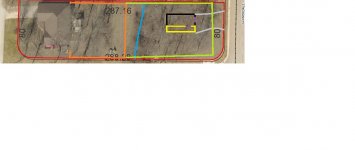
From your first post, my answer on whether to "dig-in" vs "raise grade" would depend on the elevation you need the drive access to be. Of course in-fill brings more difficulties, as does water and loads from a partial dug "basement."
I need to talk to a concrete guy I know does foundations and see what he says. In the researching I have done so far I have seen this done two ways.
1. You have fill brought in to " raise the site to grade then build on that.
2. You build the foundation and have one heck of a stem wall if you will, fill in the area inside the stem will bringing that up to the level of grade you want your floor to be. Which what I am seeing is going to require fill on the outside of those walls anyway so I am really not gaining any cost savings.
Now looking at your additional posts and descriptions, it seems you want to build a "basement" garage on the additional lot, because you say you won't have an extra assessment for an above grade "framed" building that's only 25% the size of your house?
No, I can see where you would see that. I do not want a basement garage. The 25% is the square foot allowance I am allowed to have for an accessory building based off how the city calculates sq. ft. of the house. 3,154 sq ft ( house) x 25%= 788 sq ft. ( accessory building ). Its a ridiculous code if you ask me but it works like this. I have a walkout basement. I am allowed to count the square footage of the basement, plus the main level and the garage in my total " gross " sq. ft. number which is the baseline for the accessory building. The part about the 2nd story talk was nothing more than over explanation of how the code works.
First, if two individual properties you would need to have the them joined together into one single plat. They surely will not allow just a garage to be built without a house on an individual lot in a planned subdivision. That would probably require a variance, and to be successful you would have to argue that an empty lot (albeit a "garage", but one without a house) will fit in with the character of the neighborhood. Just looking at the closeness of the houses and lot sizes and that both of your lots are on a corner, just an individual "basement garage" might be a hard sell.
I already own both lots. The site map I shared is the county assessment imaging. It shows both lots because that is how they were platted out. Previous owners of the house obtained the other lot dirt cheap and I was lucky enough to get it along with the house. Sorry, I should have explained that.
Secondly, if you can build it, you need to avoid the creek with the building and a driveway. The soil within the creekbed is usually more unstable and organic. So, from the satellite photo, if you were to mirror a house to the back lot the same distance from the curb as yours is from your street, that is where the buildable portion of the lot is (not to mention setbacks). That would mean you need a separate curb cut, which circles back to the variance, which will seem like a single garage separated from the house (visually and physically by the creek), which might fail a variance.