To avoid these ads, REGISTER NOW!

Please comment on my proposed Air Outlet setup

kylek350

Member
Joined
Sep 6, 2011
Messages
18
Location
Chicago, IL
I plan to use 3/4" Copper pipe to distribute air around my garage. What do you think about my proposed air outlet setup? I plan to have these located around the room, spaced to similarly to electric outlets.

3/4" Copper distribution to tee fittings, then 3/4" to 1/2" NPT female adaptor. From there, I will screw in 1/2" to 1/4" Hex Bushings, and finally 1/4" male Universal outlets. This will give me the flexibility to go between 1/4" and 1/2" at the outlets (if the need arises) without re-soldering in the future.

The hex bushing I found at my local Home Depot is galvanized steel. Is that advisable when connecting to Copper?

Thanks!

5cbe1912c7792e00ddcf8dff57d99a42.jpg


Sent from my iPhone using Tapatalk
 

Attachments

  • 5cbe1912c7792e00ddcf8dff57d99a42.jpg
    5cbe1912c7792e00ddcf8dff57d99a42.jpg
    558 KB · Views: 1
To avoid these ads, REGISTER NOW!
OP
K

kylek350

Member
Joined
Sep 6, 2011
Messages
18
Location
Chicago, IL
I take it brass would be a better material for the bushing than galvanized steel, correct?


Sent from my iPhone using Tapatalk
 

dr_clyde

Well-known member
Joined
Jan 7, 2009
Messages
6,440
Location
Holland, MI
Should work just fine.

If you're worried about galvanic corrosion, just slip a little anti-seize on the threads after you put on thread tape.
 

machine_punk

Well-known member
Joined
May 14, 2011
Messages
2,540
Location
Napa Valley, California
You haven't given us the size your shop, but you COULD go with 1/2" copper distribution pipe, unless your shop is HUGE. (Don't get me wrong, for a few dollars more, I'd go with 3/4" too).

I'd use some sort of soft hose between the pipe and the compressor too, to decouple it from the vibration. If you don't, then I'd definitely BRAZE the pipe, instead of solder. The solder may not hold up to the constant vibration of the pipe. I seem to remember that when I was researching a copper system, I wasn't pleased with the percent of safety factor with just soldering (it was rated for enough pressure for the system I planned, but it didn't have that "twice the system pressure" safety factor I prefer in compressed air systems and lifting systems.

I'd put at least a filter at each outlet. This is the little 'glass bowl' thingy. It has a sintered brass filter inside. It does a WONDERFUL job of removing water from the air--as long as you place them far enough away from the compressor. I've tried placing these right at the compressor, but the air is still too warm and able to hold a lot of water. Once you get a few feet from the compressor, the air cools down and these little filters do a great job of taking water out of the compressed air.

You could use a 90-degree fitting to install the filter horizontally.

In the places I work the most, I like to have at least 2 outlets, so I can have 2 tools set up at at the same time. OR, you could build a little manifold to plug in, whenever you want more than one tool ready at a time. (I have both options at my shop...both the compressor and remote outlet have a pipe-fitting manifold with two quick-disconnects each. I also bought a little aluminum manifold block online and have a one-input, 3-output manifold I can attach, when I want more tools working at the same time, or I am visiting someone else's shop).

My other thought is that I was headed in the same direction you are, but now I'm going a little different route with my setup. I think I'd rather have a small number of hose reels, mounted high, than have a lot of outlets, mounted low. A 35- to 50-foot hose reel in each corner can reach just about anywhere you want to go in your shop and doesn't take up critical wall space with outlets, unless you have a HUGE shop. Even in a huge shop, I'd rather have fewer hose reels, mounted higher, than more outlets, mounted lower. Wall space at waist height is at a premium. Higher mounted reels stay out of your way and keep hose off the floor as much as possible.

I wouldn't go straight down into the quick-disconnect coupling. Any moisture you have in the air will go straight into the tool. I'd use a "T" where you show the quick-disconnect, run a filter horizontally off the pipe and add "T's" and elbows to put a couple of quick-disconnects on each filter. Then, run a couple more feet of pipe straight down through the "T", with a tank drain valve at the bottom (either a 'pull ring' style, or the standard valve at the bottom of a compressor tank, a more-expensive ball valve, or an electric-auto-timer-valve, if you really want to go fancy). This will allow a lot of moisture to drop directly into the tubing extension and you can empty the extension daily, while the system is pressurized.

For the price, you may want to look at what RapidAir has. They have a pretty extensive 3/4" piping kit for $200. You'd likely need to add a few components, but I've definitely considered going that route too. You could really get away with their kit with smaller tubing, for about $75, unless you have a humongous shop.

You've got a great start to your planning. Looking forward to pics, whatever you decide to do.

Kev
 
Last edited:
To avoid these ads, REGISTER NOW!
OP
K

kylek350

Member
Joined
Sep 6, 2011
Messages
18
Location
Chicago, IL
Thanks for all of the great info, everyone!

So here's the lay of the land: I have two adjacent garages, one being a 3-car (30' W x 22' D, and the other being my shop (~15' W x 30' D with a 14' ceiling). The compressor (IR 60 Gallon) is in the 3-car garage.

I'm going to connect it by 3/4" rubber hose to a Copper cooler dryer that I plan to build. For the cooler/dryer, I'm thinking I'll do 3 or 4 up/down runs of 6' or so with drain valves at the bottom of each run.

From there, I plan to then have two trunks, one serving the 3-car garage, and the other serving the shop. I'd like to have separate regulators/filters/oilers/desiccants per trunk.

Which such a cooler/dryer setup as I plan to build, is it still advisable to have additional drains through out the trunks even if I'm running desiccant dryers?


Sent from my iPhone using Tapatalk
 

sberry

Banned
Joined
Jun 18, 2005
Messages
35,747
Location
Brethren, Michigan
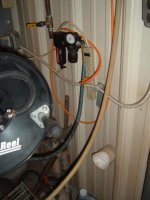
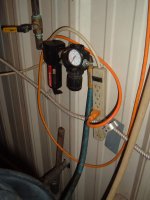
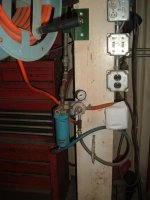
I don't care for hydrants and moving hoses. I like a real or fixxed whip. It just adds another coupler in the line that really isn't needed.
 

Attachments

  • air reggy.jpg
    air reggy.jpg
    130.5 KB · Views: 74
  • air reggie.jpg
    air reggie.jpg
    133.2 KB · Views: 64
  • air 2.jpg
    air 2.jpg
    136.7 KB · Views: 62

mbshop

Well-known member
Joined
Nov 23, 2010
Messages
1,539
Location
visalia ca
Yup, a water filter about 2 or three feet away from the comp and then down the line before the outlets a u setup with a drain plug at the bottom should take care of most moisture issues in the line. If painting then that is a whole nother issue.
 

sberry

Banned
Joined
Jun 18, 2005
Messages
35,747
Location
Brethren, Michigan
I have a reel with a small filter/reg ahead of it just for paint. There is a valve ahead of this whole leg to shut it off unless its needed.
 

Attachments

  • paint air 2.jpg
    paint air 2.jpg
    142.3 KB · Views: 40
  • paint air dis.jpg
    paint air dis.jpg
    145.5 KB · Views: 37

DC73

Well-known member
Joined
Dec 27, 2014
Messages
1,627
Location
Lubbock TX
I plan to use 3/4" Copper pipe to distribute air around my garage. What do you think about my proposed air outlet setup? I plan to have these located around the room, spaced to similarly to electric outlets.

I did something similar when plumbing my workshop for air. I would recommend a brass bushing instead of the steel one. I ended up opting for fewer drops in the shop by going with a 100' hose reel at one drop and 25' hoses at the other drops.

I also plumbed each drop with a shut off valve and a drip leg with another valve. Even though my system doesn't generate much moisture at all, I like being able to close the shut off valve and then use the drip leg valve to depressurize the drop which keeps pressure off the hoses when not in use and makes it much easier to connect tools to the hoses.

DC
 

Viz

Well-known member
Joined
Oct 20, 2008
Messages
83
I also use a shut off valve at each coupling outlet. You never know if you'll need one there until you don't have one.
 
To avoid these ads, REGISTER NOW!
Top Bottom