four.cycle
Well-known member
Not a clue.
Rather odd that a magazine blurb would tout the name but not mention the maker.
Rather odd that a magazine blurb would tout the name but not mention the maker.


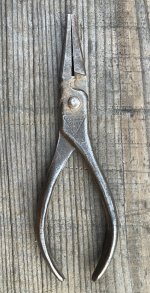
I don't know, but I suspect it's a relatively minor and more obscure mfgr with whom we just don't have the same level of familiarity as others that we can readily identify by initials, such as K&B, S&H, B&C, and P&C, or even other forms, without the ampersand, such as SK, KD, B-M, G-P, or NB, or even OTC, BHM, MTF, and, closer to the topic, PS&W.still wonder: who was “D&H,”
My Google book searches have yielded nothing, includingstill wonder: who was “D&H
You said this in reply to LS's original quote, but I'm assuming you're referring to me and the 1915 The Advanced Age piece I posted. You probably didn't use the same exact syntax as me. My query was "D.&H. Hand-Forged Pliers" with no spaces between any of the characters in the term "D.&H."My Google book searches have yielded nothing,including your article, which surprised me,
My first thought was actually something like that, due to the improbability of two brands ("D. & H." and PEXTO) on the same pliers, but I am convinced the initials are the trade name of the manufacturer. That magazine consistently takes the same approach in all the pieces, including the one right next to it o the same page, and we all know that mfgr.the questionable answers, telling me it stood for Durable & Hardened, by a known maker.
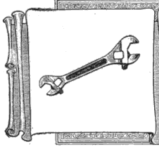


Oops, fixed the first part.You said this in reply to LS's original quote, but I'm assuming you're referring to me and the 1915 The Advanced Age piece I posted. You probably didn't use the same exact syntax as me. My query was "D.&H. Hand-Forged Pliers" with no spaces between any of the characters in the term "D.&H."
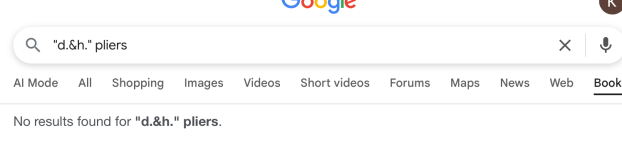
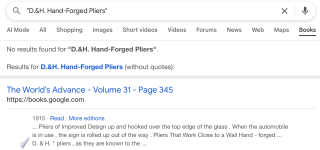
I won't comment on Google, because I don't use it, but syntax - including spaces, absolutely matters to the Google Books search engine and always has.Google searches aren’t supposed to care about punctuation,
There's no "seems" about it. As the name implies, it only includes books and periodicals. A total of 45M+ volumes and growing!There seems to be a difference between the specific body of data that Lugz is searching (Google Books) and the Internet at large.
Not sure what prompts the analogy or the dire prediction, LS, but Google Books (and its antecedents, Google Print and Google Print Library Project) has been run like a separate entity from its oft-vilified parent business entity for 21 years, and in all that time it has shown no propensity for monetization, and has instead forged alliances with other non-profit efforts such as HathiTrust, Internet Archive, the Smithsonian, the New York Public Library, and many private and state university digital library programs, including the largest in the country (California), all of whom depend on it for large percentages of their volumes. These relationship and its well-established commitment to openness and the free democratization of knowledge has helped stave off several misguided and ill-fated lawsuits by various more parochial associations.After GB has walmarted volunteer and nonprofit repositories out of existance, isn’t the next predictable step to sell advertising space and stepped subscription fees?
You and me both.I must be a terrible salesman. (I've been using it, citing references from it, and recommending it for years.)
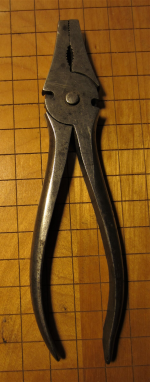


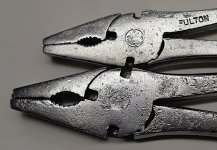
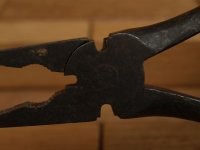
This is close and may be related. The outside of the jaws are shaped different and like you said, the pivot pin too. Found a V&B catalog 21 and at the bottom right they have one that looks closer to the Fulton Tool Co one called "Double Duty".Possibly Vaughan & Bushnell?
The shape is similar to this old pair of Keen Kutter pliers I own, although the pivot pin is different and the tip of one of the handles flares out on these.
"The patent is for a groove in the inside face of one half of the tool, and a ball stop on the inside face of the other half, positioned so that the stop aligns the wire cutter notches fully open and ready for use. The pliers jaws are incidental and not part of the patent claims. Vaughan & Bushnell added "Button's pattern pliers" to their product line starting in 1901."
(Taken from here https://www.datamp.org/patents/advance.php?pn=667411&id=15662&set=13 )
Apparently, it was William L. Peterson 's only patent, but Sanford S. Vaughan has thirteen to his name. Mostly hammer and axe related.


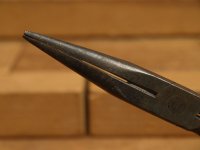
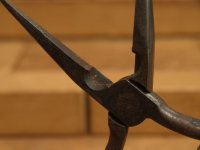


Those are two beautiful examples of contract production - nice chrome, too!Here are two pairs of pliers found at an estate sale today.
Xcelite.
Xcelite handle pattern (Crescent)
Stanley Handyman.
Stanley Handyman handle pattern (Plombpire).
-Don
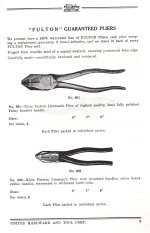
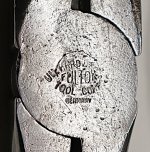
I have a earlier C.E. Jennings catalog of March 1907 and it shows them at 21 Murry St. so apparently they moved between 1907 and 1914.United / United Hardware & Tool Corp., 74 Reade St., New York, NY / "Fulton" / importers and distributors /
Jennings / C. E. Jennings, 71-73 Murray St. (79 Reade St.), New York, NY / "Arrow Head" screwdrivers, saws, chisels, edge tools, tool boxes / patent 278935 Jun 5 1883 George W. Griffin & 813152 Jan 20 1906 Archer B. Jennings / https://swingleydev.com/ot/get/198293/single/ /
Miller / Chas. E. Miller, 97-99-101-103 Reade St. & 121 Chambers St., New York, NY / manufacturers and importers of automotive parts, tools, and accessories /
all coincidence that all three operations were almost within spitting distance?
(there are a couple others in the list on Reade Street, but they looked to be more than two blocks away.)
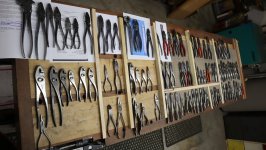

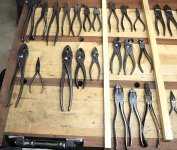
Very nice catalog. Thanks for sharing.Here is a German catalog with a boatload of pliers shown. Even more than @Eric Brown has out on the table in the picture above.
Geharo Werkzeuge : Liste Nr. 16 : Gebrüder Hallenscheid : Free Download, Borrow, and Streaming : Internet Archive
84 p., illus., 24.3 cm, trade catalogarchive.org
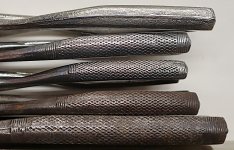
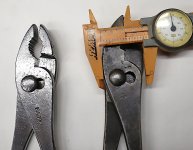
To continue the above group, I have another Fulton plier that doesn't quite match up to the Danielson's. Where the handle goes from the grip to the lever has a different length. The grip has a different pattern and the measurement across the pivot area is different with the Danielson being smaller. Comparing to a Barcalo though it looks a lot closer to a match. Grip pattern is similar, but not an exact match. The length between the grip and the lever are the same and the pivot area with is also the same. In the pictures below I put some red lines showing the grip to lever angles and I measured the Danielson and then put it over the unknown Fulton so you can see the gap.Here is a group of Fulton pliers that all seem to have been made by J.P. Danielson based on the following: The top two pliers are marked with 312.1 which was a Sears supplier number for Danielson. The top pair also has cast into the handle side A20 which is a date code Danielson used. Second pair has no numbers on the handles but does have a grip pattern. The bottom three pairs simply have Fulton inside a rectangle but have the same grip pattern as the second and third pairs. Bottom two pairs also have date codes of N3 K7 and 10 A 3 on the handles.