d42jeep
Well-known member
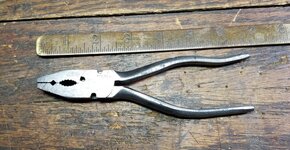
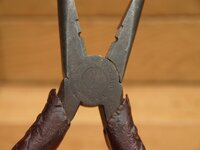
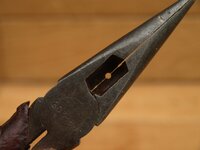
Here are my Diamond DC pliers along with a conventionally marked pair. 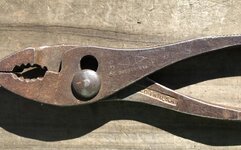


-Don
-Don


Thanks, Tom, but I'm punting on that. I'm having enough trouble figuring out their model number/marketing scheme in the same production year, where all other markings except the branding (Motor Spec vs < DC >) is identical, let alone taking on those kinds of differences, which are probably production era related.Another difference can be seen on the handles, where it says FORGED IN U.S.A. , <U.S.A.> and MADE IN U.S.A. .
I think your intuition, which confirms mine, is good.I’ve always thought that the DC line was a response to Crescent’s less expensive Cee Tee line but I’ve never checked into it any further.


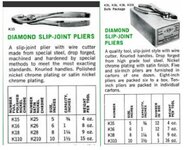
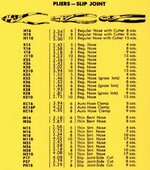




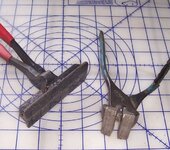


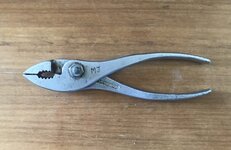
Thanks, Tom, but I'm punting on that. I'm having enough trouble figuring out their model number/marketing scheme in the same production year, where all other markings except the branding (Motor Spec vs < DC >) is identical, let alone taking on those kinds of differences, which are probably production era related.


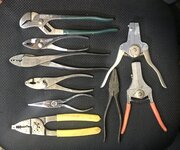
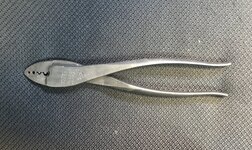
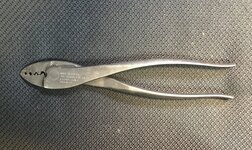
I have two, one owned since the late 70s, the other grabbed a year or two ago at a garage sale. Always able to find a pair when I need them now.I'd be proud to own that nice T&B crimper.
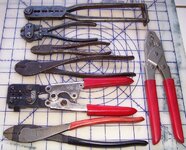
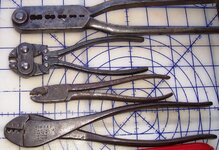


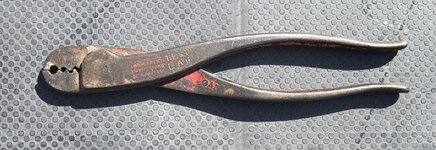


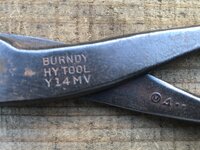


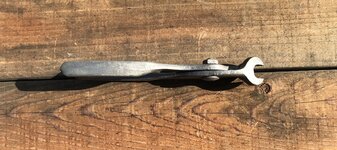
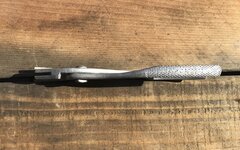

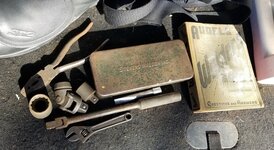
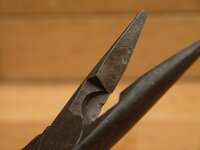
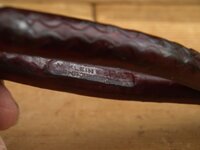
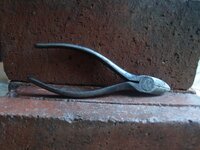
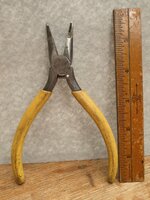
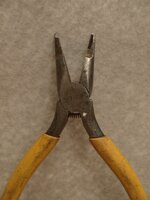
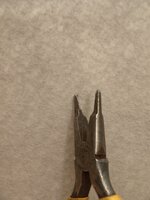
Carpenters pinchers, not wire cutters top left, yours is 6”Wondering if the C.T CO as on these wire cutters is the same as Cee Tee as shown above. Crescent Tools? Also labelled: MADE USA 282-6


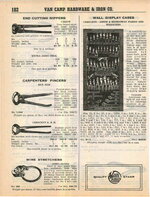
Wondering if the C.T CO as on these wire cutters is the same as Cee Tee as shown above. Crescent Tools? Also labelled: MADE USA 282-6
Carpenters pinchers, not wire cutters top left, yours is 6”
My problem with our identification is the shape, but since the number is there, I’m thinking our age is wrong. All of the pix show a single or pair of bent handles, while the OP’s appear to be straight, no nail puller on the leg. And flipping thru the catalogs, I only recall seeing the CT Co moniker later, like 1942, which could be poor memory, or mean nothing, but would S&H use CT Co? I could see Crescent.The 1942 Crescent catalog shows their end nippers as having a different part number as well as appearance. As near as I can tell, you found a pair of early "Smith & Hemenway" "Crescent" end nippers.

Cincinnati Tool Co (Hargrave) also did, but I think the number match might be pretty damning to CrescentI have been informed on this site that my gapper was made by the Caterpillar Tractor Co.
Yes. They used "C.T. Co." on some tools, even screwdrivers. Look in the 1961 catalog (35M) for your nippers. I believe there is a copy in the Internet Archive International Tool Catalog Library.Wondering if the C.T CO as on these wire cutters is the same as Cee Tee as shown above. Crescent Tools? Also labelled: MADE USA 282-6
Well hell, didn’t expect it to be newer, but I guess shrinkflation has been going on for a long time, removing features. Was guessing older, before the features were thought up.His tool is in Crescent catalog No. 35M (1961).