
You are using an out of date browser. It may not display this or other websites correctly.
You should upgrade or use an alternative browser.
You should upgrade or use an alternative browser.
Pliers; How Many Is Too Many?
- Thread starter MisterEd
- Start date

I’m with @four.cycle on this: kroy-ter. It’s the closest pronunciation to the German word for “herbs” that I can manage.Thanks. That's been my first guess, but I've never been sure of it. I've had two or three old Kraeuter tools for decades, and never knew the proper pronunciation.
Two different youtube videos with voice synthesizers give “kree-u-ter”, which I can understand if you thought it was an English word and that æ should be pronounced “ee” like in encyclopædia, but it isn’t an English word. (BTW, æ is “ash,” usually pronounced as the short “a” sound in “rat.”)
In the USA, surnames do drift considerably in both spelling and pronunciation, even in a generation or two, and they don’t have to follow any English pronunciation rules. I can imagine that German word could be pronounced one way, the owners’ name another, and the company name a still different way by employees or distributors.
I’ve seen my one great-grandmother’s maiden name spelled at least four ways on family headstones, and her husband’s name - Koch - I’ve heard pronounced “cook” “cuck” “cotch” and (by my relatives) “coke.”
Last edited:
four.cycle
Well-known member
^ It was @Private Lugnutz who claimed that was the correct way to pronounce it. Not sure where he posted it here, but I very clearly remember this discussion taking place in the past.I’m with @four.cycle on this: kroy-ter.
Private Lugnutz
Well-known member
I think "correct" is probably an overstatement. I do agree with this...It was @Private Lugnutz who claimed that was the correct way to pronounce it.
And I would say as far as anyone could manage. The German word is spelled Kräuter, which is pronounced KROY-ter, and has been commonly spelled like "Kraeuter" by more than just the pliers-making business family, with that little "e" to affect the pronunciation of the "a" that the diacritical umlaut mark would affect in German, as opposed to an "a" without an umlaut (or an "e" following it), like Krauter, which would be more like KROW-ter (rhymes with OUT-er).It’s the closest pronunciation to the German word for “herbs” that I can manage.
Or . . . Saw Set Gappers?good candidate for saw sets.
Guess I didn't look in the right place... Urban Dictionary has your description as the top definition.Ya taught me something this morning.
For as far back as I can remember, local vernacular hereabouts has used the term very loosely to describe anything that's been abused, burned out, worn out, damaged, or otherwise at end of life.
As usual, past the first definition the term becomes more guttural defined.

Skyman
Well-known member
Okay, there seems to be a consensus that Kroyter is the accepted pronunciation. Thanks to all who've responded to the various aspects of my recent posts.
Outlawmws
Well-known member
Hmm I've always pronounced Kraeuter as Kraut - er - but I've been wrong before.
Skyman
Well-known member
The apparent consensus was a mirage. 
Skyman
Well-known member
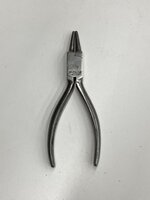
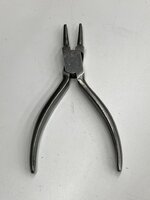
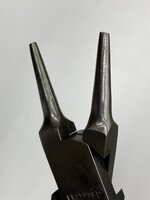
Another Kroyter/Krouter pliers arrived today in very nice condition.
Outlawmws
Well-known member
Nice condition wire forming pliers!
Skyman
Well-known member
I think so, too. I'm pleased to have them. I think they're every bit as good as the Knipex that live in my workshop. The similarity is notable, aside from the obvious grips on the Knipex.
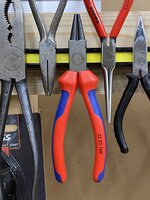
I like the way the Kraeuters feel in my hand better than the beefy grips on the Knipex, although both will do well whatever I ask of them.
The new arrival will reside with the garage tools.
I like the way the Kraeuters feel in my hand better than the beefy grips on the Knipex, although both will do well whatever I ask of them.
The new arrival will reside with the garage tools.
four.cycle
Well-known member
I did as well, until it came up somewhere a while back. Lugz said it was "KROY-ter".Hmm I've always pronounced Kraeuter as Kraut - er
Maybe I'm crazy, but that's how I remember it.
I had always thought it was "KRAUT-er" - same as you - before that.
I don't profess to be a linguist, by any measure.
We should ask @Nobody-named-Olli maybe ...

Outlawmws
Well-known member
It's pretty clearly a German name, As I recall from HS - German pronunciation rules are a lot different than English/American. I'd want an opinion from a German linguist.
Private Lugnutz
Well-known member
As LS and I both delved into, a little. But note that "Kraeuter" is almost certainly an anglicized version of a German word, and, as LS and I both surmised, probably Kräuter. You can also see this surname as Krauter, Kreuter, and even Kreider. All probably derived and anglicized, all probably pronounced slightly differently. Hence, my caveat about "correct" above. Arguing about how to pronounce an anglicized word is probably a fool's errand. It would be interesting to see how the tool maker's family pronounced it, if that were possible.It's pretty clearly a German name, As I recall from HS - German pronunciation rules are a lot different than English/American.
Pronouncing "Kräuter" is not debatable, though.
Or a native German speaker, such as...I'd want an opinion from a German linguist.
But in the meantime, if you click on the link I provided in my last post, you can hear it pronounced by a recorded native speaker.@Nobody-named-Olli
four.cycle
Well-known member
ah! dunno how I missed that one... she's pronouncing it a bit differently.
Private Lugnutz
Well-known member
If you mean differently than KROY-ter, yes, agreed, and this too was alluded to by LS and myself. It's almost impossible to capture the German pronunciation of Kräuter in English, phonetically. Almost more like KWOY-tah, the "r" is so swallowed and the "a" so squelched. But it's clearly a lot closer to OY as in boy than OW as in cow.she's pronouncing it a bit differently.
Beerhippie
Well-known member
I'll take some advise from my previous life as a botanist: Jepson's Flora of Northern California says re. the pronunciation of biological binomials: "No one actually knows how to pronounce names in Latin/Greek/Latinized whatever. If corrected, just give a knowing grin and a nod of the head and carry on."
Paraphrased, I'm sure.
I can still get a chuckle out of the memory from 40-odd years ago of a field trip in the Columbia River Gorge with a visiting botany instructor from Germany. He absolutely insisted on his "correct" pronunciation of Latin names and when, on seeing his first mature Ponderosa Pine, he exclaimed "Mein Gott! Look at the size of that Pinus (Latin name for the Pine genus)!"--pronouncing it *****. The busload of students, half of whom were young ladies, didn't know quite what to make of it, especially as we were just passing Rooster Rock, formerly known as **** Rock.
Paraphrased, I'm sure.
I can still get a chuckle out of the memory from 40-odd years ago of a field trip in the Columbia River Gorge with a visiting botany instructor from Germany. He absolutely insisted on his "correct" pronunciation of Latin names and when, on seeing his first mature Ponderosa Pine, he exclaimed "Mein Gott! Look at the size of that Pinus (Latin name for the Pine genus)!"--pronouncing it *****. The busload of students, half of whom were young ladies, didn't know quite what to make of it, especially as we were just passing Rooster Rock, formerly known as **** Rock.
Last edited:
four.cycle
Well-known member
^ the lady on the recording pronoucing it is definitely different than "KROY-ter".
Lugz and I both hail from the easten half of PA, which is why we agree on the phonetic spelling “kroyter” for what the recording sounds like. (I won’t go into the subtleties of the “r” because I suffered enough in elementary school speech therapy for the crime of having a German-speaking babysitter in my first year of life.)
If you disagree, it’s because you’re pronouncing “oy” differently than we do. If we grew up closer to WV, we might spell it “krighter.”
I can easily imagine that somewhere in America “kroyter” could be pronounced the way I would pronounce “crow eater” but I’m not rounding the “o” that much, so it’s about midway between “crow eater” and “crah eater” (and of course, “oy” is not really two separate vowels but a single dipthong). For me that difference is like between “Bowie” and “boy,” but none of this helps us because we are not hearing each other make different sounds speaking the same words.
The IPA spelling is ˈkʁɔɪ̯tɐ which is not subject to local interpretation.
If you disagree, it’s because you’re pronouncing “oy” differently than we do. If we grew up closer to WV, we might spell it “krighter.”
I can easily imagine that somewhere in America “kroyter” could be pronounced the way I would pronounce “crow eater” but I’m not rounding the “o” that much, so it’s about midway between “crow eater” and “crah eater” (and of course, “oy” is not really two separate vowels but a single dipthong). For me that difference is like between “Bowie” and “boy,” but none of this helps us because we are not hearing each other make different sounds speaking the same words.
The IPA spelling is ˈkʁɔɪ̯tɐ which is not subject to local interpretation.
Last edited:
Private Lugnutz
Well-known member
Pennsylvania Dutch (i.e., German) territory!Lugz and I both hail from the eastern half of PA, which is why we agree on the phonetic spelling “kroyter” for what the recording sounds like.

Beerhippie
Well-known member
My family moved from West Texas to rural Western Oregon when I was 8 yrs. old. I know what you mean! I got no end of **** from teachers when they found I pronounced "while" and "whale" the same.Lugz and I both hail from the easten half of PA, which is why we agree on the phonetic spelling “kroyter” for what the recording sounds like. (I won’t go into the subtleties of the “r” because I suffered enough in elementary school speech therapy for the crime of having a German-speaking babysitter in my first year of life.)
If you disagree, it’s because you’re pronouncing “oy” differently than we do. If we grew up closer to WV, we might spell it “krighter.”
I can easily imagine that somewhere in America “kroyter” could be pronounced the way I would pronounce “crow eater” but I’m not rounding the “o” that much, so it’s about midway between “crow eater” and “crah eater” (and of course, “oy” is not really two separate vowels but a single dipthong). For me that difference is like between “Bowie” and “boy,” but none of this helps us because we are not hearing each other make different sounds speaking the same words.
The IPA spelling is ˈkʁɔɪ̯tɐ which is not subject to local interpretation.
We have a goodly selection of IPAs here at the pub, but not that one.
Skyman
Well-known member
Beerhippie
Well-known member
Willys--as in the jeep. Try to find ten people who agree on that one....OK, now do Knipex....
Mike'smeatshop
Well-known member
- Joined
- Apr 1, 2023
- Messages
- 1,273
spreken ze dutch ?Pennsylvania Dutch (i.e., German) territory!
Private Lugnutz
Well-known member
As someone who doesn't own many modern tools or frequent modern tools forums, I'm not familiar with the topic, but I'm going to assume it's a matter of hot debate between NIP-ex, Ka-NIP-ex, and NIGH-pex? (And maybe some fancier, frenchier try-too-harders with NIP-ay, Ka-NIP-ay, and NIGH-pay?)OK, now do Knipex....
Bob Weir was wrong.Willys--as in the jeep. Try to find ten people who agree on that one....
Only the common slang used in jest or ridicule that we all picked up as boys. Such as "heevahava" and "outen the lights" and some dirtier, vulgar phrases I won't repeat. Pennsylvania Dutch was (still is?) a strange blend of German, anglicized German, and English. Northeast PA was an interesting place to grow up. Predominantly, all the boys from town whose parents worked in mines, mills, machine shops or factories was of Eastern European extraction (Slovak, Hungarian, Ukrainian, or Russian, mainly), and we were all known as "hunkies". All the boys from the surrounding farms, almost exclusively dairy, were Pennsylvania Dutch.spreken ze dutch ?
Mike'smeatshop
Well-known member
- Joined
- Apr 1, 2023
- Messages
- 1,273
I grew up southwestern Pa with a few families, and then worked about five years near Slippery Rock and the boys would help at the trout hatchery. They would have to come down and pick the wooden switch out of the wood pile to get a switchin. And their mother would let me take them spotting for dear some nights. Great boys.As someone who doesn't own many modern tools or frequent modern tools forums, I'm not familiar with the topic, but I'm going to assume it's a matter of hot debate between NIP-ex, Ka-NIP-ex, and NIGH-pex? (And maybe some fancier, frenchier try-too-harders with NIP-ay, Ka-NIP-ay, and NIGH-pay?)
Bob Weir was wrong.
Only the common slang used in jest or ridicule that we all picked up as boys. Such as "heevahava" and "outen the lights" and some dirtier, vulgar phrases I won't repeat. Pennsylvania Dutch was (still is?) a strange blend of German, anglicized German, and English. Northeast PA was an interesting place to grow up. Predominantly, all the boys from town whose parents worked in mines, mills, machine shops or factories was of Eastern European extraction (Slovak, Hungarian, Ukrainian, or Russian, mainly), and we were all known as "hunkies". All the boys from the surrounding farms, almost exclusively dairy, were Pennsylvania Dutch.
I'm not German, but I did study the language in high school and for two years at college. I also have a sister who married a German newspaper editor and has lived in Germany for more than 30 years; we talk about many things, including from time to time German and its similarities and differences from English.
Ordinary American English speakers would likely say NIP-ex or perhaps NEE-pex. However a German speaker would sound both the K and the N in Knipex, as in the older German word for "boy", Knabe. (The modern word is Junge, spoken as YOONG-eh.)
So I tend toward the German way of saying the company name, but really no one will be in doubt however you say it.
(Where's @Nobody-named-Olli in all this discussion?)
Ordinary American English speakers would likely say NIP-ex or perhaps NEE-pex. However a German speaker would sound both the K and the N in Knipex, as in the older German word for "boy", Knabe. (The modern word is Junge, spoken as YOONG-eh.)
So I tend toward the German way of saying the company name, but really no one will be in doubt however you say it.
(Where's @Nobody-named-Olli in all this discussion?)
Provincial
Well-known member
Growing up in a town with a fair number of "German" Mennonites I learned that German is not a distinct language. Remember, Germany as a nation didn't exist until the mid-1800's, and before that was a loose collection of small independent states.
I learned that there were two forms of German spoken by local families, with the Mennonites using "Low" German, as opposed to "High" German. The High and Low appear to be references to geography, with Low spoken near the mouth of the Rhine River, and akin to Dutch.
The unification of Germany by the Prussians made High German the official language of the unified nation.
I learned that there were two forms of German spoken by local families, with the Mennonites using "Low" German, as opposed to "High" German. The High and Low appear to be references to geography, with Low spoken near the mouth of the Rhine River, and akin to Dutch.
The unification of Germany by the Prussians made High German the official language of the unified nation.
 Yesterday I was at a swap meet, combing through a sea of dollar table junk, and happened upon a pair of rusted-solid linesman pliers. Normally, I’d have left them, but I noticed they were Red Devil, so after an internal debate I just paid the dollar without performing the usual pantomime to try for a lower price. I have managed to unfreeze pliers in the past, and figured I’d try on these.
 After an overnight soak in EvapoRust, I take a cold chisel and a few hammer blows to force the jaws apart, then a few blows to close them up. Rinse and repeat, with plenty of soak time in various positions to derust the pivot.
Attachments

Private Lugnutz
Well-known member
I'm biased, but with that old script logo, they could be half returned to their earthen molecules and it is coming home with me!Normally, I’d have left them, but I noticed they were Red Devil,
Good luck with them.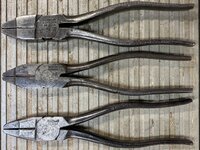

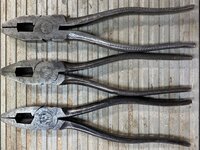
The 1150 (bottom of each photo) turned out great, opening and closing easily (a little loose, actually). At top is a 1050 (heavier - maybe that says 1650 or 1950); middle is not marked with a model number. Well worth the dollar, plus a half-hour of hand scraping and wire brushing.
Last edited:
Outlawmws
Well-known member
Nice! Cutting jaws all look in good shape too!

Skyman
Well-known member
Those cleaned up well. Nice work. I, too, like the script logo on this one.
I've had success rehabilitating quite a few pliers that were rusted to the point of being frozen solid. It's always been worth the time invested, and has never been very difficult. Evaporust, Kroil and some manual persuasion are all I've ever found necessary.
I've had success rehabilitating quite a few pliers that were rusted to the point of being frozen solid. It's always been worth the time invested, and has never been very difficult. Evaporust, Kroil and some manual persuasion are all I've ever found necessary.


Skyman
Well-known member
Nice score. I have no clue, but some of the members here with deep knowledge about these vintage pliers can likely shed some light on the application for those Bokers.
Looks like a couple of interesting Utica pliers in that group as well. I'd be interested to know more about the 75475 pliers.
Looks like a couple of interesting Utica pliers in that group as well. I'd be interested to know more about the 75475 pliers.
Outlawmws
Well-known member
The plastic/rubber is missing in the grooves but used to grip the cut ends so as not to contaminate the area:
https://www.garagejournal.com/forum/threads/what-is-it-and-what-is-it-for.533814/post-10714922
https://www.garagejournal.com/forum/threads/what-is-it-and-what-is-it-for.533814/post-10714922