Private Lugnutz
Well-known member
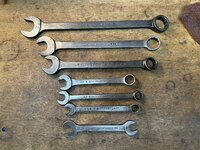
Excellent find(s), Roob!

Be careful. Try it on the back. This is a plastic/vinyl material. I have a number of proto LA versions of these. They are fairly impregnable to most anything due to their synthetic composition but once they start to harden not much you can do.It’s not leather. I don’t know how to identify these materials, so I will say leatherette. Lol. I can’t see mineral oil hurting any thing. I’ll try it in a small spot just to make sure nothing bad happens.

Ehh, good point. Depending on perspective, the "back" could be rolled into the "front" and more visible. Heck at this point I don't knowWith something like a tool roll, what is "the back? Its kind of all exposed, one way of another..

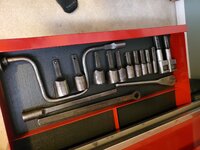
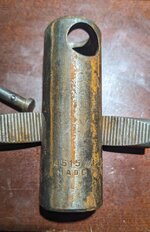
These are somewhat useful.. it takes a bit of dexterity to work the wedge and drive end simultaneously. They are especially good at removing head studs in flathead engines. Herbrand had a slightly different design, with a square hole for the wedge, which kept it in place a little better. Plomb made the 4515, 4520, and another number, 3/4” drive, I don’t remember the number. I sold mine about a year or so ago.Here is a find from the Branch 15 Swap meet in Portland a couple of weekends ago. I finally made it to that part of unpacking from my trip. Grabbed this as a Whatzit handful, where 3 of three things were unknown. I saw the Plomb name on it, and figured it would be a fun thing to figure out. Over on the GS thread, Lugz gave a quick ID, and hint at value, thank you sir.
Plomb 4515 Stud Puller came with two wedges 4516 & 4517, which are inserted crossways into the big hole, and then turned with the 1/2" drive, to wedge and unspin the stud. A bit smaller and more elegant than my Wright stud extractor. The ball detent pin holds the two wedges in a storage space between uses. 1939 - 48 per AA
I'm probably never going to use this, so if it means something to someone, give me a holler.
Not to be the defeatist, but not much. I don't have any Plvmb rolls, but I have dozens of others in this era, and they were all either oilcloth (which your example is not) or canvas or other cloth fiber backing impregnated with an artificial leather or leatherette material that was a composite, i.e., stylized form of an early plastic containing absolutely no animal by-products that could be softened and treated and preserved with oils. Once they start cracking, options are limited to slowing further cracking by simply not handling and storing in an environment where it won't get worse.
I've seen people with other, larger products, i.e., purses, couches, car seats, etc, claim that leather repair kits work. These are essentially temporary acrylic paint patches. I've never tried it, and the thought of a roll up bending and unbending just seems to defy the concept.
I'll be curious to hear other opinions.
What is the material? Plastic or an early vinyl variant? I'd try setting it in the sun to see if it softens, enough to open and get the tools out? that's not a long term solution though, but you can make a wood block rack for the tools
If leather, (unlikely) my go to is neatsfoot oil. (The real stuff on the mix or fake stuff) yes it will darken the leather, but what's better, dried useless soon to be broken leather, or a darker oiled leather?
Straight mineral oil
Be careful. Try it on the back. This is a plastic/vinyl material. I have a number of proto LA versions of these. They are fairly impregnable to most anything due to their synthetic composition but once they start to harden not much you can do.
With something like a tool roll, what is "the back? Its kind of all exposed, one way of another..
 .
. 
Zero animal by-product molecules for the molecules in the oil to affect. Mineral oil, baby oil, and hundreds of special car and home interior market products claiming to soften vinyl or naugahyde etc are selling a smell and a wet, smooth, supple surface for your hands to convince your brain it's doing something. False hope. It's plastic! Thin amazingly flexible plastic clinging to cloth, but plastic.I also tried a heavy application of Mineral oil overnight, which didn’t seem to penetrate the surface at all, but didn’t hurt anything either.
Exactly right. A judicious application of blow dryer heat will warm it enough to be temporarily "supple", but unless you block it flat, it generally reverts to it's former condition. Even after blocking, most will tend to curl again unless the process is periodically repeated.I like your own heat idea, actually. To temporarily handle it. I believe that might begin to have a softening affect for a few minutes. But days, weeks, and years of ambient temperature are going to stiffen it in the closed position again.



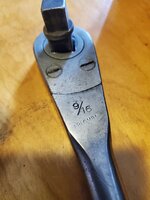
Oh heck yeah! Nice find. Did you know this was in that lot?Nice plombaloy. Here's a plomb da9 drive plug I got in a tool lot

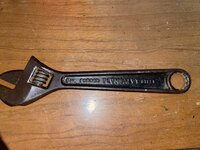
The Plomb adjustable was made in the newly acquired Danielson factory and was made in 1947. Prior to that Plomb adjustables were sourced from Utica.I got this for 5$ at the flea market and it was missing the spring and the correct screw. I also got a 3/8 wrench for a 1$
I made a new screw and hit in with a light wire wheel and fluid film to save the “patina”
I believe it to be a 1937 vintage.

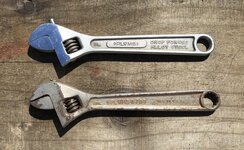
Thanks for the info!The Plomb adjustable was made in the newly acquired Danielson factory and was made in 1947. Prior to that Plomb adjustables were sourced from Utica.
-Don
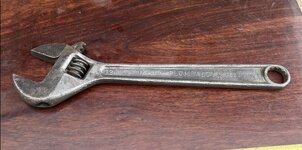
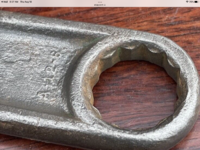


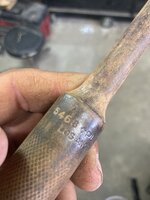
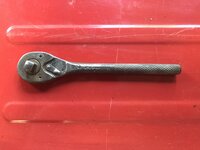
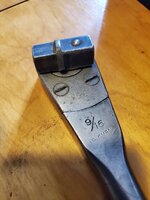
Would make a neat drawer pull.Plomb 1/2 drive extension/ breaker bar 5468… only problem is it’s broken. Any chance this can be fixed ?
You could braze something on there, cosmetically, or even maybe pallet knife some JB Weld on it, and then finely file and finish to reconstitute the shape of the drive stud, so it would fully flex, and look more like a hinge handle inside a set, but fixing it functionally is not really feasible. Moreover, not really sensible, frankly. They're not that rare as a collectible, and if you want a vintage 1/2-drive hinge handle as a user, most of them are not that rare or that expensive, either.Any chance this can be fixed ?
I like that idea....or make a cool BBQ tool like a spatula!