Agreed.I guess that 1939 was the last year of the NAF 39***** numbers. By 1940 they had transitioned to the newer NAF-1108-** numbering system.
Dang! Are they Z series or pre part numbers?
I sent you a messageDang! Are they Z series or pre part numbers?
Thanks!I sent you a message
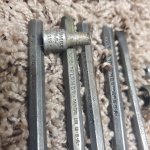
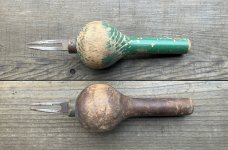
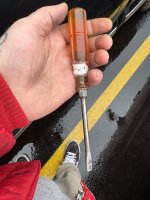
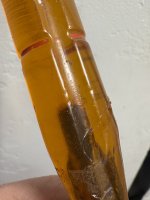
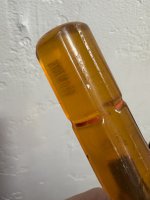
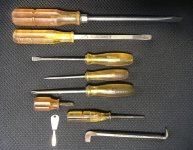
There are 2 different versions or the pyroxylin (early plastic) handles. The earlier version of the 2 you have that is a fluted style handle. The later version is has no flutes and is a cylinder that is tapered on each side of the center. It has a pebble pebble marking for both Plomb and the part number.Has anyone seen a Plomb screwdriver with the hex nut shank? I got it for $1 so if it’s modified oh well, love the color anyways. Side by side with a P&C Phillips no. 2 I need to clean up.
Solid additions!


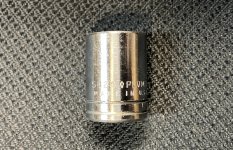
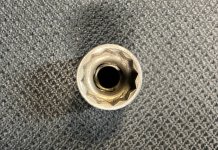
And here are those deep sockets, with a couple better views of the male drive tang with the internal 3/8-inch female square drive opening on that Pratt Whitney Aircraft socket. Not sure I've seen one like that before. Is it so it can be turned externally as well? (There's probably a really obvious explanation I am missing.)
![]()
Lugz, that PWA 2254 socket is for spark plugs on WWII radial engines. 7/8" is standard hex size for the spark plugs even now. Prior to WWII, aviation spark plugs had various size hex for installation, and other, smaller hex for servicable (take apart, clean, and reassemble) components, like insulator retainers.
The external square drive was intended for use with an open-end wrench, or a larger square drive female drive. In service, the internal square drive was almost always used, since many of the spark plugs were located in areas with poor access due to cooling fins, baffles, and intake/exhaust piping.
That's what was throwing me off about the external drive (5/8" by the way). Even though I can see it was used (a corner is burred), I don't see how they would have access! I have spark plug wrenches for aviation work with extra long reaches and weird bends on them. Thanks for the info!
... they are standard extra deep with a tommy bar hole and a 1/2-inch female drive opening. Which makes me even more curious about the PWA sockets with the short male drive tang (5/8-inch external drive) with a 3/8-inch internal female drive opening. Mine is at Post #5256. Waiting to see RagTop's. Why did PWA require that if the Navy didn't? EDIT: Maybe something to with the junior drive size.
On further thought, if the GMTK set includes a 5/8" 8-point (or 4-point) with 1/2" drive, that would be an alternative which would provide greater power to attack a stuck spark plug. Ordinarily, one avoids the greater leverage because the threads can, and do, break off if a stuck plug is overtorqued while trying to unscrew it!
These were part of an interesting buy out of Cali.
-grind off 7/8” spark plug socket. Perhaps a PWA 2254. Threaded hole in the socket wall.
One possibility for the threaded hole in the spark plug socket is for use working on flying boats. If you changed spark plugs on a PBY or PBM while it was floating in the water, a dropped tool was a lost tool. The threaded hole could be for attaching a lanyard to keep the tool from being lost.


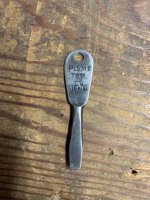
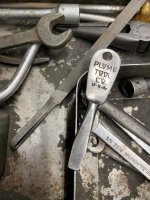
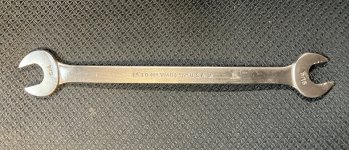
Nice keychain screwdriver! Also nice of the Plomb TPC file to photo bomb.As many of you know I have been busy narrowing my Plomb collection to a more core group of pre war or war time items. So no early stuff or Plomb Los Angeles and no pebble or chrome tools for the most part. But there was one thing that has evaded me for years so when I found one on eBay for a reasonable price, I hopped on it.
I would say it looks right at home in my 1/4 drive box set (but it's actually now tucked into my display cabinet in my living room)
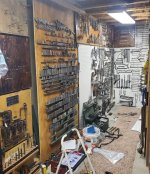
Another 2 feet of wall space. Thanks to @Smokeshow69 for the 2 puller display boards. I made a stack of boards opening up some additional peg board space for hammer and other auto body tools.
I thought about making something like that using unistrut and roller assemblies. I was concern about the load bearing of the rafters with that much weight. I have haven't ran the math but at 1st blush. 1500 tools average 2.5lbs each would put us 3.750 tools load and add another 500lbs in hardware and displays would put us down over 2 tons.What you need to do is move the light out and over 4 feet; then set up some rails (think sliding closet door, rails) and then how many floor to rafter panels can you setup in the 2-3 feet where you have the panels on the back wall (defined as where all the DOE's are..)
OK go the other direction - foot rollers like sliding glass doors use. you need 8 ft of track for each, and a couple of guide rollers up top. per panel.I thought about making something like that using unistrut and roller assemblies. I was concern about the load bearing of the rafters with that much weight. I have haven't ran the math but at 1st blush. 1500 tools average 2.5lbs each would put us 3.750 tools load and add another 500lbs in hardware and displays would put us down over 2 tons.
I suppose if the weight was support off the concrete floor it would work. I am going to look into that. Thanks for the idea!OK go the other direction - foot rollers like sliding glass doors use. you need 8 ft of track for each, and a couple of guide rollers up top. per panel.
Im glad someone saw the ignition file photo bomb!Nice keychain screwdriver! Also nice of the Plomb TPC file to photo bomb.
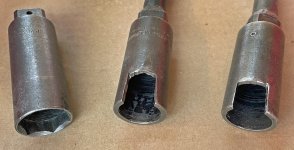
I suspect that the molested sockets are a shop-made tool for compressing valve springs/rocker arms for Pratt & Whitney engines. They slip over the valve end (with adjustment screw) of the rocker arm and you pull on the rod to pivot the rocker arm to depress the valve. This frees up the push rod end and allows removing the push rod to replace seals on both ends of the push rod cover tube.I always appreciate @Provincial 's knowledge of aviation tools!
At an estate sale last weekend I picked up 3 PWA 2254 sockets. Interestingly, the external across-flats dimension on the outside of the square tang is 3/4" on all three of them (instead of 5/8" like the one @Private Lugnutz has).
Regarding @3baygarage 's possible 2254 with the side hole: I wonder if maybe some of the 2254 sockets came with the threaded hole from the factory? Because, one of my sockets also has a threaded hole with a set screw.
And, to finally get to a question. What did I find?
One of my sockets is unmolested. However, the other two are welded to a 5/8" diameter solid rod for an overall length of 13 inches. These two have the internal 6-point service end portion of the socket cut off (3/8" cut off of one and 1/2" cut off of the other) leaving only the smooth round bore. These also have a slot cut out of a portion of the circumference. The cut out slot is about 5/8" x 5/8".
After a bit of searching, i found that the now-deceased owner of the tools was born in 1934, was a Marine with Aircraft Maintenance as his MOS, likely took classes at the Northrop Aeronautical Institute in Inglewood, and completed AS 90C-6 727C Airframe and Systems training at the Boeing Airplane Division Service School. (He also had a Bonney PWA 1437 that I'll post in the Bonney thread.)

![]()
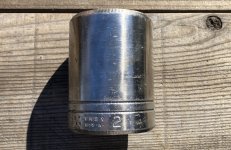
1468 is for the nut that holds the shielded ignition lead onto the top of the spark plug. There are several sizes of hex. If that one is 3/4", it is WWII, and probably not for B-29's.
I suspect that the molested sockets are a shop-made tool for compressing valve springs/rocker arms for Pratt & Whitney engines. They slip over the valve end (with adjustment screw) of the rocker arm and you pull on the rod to pivot the rocker arm to depress the valve. This frees up the push rod end and allows removing the push rod to replace seals on both ends of the push rod cover tube.
The original P&W tool (PWA 1392) was a "socket" with 3/8" drive that used a very heavy duty extension for a handle.
@Mintgrun , thanks for showing me the 1392.

So... the sockets are male drive? How odd.
Yes. They ran this design up until the late 20s before converting over to the standard drive sizes. Plomb's 1st socket set was the 9/16" drive. I picked up the earliest variant of these about 12 years ago tucked in an old ammo can at a farm estate. They were longer male drives and no retention ball.^ Pretty amazing find there, Roy.
So... the sockets are male drive? How odd.
slip fit? interference fit?. They were longer male drives and no retention ball.

Yes. These are pretty much that as well with the rention ball. Similar fit to a wrench on a bolt/nut.slip fit? interference fit?
I had a "radio" socket set like that.... you just jammed the sockets onto the drive tool (essentially a spinner handle.)