Re: ~ Plomb tool picture thread - show your stuff!
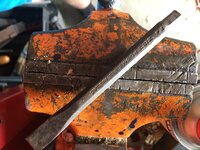
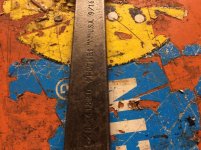
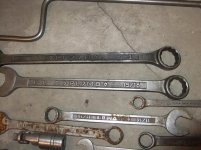
Hey Todd. I left this one behind on Sunday, but I took a pic for you. This one is marked PROTO, so they they had to have continued making this type of DBE for something...

Markings are:
1/2 USS (7/8) PROTO MADE IN USA 5/8 USS (1 1/16) 1041
Those size marking refer to evolving 'custom and practice' in the machine trades, in the early 1900's to the 1950's.
There were several standards for threaded fasteners which had been developed by the various manufacturers, as fasteners had become a commonly available industrial product during the (approx) 1850-ish to 1900-ish time-frame.
In the 'early 1900's' time-frame, trade associations came into being, and worked at providing simplified standards for fasteners. These standards included adoption of the 60deg. thread (instead of the 55deg. Whitworth standard used in the UK), and specific thread pitch series relative to major diameter, such as the 'standard coarse' of 20 tpi thread for 1/4" dia, 18 tpi for 5/16", etc, and the 'standard fine' of 28 tpi for 1/4", 24 tpi for 5/16". etc., etc. The specs included published tolerances for different classes of threads, from 'cheap' to 'precision'...well, relatively so, anyway.
The most common of the fastener standards were commonly known as 'USS' or 'United States Standard', the 'coarse thread series', and 'SAE' (Society of Automotive Engineers). the fine thread series.
The standards also specified the 'distance across flats' for bolt heads, capscrew heads, and nuts, both square and hex. (the triangular bolt-heads used in some eastern European practice were not adopted in any American standards)
The bolt/capscrew heads and nuts were specified as either 'light' or 'heavy', with 'heavy' only used in the USS series, in common practice.
It had become a custom by the 1890's (approx) for wrench makers to mark their wrenches for the thread size of standard nuts which a wrench would fit, such as the 7/8" across flats size for 1/2" USS nuts, or the 1-1/16" across flats size for 5/8" nuts..
This became a source of petty confusion when the SAE series of fine-thread fasteners went into common use. In the SAE series, the 'across flats' size for a 1/2" nut was 3/4", not 7/8", and so on in proportion for other thread diameter sizes.
Those 'dual marked' wrenches are the last examples of the earlier practice of marking wrenches by the thread diameter of the nuts they fit, and will usually be found marked for the 'USS' standard nuts. Wrenches so marked may be found even in early/mid 1950's tool production, a 'last remnant' of the earlier standard practice.
During the war, in the 40's, the War Production Board issued orders to simplify fastener and tool production, abolishing the use of 'odd 32nds' nut and wrench sizes, and specifying that wrenches be marked only in the actual size of the wrench, which would be the 'across flats' dimension of the fastener the wrench was meant to suit.
The 'dual marked' wrenches are an interesting bit of industrial history, the 'evolution of standard practice', to be sure.
Enough trivia for today?.........yes, I thought so..... : )
cheers
Carla








 He's a good boy though, works in engineering for TESLA