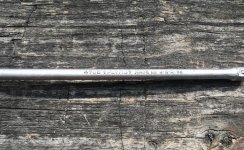
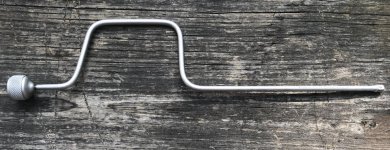
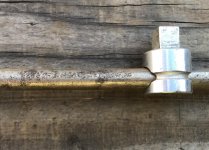
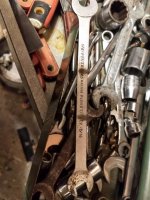
I was always of the mind that any of the "double letter date codes" were wartime, but this 1214 wrench is not only in damn good condition but it looks to be chromed.
Did I miss something?
Examples of the Letter-Letter tools do show up chrome-plated, as Don alluded to. How many, proportionally, in ratio to the number of examples that are natural steel, is debatable. There is a respectful disagreement about them. Some collectors think they disprove or cast serious doubt on the wartime dating conclusion. Others, including me, can't comprehend that.
I'll explain why not and you can make up your own mind.
Here is a summary of the Letter (Month)-Letter (Year) dating, as worked out, empirically, by Twertsy on Tool Archives, based on over a hundred examples:
LA: December 1941
AB, BB, CB, etc - LB: January 1942 - December 1942
AC, BC, CC, etc - LC:- January 1943 - December 1943
AD, BD, CD, etc - LD: January 1944 - December 1944
AE: January 1945
To fully grasp the significance, it has to be emphasized that what is not shown is just as important as what is shown. Note that no Plomb tools with Letter-Letter codes have been found (or at least have not been reported) with a first Letter after L (the 12th letter in the alphabet), or with a second letter after E.
Therefore, regardless of when the date-code system is placed on a calendar, it seems nearly undisputable that the first letter signifies month, that the second letter signifies year, and that the date code system was in effect for five (5) years.
Based on their physical characteristics (shape, construction, broaching, marking, etc), could the 5-year production period Letter-Letter tools be from an earlier era?
No. They can't be from 1927 through 1938. They might be from 1939, 1940 and 1941 when they switched to a "USA" marking, but as we know, examples of those sockets exhibit the system that Plomb was using - a Number (Year)-Letter (Unknown) code - since 1927. Note that the Number-Letter system ended in 1941.
Based on their physical characteristics (shape, construction, broaching, marking, etc), could the Letter-Letter sockets be from a later era?
Yes, they are the same style that Plomb used throughout the 40's right up to the lawsuit.
But does it make sense that the 5-year Letter-Letter system connotes 1945 to 1949? Or that they stopped date coding during the war and picked it up again when the war ended? Or that they used a different date code system after the first one, and then dropped date coding altogether after the war? Or that an overwhelmingly large portion of the Letter-Letter code tools are plain steel? Why would that many tools be plain steel in the late 40's?
That's why I don't comprehend how they can possibly bust the wartime Letter-Letter system. That conclusion can't be tossed out in a vacuum. That conclusion requires an explanation that, in my opinion, is much harder to make than looking at the plated examples of L-L tools as so far unexplained anomalies.

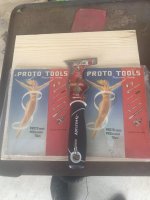
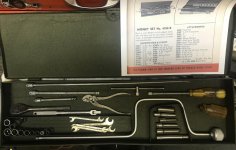


 represent!