Lug, you did a pretty deep dive into this on a previous thread (
https://www.garagejournal.com/forum/showthread.php?t=405038), so I trust your opinions on this topic.
Thanks. As a matter of course, I don't mind being challenged on any of my deep dives. In fact, I welcome it. The importance of debate is that it makes the objective truth stronger. By the same token, I don't think it's a matter of opinion. Until my facts and conclusions are objectively disproven, with substantive arguments, I will have the tendency to insist on them. That is also part of making the objective truth stronger. And that is why I read statements like yours, about it being "one of the hammers that triggered the whole lawsuit debacle," as perpetuating what I believe to be a false and unsubstantiated narrative. I have no misguided hopes of changing the minds of the people behind AA, Wiki, Van Natta, or the Proto website, I do have small hopes at changing minds here in our little corner of the tool collecting world.
Thanks for clarifying!
Here is paragraph 5 from the court's opinion:
That's the paragraph I quoted from and alluded to in my first reply to you above, quoted also in my analysis for the deep dive you are referring to.
As I said above, that deep dive pretty much debunks the popular narrative that ball-pein hammers, specifically, exclusively, are at the root of the lawsuit, which is always inextricably tied to the equally unsubstantiated idea that Plomb's Paschall brand was part of some agreement the two parties reached in 1926 to avoid Plomb using the name of their company on the one tool that Plumb also made.
There is no record of such an agreement, and hypothetically, such an agreement makes no sense, since neither Plomb (or the just acquired Paschall) were even making ball-pein hammers at the time, and Plumb had no reason to agree to anything with Plomb, having just successfully ruined Plomb's TM attempt.
The point is that when Plumb objected to the use of the Plomb name as a TM in 1926, it could not have been about ball-pein hammers, and when they sued Plomb in 1947 for using the Plomb name as a TM without Plomb having a valid TM, it was not just about ball-pein hammers. Plumb always objected to any and all hand tools and packaging bearing the Plomb Tool Company name like a trademark, got their TM squashed for that reason, then came back two decades later and sued to make them stop using it like a TM.
SilverDeck said:
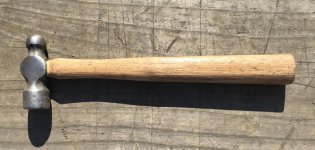
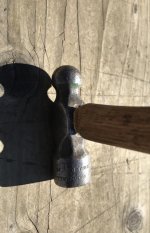
Just thought it was very interesting to see a Plomb-marked ball-pein hammer.
Definitely interesting. Maybe OOAK? We can't know what prompted Plumb to finally challenge Plomb in court after twenty-one years of hand tool production, but I doubt it was a ball-pein hammer made on contract for Fairchild Aviation during WWII. Don's point is well taken there. If, as I opined on the deep dive, Plomb somehow unilaterally thought that simply branding one of their tools differently (i.e., "Paschall" ball-peins) would keep them out of court with Plumb, maybe they thought they wouldn't need to comply with their own strange little scheme for a miltary contract.