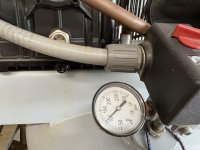
Thanks for the replies. I am looking at the information to try and educate myself a little on all this. It's very helpful and I will know a bit more now when I talk to the next electrician.
This is all coming from someone who also started out having to teach themselves, and has now successfully worked on a ton of stuff, including all the way up to a detached building subpanel. If I am wrong, one of the sparkies will surely step in and correct specific details.
Anything that I am unsure of is in italics, if the sparkies could check my work
I am going to run through the red flags, as I see them, so hopefully you can educate yourself moving forward (either with another electrician or your own work).
First, as was stated, the door to the panel needs to be accessible. It currently looks like the compressor is in front of it. If the compressor is far enough away (no line of sight
(and/or?) 50ft away, it needs a way to disconnect it from power. Within those limits, the breaker serves that function. You should not use the breaker as a "power switch" when the motor is running (longer term damage may occur). Turning off the breaker when the motor is not spinning is not an issue. Some pressure switches have an On/Off on the side, can't tell if yours does. If you choose to want a disconnect on the wall, that is perfectly fine (exceeds the minimum requirement).
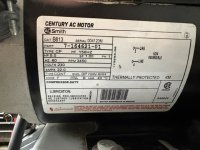
The motor on the compressor says 5HP, which is beyond the limit of what general NEMA plugs are rated for (
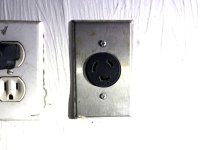
IIRC, 3HP?). So while it could carry the amperage, disconnecting the plug while the motor is running would be "bad news", and hence why they are not rated for that (ratings are sometimes based on red-neck/hillbilly "Hold my Beer and Watch" scenarios). So the plug on the end and the wall receptacle are bad. They make 5HP rated plugs, but they are very costly for the average homeowner, so most don't bother (pin/sleeve connector). They are rated to not be "bad news" if some employee accidentally unplugs when the motor is running. Sidestepping the specifics of "bad news" for brevity here.
The flex conduit around the wires is an acceptable way to shield them for protection, but it was not rated to dangle like that at the end going into a plug. A competent person could use the receptacle box and have the tubing run to the front and connect the end safely that way, using a different cover plate. The conduit must end at a box on either side, and be secured against pulling out of the box.
The wiring is based on the electrical load (amps) along with dealing with any drop in voltage due to distance (none in this case). Wylie supplied the correct numbers for you (#10 THHN/THWN or #8 NM/B (
can NM-B be in flex conduit?) from the compressor front box to the wall box. Then make sure the same is connected from that wall box to the panel. It does not have to be continuous (no reason to be), but any connections must be inside a box, not inside the conduit portion.
The panel should have a minimum of 30A (
Sparkies, check me here) breaker for the compressor.
The joke about a larger panel was partially because most people on GJ find themselves needing more circuits, but also because the panels can sometimes be fitted (WRONGLY) with breakers that allow for too many circuits, or the wrong brand of breaker used. Make sure that the breaker matches the rest and the name of the panel (there are some cross-compatibilities, check here if unsure).
The rest of the joking was not at you specifically, but rather a "laugh or cry" kind of mentality, when faced with "paid experts" that screw stuff up so badly. Along with the part where people invariably then want to go 300% bigger than they need, just in case.
Hopefully, this helps lay it out step by step.