To avoid these ads, REGISTER NOW!

Plumbing repair question

crice63

Well-known member
Joined
Nov 6, 2014
Messages
74
Location
Lafayette, LA
Got 8” of snow in South Louisiana, and my first pipe burst in this house—7 years. It’s at the top of the stub at a T to an outside faucet—right beside my laundry feeds, in an outside wall. There are some signs that my PO must have repaired this before. Question: instead of just cutting and capping it with copper, are there any newish tricks that might help prevent this from happening again?

image.jpg
 
To avoid these ads, REGISTER NOW!

PCustoms

Well-known member
Joined
Jul 23, 2011
Messages
22,325
Location
VT
Not sure of any tricks.... insulation and heat are usually key up here. Frost proof silcocks move the shutoff from outside to inside the heated space, so there's no water to freeze in the pipe. Odds are you froze externally and the increased pressure split the pipe.

When you're fixing that I'd strongly consider fixing the fittings on the bottom top, that solder looks a little heavy handed...
 

4x4Pete

Well-known member
Joined
Aug 26, 2019
Messages
791
Location
Stroud
Not a new trick but if you can leave the pipes exposed to indoor heated air your chance of a freeze up is much less. Otherwise never put pipes in outside walls. It's a fact of life up here in the frozen wasteland.
 

jhelrey

Well-known member
Joined
Sep 15, 2010
Messages
7,238
Location
MN
Not sure of any tricks.... insulation and heat are usually key up here. Frost proof silcocks move the shutoff from outside to inside the heated space, so there's no water to freeze in the pipe. Odds are you froze externally and the increased pressure split the pipe.

When you're fixing that I'd strongly consider fixing the fittings on the bottom top, that solder looks a little heavy handed...

Louisiana buries their water lines about 12 inches deep, furnace in garage attic, next to the water heater.
 
OP
C

crice63

Well-known member
Joined
Nov 6, 2014
Messages
74
Location
Lafayette, LA
The wall is behind the washing machine, so possibly I could leave the wallboard off--though I doubt my wife will approve the plan. I've had no other problems with any other outside faucets, but the frost proof sillcock might be a good idea. Since the wall is open it wouldn't be hard to replace it.
 

thammel

Well-known member
Joined
Oct 3, 2005
Messages
2,236
Location
Maryland
My suggestions. You must have insulation behind the pipes. Then after you put the drywall up, cat a large rectangular hole and put a large HVAC return vent to cover the hole. That will cover the hole but allow heated air to fill the volume around the pipe.
 

Bert_

Well-known member
Joined
Dec 24, 2016
Messages
9,699
Location
NW Iowa
Run the pipes on top of the wall instead of in the wall.

People say it's fine down in the south, obviously it hasn't been at least twice now.
 

niget2002

Well-known member
Joined
Oct 2, 2012
Messages
11,115
Location
Josephine, TX
Did you cover your spigot on the outside? We wrap ours in hand towels then put insulated covers over them. Helps keep the spigot from transferring cold inside to the pipes.

I'm not sure I'd leave a hole in the wall, but I'd put more insulation between the pipes and the outer wall.
 

Innovate1

Well-known member
Joined
Jul 28, 2014
Messages
4,274
Location
Illinois near St. Louis, Missouri
Put some insulation board between the pipes and outside wall. Frost free faucet - they come in different lengths and even the shortest one may be a bit long to fit. You will probably need to move the pipe farther from the outside to get it in and would help overall with keeping the pipes warmer. The insulation over the pipe may help but I would take it off and replace with insulation board on the outside wall - you want insulation between outside and pipe but not between pipe and inside so the pipe is nearly the inside temp. Caulk any air leaks in the outside wall - a small draft can really lower the temp in the wall. And the faucet covers help a lot too. The vent cover is a good idea too. But you shouldn't have to do all of these - just some options.
 

HoosierBuddy

Well-known member
Joined
May 9, 2006
Messages
2,915
Location
Southern Indiana
Agree with Innovate1. I'm doubling down on the frost free hydrant recommendation.

I've had -30 degrees F at my house. Never have done anything special with my outdoor faucets (frost free) and never had one freeze up and break the pipe behind it.
 

CraigStu

Well-known member
Joined
May 22, 2014
Messages
4,012
Location
Blacksburg, Va
I had an identical problem in our previous house except that water stopped flowing but pipe did not burst. I removed the drywall and stuffed the existing insulation between the pipe and outside surface vs all around the pipe. The washing machine and the sink w/ cabinet under it hid my hole well enough. The basement just below had been finished so I grabbed a square vent grill and cut an opening in the ceiling drywall which the grill would cover. When it froze I put a space heater on a step ladder under that grill to get it flowing again. The 3rd winter we found out that if we let the faucet drip just sightly overnight, that would prevent freezing. This experience led me to talk to the builder of our current house. NO pipes in outside walls.
 

75gmck25

Well-known member
Joined
Jul 21, 2014
Messages
1,317
Location
Alexandria, VA
I installed freez-proof faucets as part of my basement renovation and its great peace of mind in cold weather. You can buy them in different lengths, depending on how thick your walls are and where you want the connection. I have brick facing on frame, so I got the 12" long freeze-proof and it comes out about even with the edge of my sill plate. The first couple I purchased were also quarter turn valves, but when I got the last one I could only find the old-style gate valve.
 

housewolf

Well-known member
Joined
Feb 3, 2021
Messages
1,144
Location
East Texas
More, better insulation. Do a better job sealing up the insulation that’s on there. If that’s a north wall, maybe build something to block wind??

I’m a (retired) plumber down here too. In fact I was born in LA 👍. The house I built four years ago has no domestic water piping on outside walls. I have yard hydrants, I can turn off, in lieu of hose bibs on my house. In general, we do a pretty poor job mitigating freeze breaks on residential plg. My sister’s, in Houston, house was a disaster in 2021.
 

David Paul

Well-known member
Joined
Jul 11, 2014
Messages
677
Location
Western New Jersey
Well as usual GJ members come up with creative solutions. I have a hot water baseboard heat pipe on an outside wall I’m concerned with. Using the fireplace insert during this cold snap in NJ, (it hit -6), the heat doesn’t come on and I’m concerned that pipe might freeze especially with some of the high winds we have had. This section of pipe is behind a finished section of the basement. I do turn up the heat a couple of times a day to move water through it to be safe. Now I’ll put in a couple air return vents in the area to get some warmer air to that section. Basement stays above 50º.
 

Rc_Guy

Well-known member
Joined
Apr 14, 2013
Messages
4,415
Location
Minnesota
The wall is behind the washing machine, so possibly I could leave the wallboard off--though I doubt my wife will approve the plan. I've had no other problems with any other outside faucets, but the frost proof sillcock might be a good idea. Since the wall is open it wouldn't be hard to replace it.
I wonder if the outside faucet is froze also?

I guess you will find out when you fix it and put water pressure back on.
 

dcg9381

Well-known member
Joined
Jun 20, 2018
Messages
11,627
Location
Austin, TX
I'd suspect most of the cold impact is coming in from the outside faucet. Was that faucet covered / insulated?

You guys are getting a record (100 year) cold event here.

If this was mine, I'd transition this to PEX using sharkbite and then I'd cover all this stuff in spray foam. Spray foam will work a lot better than the existing bat insulation.
 
  • Like
Reactions: LSU

MAD

Well-known member
Joined
Jan 27, 2007
Messages
2,700
Location
Western MA
Using type L copper pipe is helpful in freeze prone areas rather than the thin walled type M.

Also, even if you have frost free sillcock valves for your outside water, it is important to keep hoses disconnected in cold weather. Trapped water can still freeze and split the outer part after the valve. (at least the water is contained though)
 
To avoid these ads, REGISTER NOW!

Innovate1

Well-known member
Joined
Jul 28, 2014
Messages
4,274
Location
Illinois near St. Louis, Missouri
I'd suspect most of the cold impact is coming in from the outside faucet. Was that faucet covered / insulated?

You guys are getting a record (100 year) cold event here.

If this was mine, I'd transition this to PEX using sharkbite and then I'd cover all this stuff in spray foam. Spray foam will work a lot better than the existing bat insulation.
I think you are right that most of heat loss was from the faucet.

Buy using PEX means almost no heat transfer to the faucet making it more likely to freeze at the faucet back to the shut off even with a frost free faucet. I used PEX in my shop but on the outside faucet I ran copper for some distance inside to transfer heat to the faucet. May have been more than necessary but I feel much better on days like recently when lows were around 0F.

The insulation needs to be between the pipe and outside but not between the pipe and inside, or at least much less between pipe and inside. Just embedding it in foam hinders heat flow from the inside.
 

dcg9381

Well-known member
Joined
Jun 20, 2018
Messages
11,627
Location
Austin, TX
Buy using PEX means almost no heat transfer to the faucet making it more likely to freeze at the faucet back to the shut off even with a frost free faucet. I used PEX in my shop but on the outside faucet I ran copper for some distance inside to transfer heat to the faucet. May have been more than necessary but I feel much better on days like recently when lows were around 0F.
You an get faucets that clamp to PEX. If the faucet blows, that's way better than having something inside blow up. PEX also survives solid freeze very well where as copper does not.

The insulation needs to be between the pipe and outside but not between the pipe and inside, or at least much less between pipe and inside. Just embedding it in foam hinders heat flow from the inside.
I don't disagree necessarily. Yours is a different view on the same theory. It's all about heat transfer (loss).
Perhaps you'd agree that we treat this differently if it's in unheated space (say attached to a garage) than on the inside of a residence that's heated?

How do you guys up north build these things? There has to be some voice of experience.. Our homes in the south generally aren't designed to handle 100 year events.
 

Joe Reed

Well-known member
Joined
Aug 31, 2005
Messages
914
Location
Cordova TN
My suggestions. You must have insulation behind the pipes. Then after you put the drywall up, cat a large rectangular hole and put a large HVAC return vent to cover the hole. That will cover the hole but allow heated air to fill the volume around the pipe.

I did this last year. In the 20 years since this house was built I've never had a water pipe freeze (I do cover the sillcocks every fall as soon as the temps begin to dip below freezing) but I did have the trap in the drain for the washing machine freeze when the temp reached 3 degrees - very unusual for this area. Found out when my wife was washing a load and flooded the floor.
I cut open the drywall, pulled out the fiberglass insulation that was stuffed between the drain pipe/trap and the exterior wall (north side of house), used spray foam to insulate behind those pipes and used a return air grate to cover the hole. No issues since - although we also haven't had any more single digit temps. Like thammel says, I wanted warm inside air to help keep that trap from freezing.
 

Innovate1

Well-known member
Joined
Jul 28, 2014
Messages
4,274
Location
Illinois near St. Louis, Missouri
I had a cast iron drain line and lead vent line (hadn't ever seen a 2" lead pipe before!) freeze in an outside wall. It was behind a kitchen cabinet so the heat from inside was blocked by the cabinet. I cut the back of the cabinet to access it and replaced it with PVC. The old cast iron was large and didn't leave much room for insulation. With the PVC there was plenty of room for a sheet of rigid foam insulation behind it. Never had any trouble after that.
 

DGersic

Well-known member
Joined
Mar 12, 2017
Messages
6,266
Location
DeKalb, IL
How do you guys up north build these things? There has to be some voice of experience..

Here‘s mine:


Original to 1940s, note that no plumbing is in the outside walls, with the exception of the hose bib that goes through the sill. In replacing it all with PEX, I kept almost everything in the semi-conditioned basement air space, with the exceptions of the ice maker line, and the hose bib.

The ice maker line does go into the outside wall space, but only for a couple of inches.

The hose bib is now the frost free type, and the actual valve end of it is well inside the basement.

IMG_6476.jpeg

This picture is looking up in to the floor joist space. The sill is on the left. The 1/4 turn valve cuts off water to the hose bib. The loop allows replacing the hose bib from outside, instead of trying to work between the joists. The bib and the PVC water heater exhaust exit through the sill.

I won’t say that this can’t freeze, but this house has seen temps down to -35F and has spent weeks where the daily high temp was in the negative teens and has not frozen a pipe.
 

Bert_

Well-known member
Joined
Dec 24, 2016
Messages
9,699
Location
NW Iowa
For hose bibs especially, I actually prefer the old style valves. The 1/4 turn take too much effort.

Even here in NW Iowa I put in a regular old sillcock on my house. I have a valve a couple feet inside the house that I turn off in the winter. Leave the sillcock open. Simple and reliable.
 
OP
C

crice63

Well-known member
Joined
Nov 6, 2014
Messages
74
Location
Lafayette, LA
Thanks for all the suggestions. I cut off the split end of the stub and capped it with a copper cap. The outside faucet isn't leaking so if it froze it didn't do any damage. We will be freezing a few more nights this week, so I'm in no hurry to patch the wallboard, also to let everything dry well. The suggestion I see here is to keep the insulation between the outside wall and the pipe. I will get some high rated insulation shield behind the pipe, then use spray foam to fill in any gaps and cracks, especially through the wall out to the faucet. The Home Depot freeze proof faucet was too long for my application, so I will pass on those unless I get another break like this. I have 5 outside faucets on this house that I have never covered and the other 4 survived this freeze, so I will get 5 if I have to open one again. Climate change, you know.
Thanks again.
 

CraigStu

Well-known member
Joined
May 22, 2014
Messages
4,012
Location
Blacksburg, Va
I use one of the valves w/ a drain (like BombShelter shows) on one hose bib. The builders ran this one out through the rim joist which put it maybe 6" off the gravel drive. I moved the bib up about 2ft but couldn't use the frost free unit as it would have been sticking into the dining room. So I ran pex down the outside surface of the wall and used a 90 to get inside the rim. I put the drain valve about 18" into the basement. In the fall I close the valve, open the bib, then grab a bucket to hold under the little drain.
 

cgrutt

Well-known member
Joined
Mar 4, 2016
Messages
8,172
Sorry late to the game and didnt read all of this so apologies if this was already suggested. What is the connection on bottom some kind of manifold or just copper? With frost free faucet being too long I might make a loop up wall and come back down into the exterior faucet with a ball valve higher up wall. You can stub off the loop before the valve if that is even needed. In cold weather close the ball valve and open the exterior faucet to allow pipe to drain. I'd insulate all of those pipes between the pipe and exterior wall as suggested above.
 

75gmck25

Well-known member
Joined
Jul 21, 2014
Messages
1,317
Location
Alexandria, VA
Frost-free faucets come in different lengths, although I think it's only about 3" increments. I found the length that put the end of the pipe just over the center of the sill plate. If you do that you could probably add a 90" and run it up or down the wall from there.
 

BurtEggley

Well-known member
Joined
Oct 8, 2024
Messages
849
When in a place that is not build for those freezes, let the water drip at a pace enough that will help keep the lines from freezing, and check on it from time to time during the night. If the water is on and the pipe freezes, it lessens the chance of damage. We get that type weather here about every 20 - 30 years or so and that is the easiest solution because you never know where the pipes will freeze, it all depends on the temperature, wind, and other factors. The bad news is that when it freezes like that sometimes you are also without power so no heat so you may have to turn the water off and drain the house lines as best you can. I worked with guy here who closed escrow on a new home on a Friday, moved in on a Saturday, we had a 30 year hard freeze on that Saturday night and the pipe over the kitchen froze. They left for church Sunday morning, the pipe thawed while they were at church, flooded the kitchen, turning on the electric oven, which had 6" of water in it by then, which boiled that water and turned the whole house into a steam sauna. Every piece of lumber in the house either bowed, or delaminated, ruining everything. Total loss. House had to be rebuild because the walls looked like a funny house. When this house here was re-sided I put extra foam insulation around every pipe, and we use special covers over the outside faucets. I also covered all the pipes in the attic with extra insulation so they hold heat from inside the house better. And we let the faucets drip. Good luck.
 

Innovate1

Well-known member
Joined
Jul 28, 2014
Messages
4,274
Location
Illinois near St. Louis, Missouri
That 2x4 wall isn't deep enough for a frost free faucet.
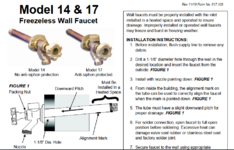
Exactly! Just looked up Woodford model 17 faucet. They are available in 2" increments from 4 to 18" wall thickness. The flange to end dimension is about 1-1/4" longer (depending on the connection type) than the wall thickness specified. Full document here: https://www.woodfordmfg.com/woodford/Wall_Faucet_Pages/Model-17.html
but here are the relevant details.
1737981461223.png
If you click on the installation button at the above link it provides more details:
1737981860610.png
They specify the wall thickness so the end would extend out the other side of the wall for the given thickness. It's all about heat transfer. It's not some magic that the valve end will never freeze no matter how it is installed. There must be enough heat transfer to the valve end to keep it above freezing with the heat loss from the outside handle end. Typically the end extends through a rim joist into a basement so it can extend through insulation also. Another way is to mount it so the end extends into a perpendicular wall. I was thinking I might find some guidance on length for different climates (minimum temperatures) but I didn't find any. I do see that the local Menards stocks 8 and 12 inch which indicates that is appropriate for St. Louis area.
 

75gmck25

Well-known member
Joined
Jul 21, 2014
Messages
1,317
Location
Alexandria, VA
The length of the freeze-proof faucet you need may not be the same everywhere in your house. I put mine at a few inches above the bottom of the sill plate, since then I just go through the brick facing, stud depth, and into the open area between the ends of the floor joists.

If I wanted to install one lower on my basement walls I would have to also go through the block wall, and that lower wall area is about 13.5" thick (8" block, 1" cement layer, 4" brick, 1/2" cement facing).
 

csp

Well-known member
Joined
Mar 23, 2010
Messages
5,719
Location
Franktown, CO
When in a place that is not build for those freezes, let the water drip at a pace enough that will help keep the lines from freezing, and check on it from time to time during the night. If the water is on and the pipe freezes, it lessens the chance of damage.
The local news recommends people do this when we get the below zero hard freezes, along with opening any cabinet doors under sinks mounted on outside walls.
 
To avoid these ads, REGISTER NOW!
Top Bottom