To avoid these ads, REGISTER NOW!

Plumbing stack issue

sh944

ALLIANCE MEMBER
Joined
Jan 1, 2014
Messages
291
Location
Linwood, KS
While demoing Sheetrock and framing in the basement for a sauna that we are going to build, I uncovered a section of horizontal run of the schedule 40 plumbing stack that has what appeared to be an old approx 12” crack in it.

IMG_4604.jpeg

I cleaned off the area, which was showing signs of old weepage, and have been keeping an eye on it. It looks stable and is showing no signs of dampness, odor, etc, but obviously it needs to be repaired. I am guessing the proper fix is to splice in a new section of pipe, but I thought I’d toss this question out to the plumbers here to see if they’d make any recommendations.

Here is a picture showing more of the area in question…
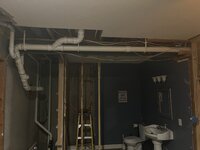
IMG_4605.jpeg
Please ignore the temp electrical runs, it’s work from the previous owner, who I suspect also cracked the stack, and will be redone shortly.

Any suggestions?
 
To avoid these ads, REGISTER NOW!

GrayFlattop

Well-known member
Joined
Jan 18, 2018
Messages
1,051
Location
Chicago
While demoing Sheetrock and framing in the basement for a sauna that we are going to build, I uncovered a section of horizontal run of the schedule 40 plumbing stack that has what appeared to be an old approx 12” crack in it.

IMG_4604.jpeg

I cleaned off the area, which was showing signs of old weepage, and have been keeping an eye on it. It looks stable and is showing no signs of dampness, odor, etc, but obviously it needs to be repaired. I am guessing the proper fix is to splice in a new section of pipe, but I thought I’d toss this question out to the plumbers here to see if they’d make any recommendations.

Here is a picture showing more of the area in question…
IMG_4605.jpeg
Please ignore the temp electrical runs, it’s work from the previous owner, who I suspect also cracked the stack, and will be redone shortly.

Any suggestions?
Replace that section. Easy-peasy. You’ll have to use a slip type pair coupling (without a stop inside).
 

BrandonV

Well-known member
Joined
Jun 9, 2023
Messages
4,030
Location
Arizona
It’s definitely a crack, not a scratch. I all but assumed that replacing the damaged section is the right approach, but thanks for confirming it. I Know what I’m doing tomorrow! Lol

Yup. Depending on your jurisdiction I'd feel okay even using a Fernco, no-hub or similar rated for PVC above-ground usage.
 

gizardlizard

Well-known member
Joined
Aug 29, 2019
Messages
727
Location
Madison, WI
Not sure how old the pipe is, but pvc does get brittle over time. Not as bad as Cpvc though. I work in a plastic injection molding plant and we have miles of 4” in our plant that was built in 1976. We’ve had to replace lots of pipe. Best suggestion I can give you: if possible, cut the pipe with a portable band saw and not a sawzall. We’ve had numerous sections of pipe crack again due to the brittle factor. The band saw is more forgiving to the pipe. Look close on the pipe and you can usually find a lot number and the date the pipe was extruded.
 

housewolf

Well-known member
Joined
Feb 3, 2021
Messages
1,144
Location
East Texas
Yeah, cut out that coupling and about 2-3’ of pipe and put a new piece in. I (with some assistance) could probably get it back together with just two PVC couplings. I’d probably use a 2x4 and pry from a joist onto that diagonal section on the left side. I’m hesitant to recommend that to someone that’s never done it because you could break a fitting somewhere. It appears to go vertical near the middle so it isn’t going to allow much play, unless maybe there’s some play on the right side(?).

You could use a PVC repair coupling without the stop but if that pipe has some bind on it and misaligns when you make the cut, you could get in trouble there too. It looks pretty well done so you’re probably safe there. Probably. Or if your cement sets up before you get the joint made up. A strap wrench (to twist while pulling) could come in handy if you go this route.

The sure bet would be to put it back together with a no hub coupling (rubber with SS shield/screw clamps). To a handyman they may seem second rate but probably 95%+ of the high-rises in the US have thousands of joints in them using no hub couplings on cast iron pipe. They work just as well on PVC.

I’d try (gently) prying on it first but if it got to the point it didn’t want to move enough, I wouldn’t hesitate to reassemble using a NHC. Good luck with it, it’s a pretty simple job. Just be patient with it.

Is that 3” or 4”?
 
Last edited:

rlitman

Well-known member
Joined
Oct 18, 2010
Messages
24,624
Location
Long Island
I would go with a pair of shielded no-hub couplings. But I would also suggest you secure the pipe more before doing any cutting. It's not that what you have isn't sufficiently supported, but once you have a section missing, it becomes much easier for parts of the pipe to move in unexpected ways, and that can lead to problems elsewhere. So, I would get a roll of strapping and first go to town locking everything in place.
 

BrandonV

Well-known member
Joined
Jun 9, 2023
Messages
4,030
Location
Arizona
I would go with a pair of shielded no-hub couplings. But I would also suggest you secure the pipe more before doing any cutting. It's not that what you have isn't sufficiently supported, but once you have a section missing, it becomes much easier for parts of the pipe to move in unexpected ways, and that can lead to problems elsewhere. So, I would get a roll of strapping and first go to town locking everything in place.

Yup. The biggest thing I see here is if you're not used to doing this sort of PVC repair work you'll find you have to work pretty quickly.

No-hub or similar fitting makes it a lot less stressful to get things aligned right. Not to mention as someone else pointed out they're used for a lot bigger and more important applications.
 

BrandonV

Well-known member
Joined
Jun 9, 2023
Messages
4,030
Location
Arizona
I've replaced some 1 1/2" and 2" shot with a nail gun and a 3" stack someone ran lagbolt thru without cracking. Everyone talks about PVC getting brittle but I've never experienced that myself with the exception of schedual 30 and 20 that was exposed to lots of direct sun.

I pulled up a bunch of 30-40 year old PVC from sprinkler systems in Arizona and I tried snapping them in two. A lot harder than I expected.
 

Jim greengo

Well-known member
Joined
Sep 3, 2018
Messages
7,415
Location
Behind my house
I've replaced some 1 1/2" and 2" shot with a nail gun and a 3" stack someone ran lagbolt thru without cracking. Everyone talks about PVC getting brittle but I've never experienced that myself with the exception of schedual 30 and 20 that was exposed to lots of direct sun.
Cpvc gets brittle,usually from exposure to cold.
 

RegeSullivan

Well-known member
Joined
Mar 30, 2014
Messages
695
Location
Canonsburg Pennsylvania (South of Pittsburgh)
Cpvc gets brittle,usually from exposure to cold.
Probably... but this is PVC. CPVC is more brittle than PVC from the get go. Every once in a while even new CPVC will snap on you when using an anvil cutter. Never had that happen with PVC except those thin traps and mostly they just crush/crease not break.
 

rlitman

Well-known member
Joined
Oct 18, 2010
Messages
24,624
Location
Long Island
I've replaced some 1 1/2" and 2" shot with a nail gun and a 3" stack someone ran lagbolt thru without cracking. Everyone talks about PVC getting brittle but I've never experienced that myself with the exception of schedual 30 and 20 that was exposed to lots of direct sun.
I've pulled some circa 1985, 1-1/2" schedule 40 PVC from my house that had gotten rather brittle, and had to repair one 45 elbow that had cracked in a wall. That 45 was part of a vent in an open wet wall, so it's not like it took an impact. My guess is it had some stress on it. Other similarly old pieces of PVC seemed just fine, though I wasn't going to risk re-using them.

Yes, UV certainly ages PVC faster. Just look at vinyl siding. Temperature also matters a lot.

Probably... but this is PVC. CPVC is more brittle than PVC from the get go. Every once in a while even new CPVC will snap on you when using an anvil cutter. Never had that happen with PVC except those thin traps and mostly they just crush/crease not break.
I've never had an issue with an anvil cutter and new PVC from the store AT ROOM TEMPERATURE. Can't say the same for old stuff.
 
To avoid these ads, REGISTER NOW!

carlaisle

Well-known member
Joined
May 14, 2022
Messages
379
Making that repair with PVC repair couplings for the inexperienced would be a challenge. 15 minute job with a couple of Ferncos.

That's not the cleanest install I've seen. Pipe could have been damaged before it was installed, could have sat outside for 10 years, who knows. One nice thing about cast iron is no one who installs it lives long enough to hear any complaints.
 

rlitman

Well-known member
Joined
Oct 18, 2010
Messages
24,624
Location
Long Island
Out of curiosity how would you connect lets say cast iron to PVC inside a house? Seems pretty common in commercial work. Fernco shielded couplings and similar.
The point as I understand it is that a "Fernco" is considered by plumbers to be a flexible rubber fitting that goes on with band clamps. That's because the brand name has become associated with the product that started the market they still dominate. But Fernco (the company) absolutely does make both above and underground rated couplings. Both can even be shielded. You just need to get one that is rated for aboveground use.
 

BrandonV

Well-known member
Joined
Jun 9, 2023
Messages
4,030
Location
Arizona
The point as I understand it is that a "Fernco" is considered by plumbers to be a flexible rubber fitting that goes on with band clamps. That's because the brand name has become associated with the product that started the market they still dominate. But Fernco (the company) absolutely does make both above and underground rated couplings. Both can even be shielded. You just need to get one that is rated for aboveground use.

That makes a lot of sense. I certainly use the term to refer to any form of coupler with a clamp but yes I suppose I've heard the term used mostly with those flexible rubber ones.
 
OP
S

sh944

ALLIANCE MEMBER
Joined
Jan 1, 2014
Messages
291
Location
Linwood, KS
I suspect the damage occurred when the previous owner finished the basement bathroom and he either tried to move it or pry against it. There was substandard framing around it that was sorta "tacked" to the joists. There is no obvious sharp impact point on it.

I found a *lot* of work that was "home owner" quality, not contractor quality. I don't mean that to be derogatory towards all home owners that do their own work as plenty are capable of doing quality work, but I work in commercial trades and there is a huge difference between "right" vs "wrong" and I am not sorry that I ultimately decided to take the bathroom down to the studs.

Its a 3" pipe, by the way.
 

mike93lx

ALLIANCE MEMBER
Joined
Dec 9, 2013
Messages
37,643
Location
Richmond, VA
I wonder if it cracked when the pipe was cut with a saw all, and the cut has grown over the years from heating and cooling cycles.
 
OP
S

sh944

ALLIANCE MEMBER
Joined
Jan 1, 2014
Messages
291
Location
Linwood, KS
And by the way, thanks for all the input here, I appreciate it.

My plan for later this evening is to cut and replace about 4' of the pipe, use a typical PVC coupling on one end and if most likely a slip coupler on the other as I do not expect it will have much give in the pipe to be able to use a second normal PVC coupling. I'll use a Fernco if I *have* to, but it wouldn't be my preference since its a horizontal run and I suspect rubber doesn't age as well as PVC, especially where soiled matter might collect at the seam.
 
OP
S

sh944

ALLIANCE MEMBER
Joined
Jan 1, 2014
Messages
291
Location
Linwood, KS
Assuming it was to begin with but the plumbing in the house has been pretty solid, aside from this. I should be able to get the pipe aligned so it maintains the same pitch as its pretty rigid in place already. I've done my share of remodels, repairs and installs over the years and I understand the concept of what rolls downhill. lol
 

no704

Well-known member
Joined
Apr 27, 2016
Messages
5,224
Align your slip coupling. Plug all drains and stack. Apply a shopvac to one drain and **** the glue into the coupling.
 

rlitman

Well-known member
Joined
Oct 18, 2010
Messages
24,624
Location
Long Island
Align your slip coupling. Plug all drains and stack. Apply a shopvac to one drain and **** the glue into the coupling.
PVC should be primed and fully glued before assembly. For a slip coupling, you can seek out a slower setting glue. Something that buys you a few extra seconds. That would be something like this. The slow-set cements I'm familiar with aren't the all-in-one self-priming type (these tend to set up pretty fast), so don't forget the primer.

ABSOLUTELY do not rely on a vacuum to pull glue in! Using a shop vac on your sewer lines is a bad idea on its own merits, plus it won't be able to create enough suction to pull any glue in anyway (since the line is vented), PLUS PVC really needs a fully glued joint to have any strength, so no amount of suction can sufficiently pull in the glue.

Keep in mind that normal PVC fittings have a tapered fit. Don't believe me? Get yourself an inside caliper, set it to the internal diameter of the fitting all the way in where the stop ridge meets the end of the pipe, and then look at how it widens as you move it out towards the opening. The idea is that the pipe will fit in loosely about half way, and then becomes an interference fit from there in. This is because PVC cement is not a great filler (if you section a cured joint, you will see that the dried cement is kind of foamy), so you want a TIGHT fit at least at the end of the pipe, and the cement lubricated pipe with it's softened primed surface will worm its way into the end, but if you don't hold the pipe in place for the few seconds it takes to set up, the tension will actually cause the pipe to slip back out and be loose.

For the slip coupling however, the ID is cylindrical and looser all around than a typical coupling. This requires gobs of cement to work reliably. I'd also suggest clamping a hose clamp on one side as a stop for the slip coupling, so you know when it's centered.
 

72Anthony

Well-known member
Joined
May 22, 2010
Messages
296
Location
Houston, TX
I'm not a plumber by any means.

If you do decide to repair with couplings and glue, I'd definitely recommend using the slow set glue as mentioned above. It also helps to have a second or third pair of hands to get it all in place.

My experience is using 4 inch schedule 40 pvc to extend some gutter outfalls. Use lots of glue on the slip fitting since it acts as lubricant to push the fitting all the way on the pipe, then slide it back across the joint before the glue starts to set up.
 

carlaisle

Well-known member
Joined
May 14, 2022
Messages
379
Gee, I'm wondering why, while simultaneously picturing the installer with a cigarette hanging from his lip while his face is in the middle of the cloud hanging over the lead melting pot.
The point I intended to convey, which may have flown too high, is that cast iron is generally expected to have a 100 year service life.
 

Jim greengo

Well-known member
Joined
Sep 3, 2018
Messages
7,415
Location
Behind my house
Probably... but this is PVC. CPVC is more brittle than PVC from the get go. Every once in a while even new CPVC will snap on you when using an anvil cutter. Never had that happen with PVC except those thin traps and mostly they just crush/crease not break.
Yep,that's why I said cpvc instead of pvc.
 

housewolf

Well-known member
Joined
Feb 3, 2021
Messages
1,144
Location
East Texas
Making that repair with PVC repair couplings for the inexperienced would be a challenge. 15 minute job with a couple of Ferncos.

That's not the cleanest install I've seen. Pipe could have been damaged before it was installed, could have sat outside for 10 years, who knows. One nice thing about cast iron is no one who installs it lives long enough to hear any complaints.
It’s not the “cleanest” I’ve seen either, but it’s far from a shoddy job. From what I’ve seen in residential plumbing (95% of my experience is large commercial), it’s way above average. I think it’s unlikely a plumber that is that neat with his cement and primer(?) would to fail to notice a cracked pipe.
 

rlitman

Well-known member
Joined
Oct 18, 2010
Messages
24,624
Location
Long Island
The point I intended to convey, which may have flown too high, is that cast iron is generally expected to have a 100 year service life.
I totally understood it. It's just my curmudgeonly way of venting about the number of times that cast iron has let me down. One was a crack just like the one above (60 year old 4" XXH iron pipe cracked almost a foot lengthwise coming out of a hub and oozed), one trashed a kitchen ceiling (75 year old sanitary tee started leaking), one spilled nastiness all over though didn't damage anything (less than 10 year old no-hub fitting started leaking), and one led to an insurance claim (90 year old house trap had a chunk of iron just FALL out leaving a hole you could stick a fist into and come back out clean).

All said though, I have a lot more positive experience with CI than I do with PVC, so at least in my experience, they're neck and neck. I just don't appreciate when either fails me, because wading in **** isn't fun.
 

mike93lx

ALLIANCE MEMBER
Joined
Dec 9, 2013
Messages
37,643
Location
Richmond, VA
I totally understood it. It's just my curmudgeonly way of venting about the number of times that cast iron has let me down. One was a crack just like the one above (60 year old 4" XXH iron pipe cracked almost a foot lengthwise coming out of a hub and oozed), one trashed a kitchen ceiling (75 year old sanitary tee started leaking), one spilled nastiness all over though didn't damage anything (less than 10 year old no-hub fitting started leaking), and one led to an insurance claim (90 year old house trap had a chunk of iron just FALL out leaving a hole you could stick a fist into and come back out clean).

All said though, I have a lot more positive experience with CI than I do with PVC, so at least in my experience, they're neck and neck. I just don't appreciate when either fails me, because wading in **** isn't fun.
I like cast iron for vertical runs through living spaces for noise control and pvc everywhere else
 
To avoid these ads, REGISTER NOW!
Top Bottom