To avoid these ads, REGISTER NOW!

Pole barn girt framing method

shamrock12

Well-known member
Joined
Dec 26, 2007
Messages
958
Location
South Dakota
Our 30' x 48' x 14' gambrel pole barn is being built in a couple weeks. There is one thing that still need to be worked out between us and the contractor. I wants a commercial girt (bookshelf) for increased capacity to hang heavy objects on T1-11 walls. There would be 2x6s laid horizontally between the posts and be spaced every 24 inches OC. It would be insulated with 22.5" batts of R-19s.

The contractor wants to do standard girt with 2x4s nailed on the side of posts, both outside and inside the barn, and use a large 8' blankets of insulation instead. This probably would help reduce the thermal break, but is there really that much of a difference?

If money is not an issue, which way should I go with? Thanks!
 
To avoid these ads, REGISTER NOW!

nehog

Well-known member
Joined
Jan 2, 2010
Messages
7,935
Location
Jaffrey, NH
... There would be 2x6s laid horizontally between the posts and be spaced every 24 inches OC. It would be insulated with 22.5" batts of R-19s.

The contractor wants to do standard girt with 2x4s nailed on the side of posts, both outside and inside the barn, and use a large 8' blankets of insulation instead. ...

If money is not an issue, which way should I go with? Thanks!
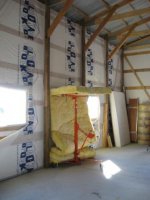
Though both are probably technically equal, I like your idea better because it slightly increases your inside space. As far as insulation, I don't think there is a big difference but one would have to do calculations to be 100% if the difference is significant or not.
 

Bennie

Well-known member
Joined
Jun 13, 2011
Messages
181
Location
Belle Plaine, MN
I paid $500 extra to do the 2x6 girts. That was the recommendation from my builder for what I was after. I've heard arguments both ways for insulation. My builder said he's opened up walls and seen the 8' wide insulation piled up on the bottom. :(

I haven't insulated or finished mine yet but I'm happy with the girt framing.
 

olytdi

Well-known member
Joined
Dec 3, 2011
Messages
2,202
Location
Olympia, Washington
I have the 2x6 version but live in a mild climate. I would think hard about the insulation values given where you live. There should be ways to ensure that the insulation remains in place. Sure, you'll give-up a little interior space but that can be made-up for in overall sizing. One thing's for sure -- do it the way you want with NO compromises and review carefully the older threads on "what I wished I did/din't do when I built my shop!"

Good luck!
 
OP
S

shamrock12

Well-known member
Joined
Dec 26, 2007
Messages
958
Location
South Dakota
Good point about the insulation ... the weight of 8' blanket does concern me too and makes me wonder if it could be problematic later in the future.

Would it hurt if the builder do standard girt on the outside only and then I do the bookshelf girt myself after the shell is up?

PS - the barn will have exterior wall wrap all around too.
 
Joined
Nov 21, 2007
Messages
613
Good point about the insulation ... the weight of 8' blanket does concern me too and makes me wonder if it could be problematic later in the future.

Would it hurt if the builder do standard girt on the outside only and then I do the bookshelf girt myself after the shell is up?

PS - the barn will have exterior wall wrap all around too.

You can do what your suggesting. My builder was going to put the building up and come back and put the bookshelf girts in after the building was up. But I wanted the 2x4's that go around the outside nailed into the bookshelf girts. So that is what he did. Not saying its any better but it's just how I wanted it done.
 

Highbeam

Well-known member
Joined
Feb 15, 2011
Messages
2,292
Location
Mt Rainier foothills, WA
I wants a commercial girt (bookshelf) for increased capacity to hang heavy objects on T1-11 walls.

This is not correct. The strong dimension of the girt is the tall way, not laying flat as bookshelf girts. You're girts are more likely to sag under weight if you hang things on them when they are built as commercial girts. The only strength benefit of commercial girts is that the wall is less likely to be blown in from wind.

I am a fan of standard girts on the outside. Do what you need on the inside to attach your inner finish which for me, means framing regular stud walls between the posts.
 

mtwaterguy

Well-known member
Joined
Nov 16, 2007
Messages
3,518
This is not correct. The strong dimension of the girt is the tall way, not laying flat as bookshelf girts. You're girts are more likely to sag under weight if you hang things on them when they are built as commercial girts. The only strength benefit of commercial girts is that the wall is less likely to be blown in from wind.I am a fan of standard girts on the outside. Do what you need on the inside to attach your inner finish which for me, means framing regular stud walls between the posts.

I'm not sure where you got this info, but you might want to do some research. First, commercial girts are better at preventing "racking" than standard girts that rely on the nails for support. Second the major benefit from commercial girts is the ability to frame both inside and outside walls at the same time. With both walls attached to the commercial girt there's really no way for it to sag.
 
OP
S

shamrock12

Well-known member
Joined
Dec 26, 2007
Messages
958
Location
South Dakota
You can do what your suggesting. My builder was going to put the building up and come back and put the bookshelf girts in after the building was up. But I wanted the 2x4's that go around the outside nailed into the bookshelf girts. So that is what he did. Not saying its any better but it's just how I wanted it done.

Funny, that is exactly what I am thinking too. Of course, that is if I get the bookshelf in before they put the exterior liner on! :cool:

The barn will be built on a flatland in South Dakota so you guess it ... WINDS!! The contractor is already a month behind schedule because of weather, mostly the winds. So it sounds like having a commercial girt, in additional to standard girt on the outside nailed together would benefit well.
 

mtwaterguy

Well-known member
Joined
Nov 16, 2007
Messages
3,518
I'm sitting on a bench here in western Montana. Lot's of wind. My building, with commercial girts, has been up for over 10 years now. Not one problem. I think girts on the outside of the post are a waste of time and money.
 
OP
S

shamrock12

Well-known member
Joined
Dec 26, 2007
Messages
958
Location
South Dakota
I'm sitting on a bench here in western Montana. Lot's of wind. My building, with commercial girts, has been up for over 10 years now. Not one problem. I think girts on the outside of the post are a waste of time and money.

I'm really leaning toward doing commercial girts now; however, I heard that having some dead air space between the insulation and exterior liner would benefit in some way. I suppose with ventilation to help the insulation breathe and to keep the condensation from the metal liner getting them wet?
 

mtwaterguy

Well-known member
Joined
Nov 16, 2007
Messages
3,518
I used tyvek between the posts and the siding. There is a small air gap between the insulation and the tyvek.
 
OP
S

shamrock12

Well-known member
Joined
Dec 26, 2007
Messages
958
Location
South Dakota
Thanks everyone. I think I'm going to have a commercial girt done as well as standard girt at the exterior as well. I have another question here though if you guys dont mind ... I plan to have Tyvek/housewrap installed too. Should I install Tyvek so that they will staples flat against the posts before nailing standard 2x4s girts? That would means the Tyvek will be right next to 6" of R-19s which would be a good thing or not?
 

mbatarga

Well-known member
Joined
Sep 14, 2005
Messages
883
Location
GA
I'd like to see pictures to understand the choices being discussed - as a shop build is in my future.
 

Steroblan

Well-known member
Joined
Jan 31, 2012
Messages
259
Location
Northern Calif
Put the tyvek against the girts like you would on standard stick framing otherwise the girts ar not protected. Use stainless staples or they will rust out pretty quick and the tyvek will sag.
 

Flexia

Well-known member
Joined
Mar 8, 2013
Messages
215
Location
Akron/Canton Ohio

Thar seems to have outside 2x4 girts with 2x6 shelf nailed on in between the post. A true flush frame doesn't have the outside girts. It uses the shelf girts for siding or sheeting nailing

I am in the process of designing mine. The only things I am unsure of are how the skirt board and bearing plates are mounted to be flush. Maybe someone can post some info on that.
 
Last edited:

kbs2244

Well-known member
Joined
Nov 11, 2006
Messages
14,065
In the end,
You are going to be living with what you are building.
Your builder is going to cash his check and move on.

Do it your way.
Of course, then you have no one to blame but yourself.
 
To avoid these ads, REGISTER NOW!

bigguns69

Well-known member
Joined
Aug 23, 2011
Messages
411
Location
Iowa
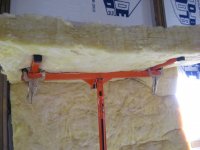
This is what I did several years ago for my 36'x50'x15' building. 2" x 6" girts on the outside, 2' x 4' girts on 2' center on the inside, 1.5" styro-foam board cut and fit between exterior girts, house wrap, 6" non faced batt insulation 6' wide x 15' tall hung on the interior side of the exterior girts, finished with painted 7/16" OSB plywood. The walls are solid and tight. Have cabinets hung on the interior 2" x 4" with no sag. My poles are 6.25' on center. A few hundred bucks for extra wood in poles, upgraded trusses and girt quantity goes along way in increasing strength. From an engineering standpoint, face mounted girts are much stronger than bookshelf mounted girts because the fastners are in shear, perpendicular, rather than pull via toe-nailing mounting, which also has a tendency to split the wood. Also, book shelf girts give you a smaller target for screwing the outside steel to. I built my building myself and these are my reasons/observations for what I did.

My 2-cents
 

Attachments

  • insulating inside of building 004a.jpg
    insulating inside of building 004a.jpg
    31.4 KB · Views: 410
  • insulating inside of building 005a.jpg
    insulating inside of building 005a.jpg
    80.4 KB · Views: 339
  • insulating inside of building 006a.jpg
    insulating inside of building 006a.jpg
    93.4 KB · Views: 326
  • IMG_3343a.jpg
    IMG_3343a.jpg
    39 KB · Views: 421

mtwaterguy

Well-known member
Joined
Nov 16, 2007
Messages
3,518
From an engineering standpoint, face mounted girts are much stronger than bookshelf mounted girts because the fastners are in shear, perpendicular, rather than pull via toe-nailing mounting, which also has a tendency to split the wood. Also, book shelf girts give you a smaller target for screwing the outside steel to.

This is actually incorrect. Face mounted girts are weaker because the fasteners, the nails, are all that are preventing movement, where as in a bookshelf type girt system the 2x's inside the posts strengthen the building.

If needed, a chalk line can improve your accuracy. If you can hit a 2x stud in a standard wall, it's not a problem in a bookshelf framed situation.
 

bigguns69

Well-known member
Joined
Aug 23, 2011
Messages
411
Location
Iowa
I disagree, but to each their own. Toe-nailing splits the wood all the time, then the joint is compromised. Put some tension on those fastners in a toe-nail joint and they will pull through the book shelf girts, then the joint is loose and any strength with the material inside the posts is gone. Shear strength of the fastner will always beat the pull force of the fastner unless its a bolted joint. Because I do my own work, I use deck screws any ways to pull the joint tight. Either way will work and the cost difference between the two will be negligable in the grand scheme of things.
 

Highbeam

Well-known member
Joined
Feb 15, 2011
Messages
2,292
Location
Mt Rainier foothills, WA
This is actually incorrect. Face mounted girts are weaker because the fasteners, the nails, are all that are preventing movement, where as in a bookshelf type girt system the 2x's inside the posts strengthen the building.

If needed, a chalk line can improve your accuracy. If you can hit a 2x stud in a standard wall, it's not a problem in a bookshelf framed situation.

I too disagree. The only way that commercial girts are stronger is with regards to wind loading from the side. I don't see a problem with buildings blowing over. With gravity loading from cabinets or other loads, the face mounted girts are superior. It's really basic engineering. When you lay a 2x4 on the flat across two logs and walk on it, the 2x4 bends a lot. If you can lay the 2x4 on edge it is much stronger.

Not sure why you don't understand this basic priniciple.
 

mtwaterguy

Well-known member
Joined
Nov 16, 2007
Messages
3,518
I too disagree. The only way that commercial girts are stronger is with regards to wind loading from the side. I don't see a problem with buildings blowing over. With gravity loading from cabinets or other loads, the face mounted girts are superior. It's really basic engineering. When you lay a 2x4 on the flat across two logs and walk on it, the 2x4 bends a lot. If you can lay the 2x4 on edge it is much stronger.

Not sure why you don't understand this basic priniciple.

Because gravity is not the problem, it's the constant wind try to rack the building. Never seen a building collapse from gravity but Ive seen many fall over do to racking. Perhaps you should check with a building engineer, like I did and he'll explain it to you. In addition to a stronger building you also frame I/s and O/S walls at the same time. People building their own structure, that work for free might not see this as a plus however. I've built four shops this way. I don't have girts splitting, we use blocks to support the ends and use them as nailers.
 

Highbeam

Well-known member
Joined
Feb 15, 2011
Messages
2,292
Location
Mt Rainier foothills, WA
Perhaps you should check with a building engineer, like I did and he'll explain it to you.

Funny you should say that. I am looking at my Professional Engineer stamp right now.

Both ways will and have worked for thousands of structures but don't fool yourself into thinking that a board is stronger when loaded on the flat. That's just silly.

You seem to be more concerned with wind loading when the OP and I are using the interior wall for hanging stuff and fighting gravity.
 
Last edited:

mtwaterguy

Well-known member
Joined
Nov 16, 2007
Messages
3,518
Wow. Just what do you think makes a building fall down and not fall up?

Gravity definitely determines the direction the structure goes after it fails, but how many times have you seen gravity as the cause of the fail?
 

MagKarl

Well-known member
Joined
Oct 15, 2012
Messages
684
Location
Olympia, WA
I think some of you are misinformed about how bookshelf girts should be installed. Toenailing is no good. No argument there.

Pressure blocks of 2x6, 22.5" long are nailed to the post, filling the space between girts. This gives you blocks to nail the girt to in both directions and prevents twisting. Now your wall structure is 5.5" thick instead of 1.5".
 

rieferman

Well-known member
Joined
May 18, 2009
Messages
2,586
Location
Collegeville PA (30 min west of Philly)
When I worked in the industry, I talked to the bosses about bookshelf girts and why we didn't use that method. His answers were:
- Both methods are very strong, so he considered that a non-factor in the decision.
- Face girts are very fast to install, time is money.
- Finding the girts reliably when fasting the siding is fast and basically fool proof with face girts. Again, time is money.
- When finishing the interior, installing interior face girts (often called "re-girts") is again fast and easy.
- Since we used minimum 6" posts, the cavity between exterior and interior girts creates a wide space for maximum insulation.
- Continuous insulation is more effective and efficient than having framing members break it up and transmit temperature.
- The two sets of girts add a dead air space in addition to the insulation, which is again good for insulating properties.

I'm not saying this is the gospel, and there's lots of good ways to build stuff. Just passing along words of wisdom from my former boss who has owned a large pole barn company for over 30 years. Hope it's helpful.
 

jomobco

Well-known member
Joined
Nov 12, 2010
Messages
436
Location
Denver, CO
I think some of you are misinformed about how bookshelf girts should be installed. Toenailing is no good. No argument there.

Pressure blocks of 2x6, 22.5" long are nailed to the post, filling the space between girts. This gives you blocks to nail the girt to in both directions and prevents twisting. Now your wall structure is 5.5" thick instead of 1.5".

Exactly. You are T-ing your outside girts which makes them stronger. It also allows you to not have a 14' run of insulation vertically (assuming you have a 14' ceiling) which is what the OP was talking about seeing piling up inside the wall. With a shelf girt the pull on the insulation is much less (as the insulation runs horizontally) and you have the 2x6 shelf with which to attach the shop interior. Pics of girts are on my profile.

Edit: Not saying this is stronger but by T-ing the girts instead of having an inside horizontal girt and an outside horizontal girt seems like it wouldn't be as strong as having the T-'d bookshelf girts.
 
Last edited:

suavilica

Member
Joined
Dec 12, 2019
Messages
6
Location
Molt MT
I had a builder just told me Standard Girt is better for high winds than Commercial Girt. Is that a true statement?

Can I do both? We do get wind gusts in 80's where I live occasionally. Also, my pole barn will have a finished attic room upstairs for my business. Lots of weight. Doing both might be the best?
 
Last edited:

tapout187

Well-known member
Joined
Dec 17, 2010
Messages
103
Location
New Jersey
I did all bookshelf girts in my garage. The builder did the standard 2x4s on outside of posts to attach siding to. It was a little costly buying all the lumber but I like it and I just finished the rough wiring and the girts helped for a clean install.
 

Attachments

  • 74141A8E-D481-4B9C-B51E-ABC64D0C809B.jpg
    74141A8E-D481-4B9C-B51E-ABC64D0C809B.jpg
    82.3 KB · Views: 247
  • 9BF31346-D6D3-4975-A8BD-F0CEA549F28E.jpg
    9BF31346-D6D3-4975-A8BD-F0CEA549F28E.jpg
    138.5 KB · Views: 235
  • 482F0810-1A2F-4CCE-9E8C-22CB8384B328.jpg
    482F0810-1A2F-4CCE-9E8C-22CB8384B328.jpg
    100.8 KB · Views: 265

suavilica

Member
Joined
Dec 12, 2019
Messages
6
Location
Molt MT
Wow Tapout187 Looks real nice! So you end up doing both. That's what I am thinking. When I talk to my builder I will see what he says. So you ran your wires behind the posts then? That makes it much easier. Is that white stuff insulation foam? Still going to use batts in your bookshelves? Thanks!
 

jives

Well-known member
Joined
Jan 4, 2013
Messages
2,803
Location
Central NY
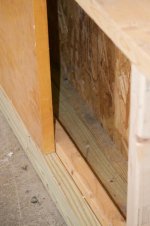
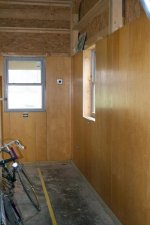
I also did bookshelf with the outside "normal" 2 x 4 girt. Note a couple of things here. One, the bookshelf girt is not toe-nailed to the post. They are nailed to blocks, which are nailed to the posts. Second, the outside 2 x 4 girt to hang the siding on (I used OSB with Tyvek and then metal) enables a gap to run wiring. Otherwise the electrical goes on conduit on the finish wall, or a hole is cut in the post. Regular 24" wide fiberglass bat insulation went in between the girts.

Yes, added lumber cost, but in my mind this is the way to do it. . .I would have kicked myself for not doing it my own way.

Bottom Girt 2.jpg
Bottom Girt.jpg
Wall Panels.jpg
 
Last edited:

tapout187

Well-known member
Joined
Dec 17, 2010
Messages
103
Location
New Jersey
Thanks I appreciate it! The white is the double bubble insulation stuff, it’s like a tin foil looking layer on the outside. Yea I’ll admit I did run some wires, 12/2 for some of the wall outlets behind posts. It’s technically cheating but oh well it’ll never be a problem. And yes a big reason I did the book shelf girts (2’ OC) was to run 2’ batts sideways between the girts and later attach probably osb to. But for the most part the wires go from panel up into trusses and run along those until they drop down their spot at wall.
 

Attachments

  • F28E7313-628F-4CC0-8F02-BA041EA68BD8.jpg
    F28E7313-628F-4CC0-8F02-BA041EA68BD8.jpg
    89.5 KB · Views: 184
  • C3B06EBB-34B3-4720-999F-A6BA86D9DB07.jpg
    C3B06EBB-34B3-4720-999F-A6BA86D9DB07.jpg
    55.3 KB · Views: 199
Last edited:

suavilica

Member
Joined
Dec 12, 2019
Messages
6
Location
Molt MT
Jives - Wow! You went above and beyond!!! Your wood panels giving me a better ideas here. How do you like it? With 2' OC do they feel weak and soft in the middles? Those panels seems like cost as much as a Sheetrock that might be it for me. Instead of Sheetrock use them. I just don't want them to be to weak in the middle...Thanks for sharing!!!
 
To avoid these ads, REGISTER NOW!
Top Bottom