To avoid these ads, REGISTER NOW!

Pole Pig Transformers

Steve from Socal

Well-known member
Joined
Jan 27, 2009
Messages
3,491
Location
Hutchinson Ks.
We have some folks here who do industrial work and I hope they will chime in. We are looking at a building with 600 amp service, the utility power comes off the pole to three transformers in a rack. We don't know the age of the transformers but, the building dates from the mid 1970's. Our understanding is these are owned and it would be our responsibility to replace them if they fail. They are 300KVa or there about. Any way to determine the status of these and how long they should last?

Steve
 
To avoid these ads, REGISTER NOW!

malibu101

Well-known member
Joined
Jul 1, 2005
Messages
3,908
Location
Walnutport PA
Can't directly answer your question but I can add another thing to your list.
Alot of old transformers had PCB's for the dielectric cooling fluid in them.
I don't know how to tell if yours do or what kind of hazardous fees would be involved with their disposal.

Good luck with the building you're looking at! With a 600 amp 3 phase service it must be a pretty nice shop.
 

Alchymist

Well-known member
Joined
Mar 1, 2009
Messages
4,423
Location
Central PA
Just to replace the transformers will cost in the thousands, and if they contain PCB type oil, mucho bucks for disposal. If no PCBs, run them till they die, probably last a long time. Spectacular fireworks if one fails tho. Could also have the POCO change service to standard if eliminating transformers - probably putting transformers on the poe outside. Big bucks there also.

Thinking of buying building - check if PCB first, becomes negotiating point.
 

ptschram

Well-known member
Joined
Sep 8, 2006
Messages
2,573
Location
Churubusco, IN
They will last a LONG time. 40 years is nothing for a transformer.

I worked for Indiana Michigan Power Company from '92 to '95 as an environmental specialist. While my job was to manage the response to the explosions when they let go, they rarely did that without an outside factor like a squirrel or lightning hit.

I would suggest there are bigger things to worry about.

Now, that said, the property owner is responsible for disclosing any "Known' issues. It's not uncommon for folks to not want to ask such questions as if the answer is not what they might want to hear, they are now responsible for divulging that info, or correcting what they might find.

edit-even if they do contain PCBs, there is no requirement to do anything about it until such time as they are breached and a release occurs.
 

Jarcese

Well-known member
Joined
Aug 17, 2010
Messages
194
Location
Boston, MA
I Don't know how your utility works, but if the transformers are yours then they are most likely beyond a primary meter which means you also own the wire and the poles beyond that meter so you might want to include that in your maintenance costs. Three 300's is more than you need for 600 amp. You must mean three 100's? Most of the transformers that have PCB's are a real dark grey. They stopped using PCB's in the 70's(Wiki says 1979). If they are original to the building then there is a chance that they have PCB oil. Newer transformers(the last 15 years or so) have a blue sticker that says non-PCB that you can see from the ground, but it doesn't mean that there are PCBs if there is no sticker. Like malibu101 said, you will be spending a lot of money to get rid of them if they fail and you will be spending more than double if they have a catastrophic failure.

Also, you can't just have any old commercial electrician come fix it when it breaks. You will need lineman which means more money spent for the tools and trucks needed to maintain/change them. Some utilities will work beyond metering but they charge hourly at around 350-500$.

On the other hand, transformers are usually pretty durable and they rarely fail without something else causing the problem such as animals or constant overload.

I think average price for a 100kva is around 1000 to 1500$ not including labor.
 

Stuart in MN

Well-known member
Joined
Sep 8, 2005
Messages
23,044
Location
Minneapolis
I've never heard of those transformers belonging to anyone except for the serving electric utility, but I suppose it's possible. I'd make a call to the utility to find out for sure.
 

foolishpride

Well-known member
Joined
Mar 21, 2009
Messages
343
Location
Southwestern Ohio
Read the nameplate on the transformers. If it says the fluid is Askarel, it's pure PCB. But I doubt this is the case. It will probably be mineral oil, but there is a remote chance it could be PCB contaminated, meaning more than 50 PPM. You could have the insulating fluid in them sampled and tested at a lab to know for sure.

It would also help assess the condition of the transformers if the lab ran some other tests, like Dissolved Gas Analysis and Dielectric Strength.
 

Jarcese

Well-known member
Joined
Aug 17, 2010
Messages
194
Location
Boston, MA
Depends on where the metering is. If the metering is on the secondaries at the building, then they would be the utilities transformers. If they are metered on the primary before the transformers then all primary equipment beyond the primary metering belongs to the customer. That's how things work around here, but everyone knows that rules are different depending on the company so take it for what it's worth.
 

dittle fart around

Well-known member
Joined
Jan 9, 2011
Messages
2,455
Location
Vancouver, Washington, USA
Grey almost always indicates built after PCBs were phased out. If they are black, they are assumed to be PCB+.
Pole transformers are painted different colors in different areas. Some locations have light blue transformers, some gray. All transformers require labeling as to the pcb content. If they are built before 1978 and say no PCB that means less than 50 ppm. That was the law before 1978, after that date the EPA changed the rule to state no PCB content meant less than 1 ppm.
 

Jarcese

Well-known member
Joined
Aug 17, 2010
Messages
194
Location
Boston, MA
I think we're thinking the same color. I'm talking about a very dark grey, almost black or sometimes black, not the silver grey that is most common with newer transformers. Cast iron is a sure giveway that it has PCBs as well. Like the post above says, they come in all shapes, colors, and sizes and the only real way to tell if it doesn't have a tag is to test it.

Doesn't really matter anyway until it has to be changed.
 

malibu101

Well-known member
Joined
Jul 1, 2005
Messages
3,908
Location
Walnutport PA
I didn't want to edit my original post so I'll say it here, like someone said above...
The potential of having to dispose of a PCB transformer only comes into play if the transformer dies. As was said too above, they normally last a long time unless a outside force causes it to fail. Like a lightning hit or squirell attack.

In my area "large" transformer ownership goes both ways. Often time the POCO owns them and charges you for secondary service at a higher rate than primary service where you own the transformers but pay a lesser rate.
 
OP
S

Steve from Socal

Well-known member
Joined
Jan 27, 2009
Messages
3,491
Location
Hutchinson Ks.
OK,

Here is what I can tell you about the transformers, they are a light gray color, they are being tested for PCB and the condition of the fluid. As far as we know, they are part of the building. There is a weather head that goes from the pole to a conduit that runs to these transformers. The meter "looks" like it is at the point where the weather head is.

Steve
 

malibu101

Well-known member
Joined
Jul 1, 2005
Messages
3,908
Location
Walnutport PA
OK,

Here is what I can tell you about the transformers, they are a light gray color, they are being tested for PCB and the condition of the fluid. As far as we know, they are part of the building. There is a weather head that goes from the pole to a conduit that runs to these transformers. The meter "looks" like it is at the point where the weather head is.

Steve

Great, the oil anaylisis will tell you if they are PCB or not and the anaylisis of condition will let you have as much info as possible.

What you are describing is a CT meter. If the rings around the wires (CT's) are on the high voltage wire you most likely own everything past them.

But I guess you know that or you wouldn't be the one getting the oil tested.
 

ptschram

Well-known member
Joined
Sep 8, 2006
Messages
2,573
Location
Churubusco, IN
Great, the oil anaylisis will tell you if they are PCB or not and the anaylisis of condition will let you have as much info as possible.

What you are describing is a CT meter. If the rings around the wires (CT's) are on the high voltage wire you most likely own everything past them.

But I guess you know that or you wouldn't be the one getting the oil tested.

CT-current tap. A means of allowing the power company to measure power used in an indirect manner-usually due to high current demands by customer.

Not to be confused with VT metering, voltage transformers, used for high voltage demand customers.
 

Tscott

Well-known member
Joined
Oct 17, 2006
Messages
1,484
Location
Keystone Heights, FL.
Get with the utility and have them tell you who they belong to. If they are part of the building then they may be a huge liability. You will need to make sure access to them is limited to only qualified personnel, and if someone gets hurt or killed, it may be no good for you. They used to do a ton of weird stuff back before the safety rules were as strong as they are today. I have come across some pretty sketchy stuff on our system. 600A is not a huge service, and it may be possible to convert it to a more standard install with a either a CT meter or even a larger self contained meter. The utility would just need to set you a new transformer bank on their pole and you could just re-terminate your existing wires in a locked disconnect enclosure. If PCB's are found that could get pricey.

Good luck

Tom
 

porcupine73

Well-known member
Joined
Jan 22, 2008
Messages
576
Location
Buffalo, NY USA
Sometimes they go with the building if they wanted to get a lower utility rate by accepting power at the line voltage.

Another thing that can bite sometimes is the short circuit capability on those. Larger transformers have a lower impedance and thus higher short circuit capability. If the panels inside were ever replaced or need to be replaced that is an important consideration.
 

foolishpride

Well-known member
Joined
Mar 21, 2009
Messages
343
Location
Southwestern Ohio
CT-current tap. A means of allowing the power company to measure power used in an indirect manner-usually due to high current demands by customer.

Not to be confused with VT metering, voltage transformers, used for high voltage demand customers.

Uh, not quite. CT stands for current transformer. They are used to step the current down to a useful value so a meter, or relay can monitor it.

VT, or more commonly used word PT, is indeed a voltage transformer, but it has nothing to do with high voltage demand. :confused: PT's are used to step the voltage down to a useful value so a meter, or relay can monitor it.
Electricity is sold on Watt Hours or Kilowatt Hours. So Kilowatt hour meters need voltage and current supplied to them. This is where the CT & PT are utilized.
 

Terry454

Well-known member
Joined
Jan 22, 2011
Messages
106
Location
Illinois
PT = pot = Potential Transformer Their use is explained by foolishpride.

CT = current transformer As has been stated

The rest porcupine73 has right. Get with the utility and settle the issue once and for all.
 
To avoid these ads, REGISTER NOW!

porcupine73

Well-known member
Joined
Jan 22, 2008
Messages
576
Location
Buffalo, NY USA
I remember a case a teacher at the GE Relay Coordination class was telling us. Something like the utility gave the transformers to the building owner for some reason and the building owner went along with it. Then they told them the transformers were something like 1% impedance and to assume an infinite bus upstream. So the short circuit rating at the panels in the building had to be over 200,000 amps, which of course they were only 60,000 or 100,000 I think.

Have heard of some cases where the utility does own the transformers but they are still secondary metered (sometimes they want a metering cabinet or space for their metering equipment in the customer's panel), seems to kind of depend on the utility/locality.
 

Jarcese

Well-known member
Joined
Aug 17, 2010
Messages
194
Location
Boston, MA
None of our transmission lines have 200,000 amps of potential fault current. That kind of current will melt any wire before a breaker trips. 200,000 amps of fault current in a building is not going to happen.

If I were scoping out the building then I wouldn't even factor in the maintenance on the transformers if you like the building. As long as you have the size service that you need for the business, then I wouldn't worry about anything on the outside. You may never need to fix anything. Although you may be looking at paying 500 bucks to re-fuse from a squirrel or lightning and over 2000 for a new transformer.

I would make sure you know who to call when something does break if it belongs to you. We used to do work for people beyond a primary meter and charge a good amount of money to do it, but we don't have enough people to do that any more. Your utility may be different. The way things work here is that if something happens beyond a meter you can call us, but if it's not something simple like a limb or squirrel, then we tag the cut-outs and take the doors with us. Then you call us after repairs are made and we will take a look at what has been done. Then you get your power back. Again, that's the way the company I work for does it so call your utility before you make any purchase to figure out how they operate. Most companies have their terms of service on a pdf file on their website.
 

W-Cummins

Well-known member
Joined
Jan 9, 2006
Messages
1,639
Location
Iowa
Oh boy at 300kva each ( if they are that big) your in for a nice big power bill to keep them warm, if they are on your side of the meter!! For me I wish I had all the transformers on the utilities side as they get the electrons wholesale, and I get to pay retail to keep them warm:-(

William.....
 

Tscott

Well-known member
Joined
Oct 17, 2006
Messages
1,484
Location
Keystone Heights, FL.
Will has a good point here. Line losses may well be a factor with these units. This is something to consider along with the many other point posted above.

Tom
 
OP
S

Steve from Socal

Well-known member
Joined
Jan 27, 2009
Messages
3,491
Location
Hutchinson Ks.
OK,

I am in Hutch and looked at these in person, talked to an engineer at Westar and this is what the deal is. They are 100 KVA 480-240 that were used in the building for ? I will turn them off and let them sit as we have no need for them.

The building had several welders and plasma systems that were using these. There are three 100 KVA transformers on the pole so we are good to go up to the 600 amp service that was here before. We will be turning the power on at 200 amps initially. The big consumer will be the 60 HP compressor, the next highest motor load is 25 HP.

Steve
 

W-Cummins

Well-known member
Joined
Jan 9, 2006
Messages
1,639
Location
Iowa
OK,

I am in Hutch and looked at these in person, talked to an engineer at Westar and this is what the deal is. They are 100 KVA 480-240 that were used in the building for ? I will turn them off and let them sit as we have no need for them.

The building had several welders and plasma systems that were using these. There are three 100 KVA transformers on the pole so we are good to go up to the 600 amp service that was here before. We will be turning the power on at 200 amps initially. The big consumer will be the 60 HP compressor, the next highest motor load is 25 HP.

Steve

That makes more sense, so your getting 3 phase 480V from the power co. Is that system your thinking of not running providing all the 240v service for the building?? If so you will need another transformer for your 240v needs and your single phase 120v stuff too. IF you need another transformer I can give you a hell of a good deal on a brand new 112kva 3 phase 480v-208/120v K rated, all copper wound one that is surplus to my needs!

William....
 

porcupine73

Well-known member
Joined
Jan 22, 2008
Messages
576
Location
Buffalo, NY USA
Sometimes you have to check with the utility to see what the largest motor they allow to be started across the line. I've seen some areas where they say you must have a soft starter or reduced voltage starter on anything over 5 HP, but that's usually when the line is a long distance and also feeds a residential area. Then sometimes the motor must be allowed to have an unloaded start or it might not have enough torque in the startup curve to get up to speed if loaded.
 
OP
S

Steve from Socal

Well-known member
Joined
Jan 27, 2009
Messages
3,491
Location
Hutchinson Ks.
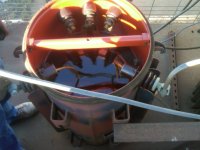
I just got back from Hutch and did an inspection of these transformers. They date from 1958 so they most likely had PCB at one time. The guy who came to sample the oil "must" have known something because first, these were like new under the lid and, he was very casual about the oil. I also found out that these were put in while the service was operated by Kansas Light and Power. Westar the company now providing service bought KL&P and, a fly on the wall told me they may be responsible for them. The serial numbers have been forwarded to a party that may be able to get some action.

Here are a few pictures.

Steve
 

Attachments

  • 003.jpg
    003.jpg
    130.5 KB · Views: 133
  • 004.jpg
    004.jpg
    133.3 KB · Views: 117

W-Cummins

Well-known member
Joined
Jan 9, 2006
Messages
1,639
Location
Iowa
If they had PCB's in them they still do, it wouldn't be cost effective to clean them to the 1ppm spec if they had any in there to begin with. If you don't need them I would have them removed at the sellers expense before you take possession of the building.

William....
 

Roots

Well-known member
Joined
Oct 31, 2010
Messages
1,788
The guy who came to sample the oil "must" have known something because first, these were like new under the lid and, he was very casual about the oil. I also found out that these were put in while the service was operated by Kansas Light and Power. Westar the company now providing service bought KL&P and, a fly on the wall told me they may be responsible for them. The serial numbers have been forwarded to a party that may be able to get some action.

Unless there's internal arcing or extensive gassing from the transformer beginning to fail, they're almost always like new when you open them up. As for the casual attitude about the oil, it's fairly common amongst people whom work with them. I'd be rather amazed if Westar or KL&P are responsible for them, even with them having installed them, if they were put in for a customer. Although, it's worth calling to see if they'd dispose of them for you, which they very well may.

While it might be prudent to retro-fill them if they're already cracked open, they'd still have to be treated as PCB in the event of a spill or disposal as lab analysis from samples are only valid for one year. The core of the transformer will hold onto PCB's during a retro-fill, and than slowly leach them out over time back into the oil, although there will be a significant reduction.

FWIW if there is no sewer drain nearby, and they're in a concrete contained area, I doubt I'd ever worry about them. Although concerns over them might be worthwhile to use as a bit of leverage while negotiating on the property purchase price.
 
Last edited:
OP
S

Steve from Socal

Well-known member
Joined
Jan 27, 2009
Messages
3,491
Location
Hutchinson Ks.
Bringing this back with test data on the oil sample.

The lab tested the oil and found less than 2PPM of PCB using EPA 8082 as a method of testing.

The wording of "less than 2 PPM" is confounding, is the level within the parameters of being PCB free or, do we still have to consider these contaminated?

These will be mothballed for the time being due to the idle current draw and our low demand for 240 three phase. The issue is do we just let sleeping dogs lie or should we replace them. The low voltage three phase and single phase power we need to run through transformers is low, 75-100 KVa or so at most.

Steve
 

porcupine73

Well-known member
Joined
Jan 22, 2008
Messages
576
Location
Buffalo, NY USA
Usually on an analytical result where it says 'less than' it means the value obtained from the test was less than the LDL (lower detectable limit) of the device used in the test. So the analysis method might not be able to say no PCB was found or 1 ppm was found; the lowest it can say with certainly might be less than 2 ppm.
 

foolishpride

Well-known member
Joined
Mar 21, 2009
Messages
343
Location
Southwestern Ohio
Bringing this back with test data on the oil sample.

The lab tested the oil and found less than 2PPM of PCB using EPA 8082 as a method of testing.

The wording of "less than 2 PPM" is confounding, is the level within the parameters of being PCB free or, do we still have to consider these contaminated?

These will be mothballed for the time being due to the idle current draw and our low demand for 240 three phase. The issue is do we just let sleeping dogs lie or should we replace them. The low voltage three phase and single phase power we need to run through transformers is low, 75-100 KVa or so at most.

Steve

You're good to go then. It is considered Non-PCB in the eyes of the EPA since it's less than 50 PPM.

I wouldn't replace them, unless the insulation resistance of the transformers was low. Do you know anyone with a Megger, or Insulation Resistance Tester that could test them? Are these transformers energized at this time? It would be best to leave them energized even when not in use.
 
OP
S

Steve from Socal

Well-known member
Joined
Jan 27, 2009
Messages
3,491
Location
Hutchinson Ks.
The transformers are energized; the idle current is a concern as the load on single phase is really low at present and near future. The lighting in much of the building is 277 volt off the 480 side and we will probably have less than 25KVa 120 volt load for quite a while. Going to a small dry transformer 50-100KVa was our first thought. Once the transformers are saturated they still use a fair bit of current I thought? These are three 100 KVa transformers by the way, our needs would be a third of that capacity at the most.

Steve
 
OP
S

Steve from Socal

Well-known member
Joined
Jan 27, 2009
Messages
3,491
Location
Hutchinson Ks.
Just to replace the transformers will cost in the thousands, and if they contain PCB type oil, mucho bucks for disposal. If no PCBs, run them till they die, probably last a long time. Spectacular fireworks if one fails tho. Could also have the POCO change service to standard if eliminating transformers - probably putting transformers on the poe outside. Big bucks there also.

Thinking of buying building - check if PCB first, becomes negotiating point.
jh2.jpg

2.jpg

Did you read any of the posts; these are 480-240, the issue is not that they work but they have a high parasitic draw. I can buy a 50 KVa dry transformer for well under 1000 bucks.

Steve
 

W-Cummins

Well-known member
Joined
Jan 9, 2006
Messages
1,639
Location
Iowa
I can buy a 50 KVa dry transformer for well under 1000 bucks.

Steve

True but you could get my better model for only $1200 :thumbup::thumbup: New price from the wholesale place is about $4k for a non K rated, copper transformer. The K13 rated model was a custom order item so I didn't even price it! BTW you have to use enough transformer to supply your panel as its main breaker is rated for, so unlike the Power Co. you can't get away with a 12 kva can feeding a 200 amp panel, you need a 75kva for that!

William.....
 

Alchymist

Well-known member
Joined
Mar 1, 2009
Messages
4,423
Location
Central PA
Just to replace the transformers will cost in the thousands, and if they contain PCB type oil, mucho bucks for disposal. If no PCBs, run them till they die, probably last a long time. Spectacular fireworks if one fails tho. Could also have the POCO change service to standard if eliminating transformers - probably putting transformers on the poe outside. Big bucks there also.

Thinking of buying building - check if PCB first, becomes negotiating point.

Just to replace the transformers will cost in the thousands, and if they contain PCB type oil, mucho bucks for disposal. If no PCBs, run them till they die, probably last a long time. Spectacular fireworks if one fails tho. Could also have the POCO change service to standard if eliminating transformers - probably putting transformers on the poe outside. Big bucks there also.

Thinking of buying building - check if PCB first, becomes negotiating point.
jh2.jpg

2.jpg

Are you a parrot? Troll? The URLs for your images link to
*** www*.changshengniaos.info/jh2.jpg*** (asterisks mine).
 

wyliesdiesels

Well-known member
Joined
Aug 14, 2012
Messages
19,994
Location
Modesto, CA
Bringing this back from the dead, yes.

Curious what the OP ended up doing...

And Im a little confused- are the oil cooled transformers that are in question 480v-240v or are they primary voltage to 240v?

I thought i read somewhere in here that they were on the high voltage line side after the high voltage line side metering....
 
OP
S

Steve from Socal

Well-known member
Joined
Jan 27, 2009
Messages
3,491
Location
Hutchinson Ks.
What I ended up doing is, continue using the transformers for the time being. I have a 75KVA dry transformer that I got a few months ago, it is on the long list of things to do! These are on the metered side of my 480 service, they are 480-240v. My low voltage service; 240 delta and 240/120 is powered through these transformers. They are not on the pole, my main 480v panel supplies these.

Steve
 
To avoid these ads, REGISTER NOW!
Top Bottom