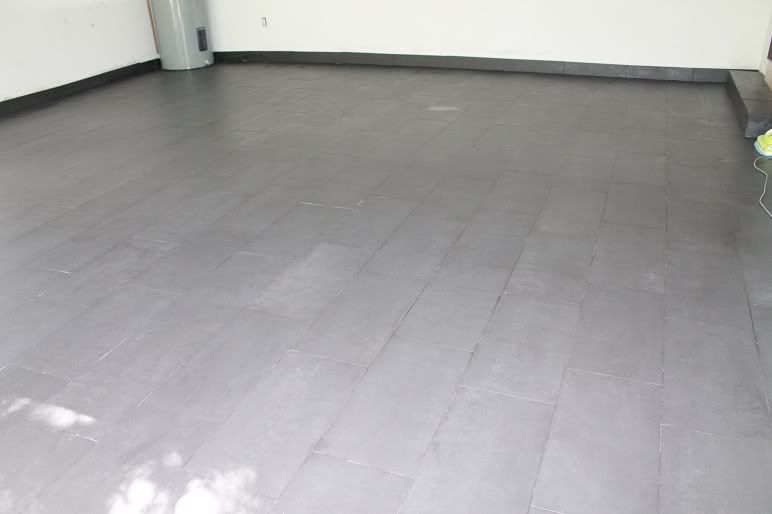
First post here, so I'll start off by saying hello everyone. I have really enjoyed reading this forum over the last few days and have come up with some great idea's for my future (hopefully soon) shop build.
I have been installing flooring professionally for the last 15 years, so I figured I might jump in on this conversation. Porcelain tile is without a doubt denser and stronger than ceramic, and you always get what you pay for. The cheap stuff Home Depot and Lowe's sells is not top quality tiles, usually seconds they get from a manufacture to sell off cheap. This isn't a bad thing of coarse, just making sure that everyone is aware.
That being said, whatever tile you decide to install will only be as solid and durable as the installation. Floor prep is key to having a solid floor, tile doesn't bend so having a flat surface is critical for a good install. High spots should be ground down, low spots filled and leveled, etc.
Setting the tile properly is the most crucial step to having a solid floor though, along with the quality of the setting material. Thinsets come in a wide variety of grades, and again you get what you pay for. A good polymer mortified thinset such as Ultraflex 2 works great for most residential and light commercial applications. Making sure the setting material is properly mixed is also crucial, too much water weakens the thinset, adding water and remixing after it starts setting up also weakens the thinset, etc.
General rule of thumb for tile installation is 90% coverage of setting material. In other words you want the tile set in the thinset completely, the other 10% comes from the ridges of the trowels. The trowel size makes a difference as well, I personally use a 1/4" x 3/8" for tiles under 14", a 1/4" x 1/2" for tiles over 14", and occasionally a 1/2" x 1/2" for extremely large tiles. Main thing is though, you don't want hollow spots in your floor, these are the weak spots, regardless of ceramic, porcelain, or marble.
Next you mentioned cracks in your existing slab. This is another problem area for any tile. You said you were reinforcing for a maxjax and level the floor up a little bit. I'm not sure what you mean by leveling the floor up a little bit, but I'll refer to what I said about floor prep. There are several crack solutions on the market you can look at, but a slip sheet is the most common I use. I've had several people, including reps from several manufactures, tell me that waterproofing compound works in the same way, but I guess I'm still a bit ole' fashioned and stick with what I know. I would suggest talking with the tile stores in your area, not HD or Lowe's because these people are not professionals, for a better understanding of crack solutions.
Grout is just personal preference, epoxy is better in my opinion for wet area's such as showers, but I've never had an issue with regular grouts in showers. Most problems with grouts arise from homeowners not properly taking care of their tile/grout. First off all grout should be sealed after it has had time to cure after a fresh install, and the better the sealer, the better it will protect and longer it will last. Wet areas such as showers and kitchen counters should be sealed regularly, at least every 6 months. Properly cleaning your tile and grout also extends the life and look of your grout. Harsh cleaners, especially bleach will deteriorate your grout. Sure it will kill some of the surface mildew, but you wouldn't have the mildew in the first place if properly sealed and maintained. I only recommend a 50/50 solution of vinegar and water for cleaning.
Grout joint size is also a personal preference, but 1/8" is as small as I would suggest on most floor tile applications. Tile is NOT all the same size, in fact most manufactures only guarantee a 1/8" variance on high end tiles. I can personally say the cheap stuff from HD and Lowe's is closer to 1/4" variance most of the time, and have seen 3/8" difference on really cheap stuff. Because of this, I wouldn't suggest a grout line less than 3/16", otherwise you wouldn't be able to keep the grout line's straight. This is usually the biggest factor in determining grout joint spacing, with personal preference following. To answer someone else above about butting tiles together with no joint, in theory yes, if all the tiles were the same size and had some sort of beveled edge to hold grout. In fact 12" x 12" marble and granite is installed like this, but even cheap quality marble and granite has a much tighter variance than even more expensive tiles. This is because they are cut with a cnc machine rather than poured into a mold.
There are a lot of benefits and drawbacks to hard tiles, depending on application. I have pondered for the last year what product would serve best in my shop build, and personally I believe I'll be going with VCT for several reasons. First of all it's cheap, you can buy most any color for around 50 - 75 cents per square foot. Secondly, it's easy to install and maintain, and properly installed it looks great. There is no grout joints to collect dirt, dust, and grease, which is a pain to clean btw, or interfere with rolling objects across the floor. It won't break from dropping a hammer or other large heavy tool, and it's quieter. It can gouge, if hit with a sharp object, but the tiles are easy enough to replace, even more so than hard tiles. A good commercial sealer and wax would last for quite some time, and most scuffs and marks can be buffed out.
I'm sorry, I seem to be rambling now, but I hope I have offered some insight, and I hope some of this information will help you make a better decision on whatever flooring choice you decide to go with. Best advice is don't take shortcuts. A bad flooring install, especially in a workshop, can be an expensive headache, and if your like me, I can find much better things to spend my time and money on.
Jon