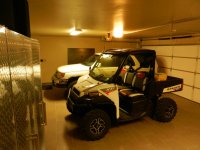
OK... time to wrap this project up. What's that? A hurricane is coming? GREAT! We need the rain. I guess I'll have to change my plans...
With the two or three days of heavy rains headed our way, I decided to do as much cutting on the tile saw outside as I could safely do this morning before the weather moved in.
A quick review for garage tiling:
Folks who have never done tiling are at a loss as to where to get started.
Inside your home you have a zillion options that can make or break an install. The key is figuring out the King Line (aka Jesus Line) that the whole pattern must follow. For entryways, it usually centered on the middle of your front door and continues as far as the tile will go. Same with single rooms like bathrooms. Snap a line from the middle of the doorway straight back to the far wall. Depending on the shape of your tile, your patterns will run right off that line.
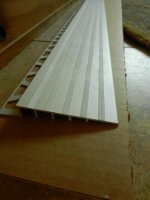
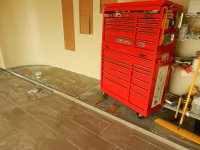
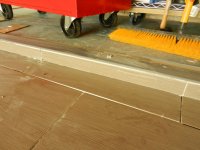
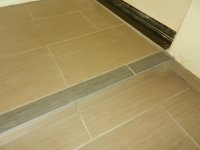
Thankfully, with garages, things aren't quite that critical. As long as you line the tile "ramp" (Schluter ramp or similar) squarely under your door, and keep your tile pretty much against the spacers on each row, the errors you introduce will be negligible, if even noticeable. YOU will notice many errors that will disappear one the job is grouted. Other you know about, will be indiscernible by your friends or the head inspector, your wife.
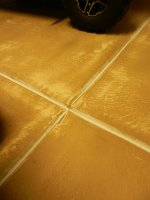
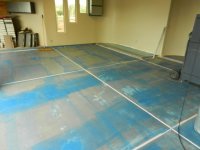
Garages have expansion joints or crack control lines, sometimes saw-cut into the slab. The old saying is, "Honor your crack joints." Those joints are intended to crack and with the normal expansion and contraction of the concrete floor, if you simply tile over those joints, you will likely see cracking in your tile over time. If you align your tile installation where there is a crack joint within 3-4 inches of a tile grout line, any cracks will migrate up through the mortar and through the grout. The tiles either side of the expansion joint will be unharmed.
So, for my garage install which has a 16' door and an 8' door, I started on the center of the 16' door which is where the crack joint was. I butted two full tiles, one either side of the slightly wider (1/4") expansion joint and tiled away from there.
Don't get too wrapped up because your expansion joints are either not straight or not square.
Remember, in most cases, guys who have poured your whole slab are finishing up the day doing the garage. The garage is the only place where expansion joints are installed and they may start out at a measured location, but from there they are eyeballed. Many times, the concrete finishers are in rubber boots, ankle deep in concrete, trying to get a smooth joint troweled in with a tool on a 15' pole. Every step they take ruins the finish of the garage floor so they want to get in and get out as quickly and carefully as they can before things really start to harden up.
All you need to do is stay within 2-3 inches of the joint as you tile, keeping your joints as close to it as possible. The closer, the better. Use a square and either snap a line or shoot a laser to find out what you are dealing with. It the line leans to the right as it travels from the door to the back of the garage, figure out how much it "leans" and divide that in half.
If the expansion joint hits the far wall 3" right of where it starts under the door, simply start tiling 1.5" right of the expansion joint and as you tile back, the expansion joint will cross under your expansion joint grout line and you'll end tiling about 1.5 left of the joint. If the joint wanders all over the place, just pick an average and let it wander under your tile joint.
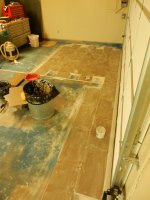
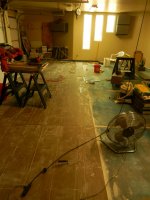
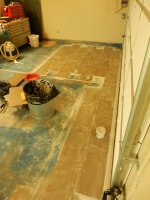
Here was my initial start, working off the main expansion joint in the center of the two-car door...
You want to lay as much solid tile as possible. Depending on your pattern, you may only be able to lay one row before having to cut tile to cover the expansion joint. NEVER substitute whole solid tiles as space keepers for tiles that need to be cut. Its always a hassle and small movements in the tiles can create big headaches as you try and fit cut tiles in between solidly set rows of uncut tiles. It is best to cut tiles or have tiles cut for that expansion joint grout line so you can at least get the main body of the floor done, either to another crack joint or to the walls on either side.
Here is where I got ahead of myself and used a few "spacer tiles" to position tiles either side of an expansion joint. When I came back the next day to cut tiles, I found the rows were very slightly out of alignment. The tiles bridging the expansion joint had to be custom cut and that was a major pain. From that point on, I had a stack of tiles split in two to toss in as I went. Much 'Mo Bettuh.
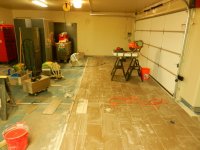
Doing the fill-in tiles along the wall is kind of fun. You simply measure each tile leaving a gap for the spacer in the inside and a 1/4" expansion gap on the outside edge next to the wall. Cut the tiles and lay them in the holes so you know where they go and you can go to town cutting a bunch. With the hurricane supposedly raining all day tomorrow, I have about 30 tile pieces already cut awaiting mortar. I'll spend tomorrow gluing them down.
The new tiles are easy to spot as they are the clean ones with no grout...
After tiling a 1200 sqft workshop, and office off the workshop, and now a three car garage, I find I actually like doing tile work. If you don't have a saw or don't have the time to do what ends up being a multi-day job, by all means hire the work out -if you can be sure of the guy you hire. If he wants to tile right over expansion joints, I'd find another installer.
Even if you hire a guy, at least by reading this thread, you will know enough to figure out whether your guy is qualified.
Ray


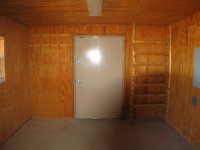

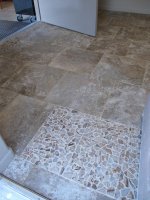
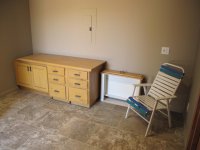





























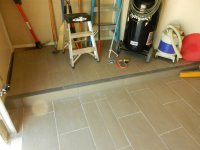

 That will change this winter.