any updates?? Also would like to see some photos what you did on the heads ports. I've done quite a bit of head porting for race cars back in the day, so was going to work some magic on my 705 head.
First off….
When I did all of this, I talked with an engineer at Saylor Beall about what I was doing and he said they had someone test the head for flow to see if they could make improvements and the company that tested it said to do EXACTLY what I was doing because that was where the restriction was. I don’t know if they have changed the design because of it, but they should if they haven’t.
Now for the meat and potatoes…
I decided to scour the internet for some pictures so I could at least give you some info. These are NOT my pictures. My parts now look much different.
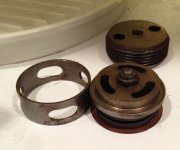
The valves are in the head. They are disc valves. There is a metal disc that opens away from the valve surface to allow air to travel through 3 holes in the valve body. This disc valve can only move so far because it hits a keeper that holds it in position with a spring. (The intake spring is lighter than the exhaust) The valve sits in a recess in the head that is slightly larger than the valve body. There is a metal ring on each valve with holes in it that lets the air move between the valve and the passages in the head.
The air has to make 3 or 4 90° turns to get through the valves. Obviously this is not ideal or efficient. What I did was make the flow through the valves more efficient.
I stole these pictures off of youtube and the internet…
Here is the head and block. The 3 valves on the low pressure side are all inside the diameter of the cylinder. Two intake and one exhaust. You can see how small the recess is around the two intake valves. This has to be opened up for better flow. The air has to make a VERY sharp 90° turn inside that recess to enter the valve and then ANOTHER sharp 90° turn as soon as it gets inside the valve. I don’t remember how far I opened the recesses, but it was a decent amount. i also rounded the edges for better flow.
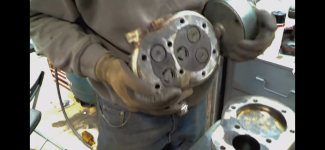
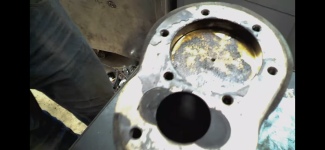
Here is the top of the block. The two high pressure valves are mostly outside the cylinder bore. This makes the previously mentioned problem even worse because the cylinder wall and valve body block the flow of air. I rounded the edges of the cylinder where the valves sit to allow better flow. I also opened the recess around the intake valve a LOT on the cylinder head. More on the side toward the cylinder and tapering as you get around the far side of the recess. The entire thing gets opened up, but more toward the cylinder.
The exhaust valve needs to have a shallow ramp cut into the block underneath it to allow better flow.
Here are the holes in the valve. They have sharp edges inside and out and are quite small. I opened them up a bunch and rounded/blended the edges inside and out. I flow tested with water before and after and the difference was staggering.
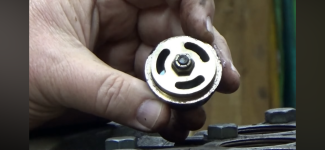
Here is a side profile of the valve. You see that gap? That’s how far the disc opens. It doesn’t leave much room for air to get by, especially when you consider the sharp edges on these surfaces.
The first thing I do is thin the disc retainer to allow more travel for the disc. This will increase the flow of air by a LOT. Google ‘valve curtain area’ if you want some good reading. Just leave enough room for the spring to compress without getting smashed by the disc. You could turn the valve body to increase the disc movement even more. I ended up with .1” just by thinning the retainer.
There are two edges you can round… the very bottom of the disc retainer, which lets more air into the recess in the head. And the inside lip on the main valve body where the air turns 90°, but make sure you leave enough flat surface for the valve to seal on. You have to leave enough that it doesn’t get beat up on a thin edge.
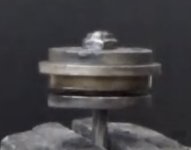
This is the metal ring with holes in it. I enlarged these holes for better flow, making sure to round the edges. The top and bottom surfaces of the ring must not be damaged because they are sealing/bearing surfaces.
It’s a good idea to surface the block and head because they are not always flat. You can see in the first picture where the gasket was not making good contact and was very near failure. This will help increase your ‘compression ratio’ which clears more air from the cylinder on each stroke. You want the piston to be very close to the head at tdc because any air left in the cylinder will expand as the piston moves down and refill the cylinder, preventing more air from being sucked in on, which means less cfm. This is where real gains can be had once you have good flow through the valves/ports. Port/valve flow comes first because if you increase your compression ratio first, the compressor will just get hot because there is no way for the air to get out.
I used thinner gaskets when I assembled mine and measured the clearance as I went. I think the piston to head clearance was around .020” when I was done.
Opening the pockets/recesses in the head would be pretty easy with a bigger lathe or a mill. I used a dremel and a lot of patience.
The insides of the head passages are very rough on some castings. I try to remove as much roughness as I can reach. The same for the “coolers”. Those should also be gasket matched to the head. One of mine was way off and needed some serious work to line up. It was a knock off brand, but still something to look for.
All of these things will work together to increase flow and reduce back pressure, and that will help any air compressor live longer due to lower temps and less stress. A nice big air filter is a good idea too. The surge flow on these is 200-300 cfm, so every little bit helps. Air compressors GULP air in short pulses, and that’s why you hear “thump thump thump” when they run. Total intake/output might only be 10-20 cfm, but that’s not what the valves and passages have to handle. I mentioned earlier that an air compressor might only have 30° of crank travel to push the air out before the piston goes back down. That number gets lower as the pressure goes up because the air compresses more before it leaves the cylinder.








 threw it into a snow covered bank when he noticed the wobble in the sheave.


