To avoid these ads, REGISTER NOW!

Ported air compressor?

Ike Carlson

Well-known member
Joined
Jun 14, 2019
Messages
168
Location
Wisconsin
I am finishing up the work on my Eaton compressor. (SB 705 clone) I have the head taken apart for cleaning/rust removal and the rest is all back together. The previous owner left it in a salty snowbank all winter and it was rusted and locked up tight. He seems to have messed with it before throwing it outside, but I don't think he knew what he was doing. I picked it up for $10.:bounce:

The intake looks pretty good, nice and open, but the exhaust and intake going to the second stage look like they could use some work. Lots of sharp/rough edges and a couple of tight areas. I think a light touch with a carbide burr could be good thing.

I used a thinner base gasket and I plan on running a thinner head gasket. I have done it in the past and it bumps the cfm by a good margin. The old gaskets were ~.038", the new ones are ~.014" before clamping. The pistons are now .050" closer, but still ~.026" from the head.

The pump in stock form specs out to ~18 cfm with the 3 hp motor/pulley I have. Max pressure will be ~140 psi. I like having more air in the tank, but I would rather trade some psi for more cfm. I don't run anything over 140 psi, so flow is more important than more pressure. I have a small single cyl Westinghouse pump on my 60 gallon tank and it will keep right on pumping. The pressure switch and tank are good to 325 psi, but I have never let it get that high. This pump will likely go on my 120 gallon tank.

I don't know if anyone has ever messed with porting one of these, and I don't know how much it will help, but I'm going to see how it turns out.
 
To avoid these ads, REGISTER NOW!

American Locomotive

Well-known member
Joined
Jan 8, 2017
Messages
10,953
Location
Rhode Island
I mean it can't really hurt to clean the ports up a bit. I'm not sure how much it would matter since overall flow is really kow compared to something like an engine.

Thr real SB pumps tend to get more CFM per HP than many other pumps (presumably the dual intake valves help) but I don't think you'll get 18 CFM out of it without overloading a 3HP motor
 

TonyJ

Well-known member
Joined
Sep 10, 2019
Messages
384
Location
West Virginia
The clone sb’s are known for their rough castings and like the other fella said 18 cfm is going to be a stretch to get to with only a 3hp. Usually most “ real “ pumps will get around 4 cfm per hp before the motor starts getting loaded.

I have the clone Sb 705 and a real Sb 705 and also a real Sb 707. 707 I run with a 10 hp so can’t really compare that one but both the 705’s are being run with 5 hp and cfm wise the real Sb walks off from the clone but however the clone is way quieter while running.


Tony
 
OP
I

Ike Carlson

Well-known member
Joined
Jun 14, 2019
Messages
168
Location
Wisconsin
The clone sb’s are known for their rough castings and like the other fella said 18 cfm is going to be a stretch to get to with only a 3hp. Usually most “ real “ pumps will get around 4 cfm per hp before the motor starts getting loaded.

I have the clone Sb 705 and a real Sb 705 and also a real Sb 707. 707 I run with a 10 hp so can’t really compare that one but both the 705’s are being run with 5 hp and cfm wise the real Sb walks off from the clone but however the clone is way quieter while running.


Tony

That's interesting stuff Tony.
I think you have confirmed something for me. I was doing some calculations last night. The volume of air flowing through a hole depends on the size of the hole, the shape of the hole, and the pressure. A rounded edge on the hole can increase flow significantly.

I suspect the real SB walks away from the clone because of the restrictions in the head. I would love to have a peek inside a real SB head. The flow through a compressor valve is in bursts, so the flow capacity of the valve has to be much higher than the output of the compressor. The valves need to flow many times more than the rated output to be efficient.

If a compressor has an 18cfm output, the valves have to flow about 200 cfm to be efficient. Restricted valves will increase the pressure required to move the air and will raise the temp proportionally. The load on the motor will go up as well.

Tony- could you measure the temp difference on the two 705's while running? I suspect the real one will run cooler.

The reason I am limiting my pressure is because I only have 3hp.
 
OP
I

Ike Carlson

Well-known member
Joined
Jun 14, 2019
Messages
168
Location
Wisconsin
I am almost done working over the valves. I increased the valve lift from ~.055" to .100". I found a video of someone working on the real 705 on youtube and took measurements from the video. The real 705 looks to have ~.100" valve lift, so that's what I went with.

I took the dremel to the valve bodies and cleaned up the roughness and rounded the edges of the holes. I talked with a Saylor Beall tech today and I think I am on the right track with this clone. He said the ports could be .125 bigger, and I already did that. I also unshrouded the valves a bit. Nothing crazy, but enough to help air get out of the pocket. I contoured the high pressure intake to increase flow into the cylinder, since the valve is half covered by the block.

I am using thinner gaskets to get the pistons closer to the head and help empty the cylinders. I figured for rod expansion.

I guess we'll see how it works.
 

The Tool Tyrant

ALLIANCE MEMBER
Joined
Dec 19, 2011
Messages
2,182
Location
Bonita, Ca. (San Diego)
Ike, I'm quite sure that your pump will flow better with your porting job, and I can understand a higher compression ratio by utilizing a thinner head gasket, but I don't understand how that would increase your CFM. You've decreased the cylinder volume by decreasing the gasket thickness, so less air to compress.
You state CFM is more important than PSI, but you must remember that PSI translates to volume of usable air in the receiver. If you have the correct sheave ratios for your 3 HP motor, then running to 175 PSI will not hurt it...if fact, it will cycle less @ 175 PSI which will increase its life.
 
OP
I

Ike Carlson

Well-known member
Joined
Jun 14, 2019
Messages
168
Location
Wisconsin
Ike, I'm quite sure that your pump will flow better with your porting job, and I can understand a higher compression ratio by utilizing a thinner head gasket, but I don't understand how that would increase your CFM. You've decreased the cylinder volume by decreasing the gasket thickness, so less air to compress.
You state CFM is more important than PSI, but you must remember that PSI translates to volume of usable air in the receiver. If you have the correct sheave ratios for your 3 HP motor, then running to 175 PSI will not hurt it...if fact, it will cycle less @ 175 PSI which will increase its life.

I realize the part about more psi meaning more air. I will run the psi as high as I can. My problem is that I don't know what this compressor will do with 3hp. There are factory specs on it, but I think those are about as useful as a fart in the wind after seeing how choked up it was inside and how inconsistent the valves were. I think it would have been lucky to put out more than 10 cfm in stock form. And it would have been very hot after even a short run. I have seen videos of compressors online and some of the outlet temps are 300-350*F. Some of that heat comes from friction, but a lot of it comes from compression. Restriction increases compression and reduces output, so any heat made from that stays in the head.

Here is my thought process. Gasket thickness changes the clearance volume. It doesn't change the swept volume. The swept volume is the stroke, and that's what does the work. So I am doing the same amount of work, but pushing more of the air out of the cylinder, rather than simply compressing it and having it refill the cylinder when the piston goes back down.

If you look at the first illustration below, you will see the clearance portion of the cylinder is not doing any useful work. It only acts as a reservoir. Any air left in that reservoir has to expand as the piston goes back down and will reduce the intake charge. The lower the "compression ratio" of the cylinder, the more air is left to expand. I have bumped my compression ratio to roughly 30:1 with almost zero clearance volume. Of course it will never see 30:1 because the air can leave as it compresses. The valves will flow much better with the porting work and increased valve lift. This combination should work as follows:

Faster and more complete filling of the cylinder on suction stroke
Better flow out of the cylinder as the pressure builds above outlet pressure
Nearly complete purging of the cylinder at the top of the stroke because of the reduced clearance volume, which means better filling, and the cycle repeats.

Any restriction to flow increases pressure. Increased pressure means more heat.
If the compressor has to make 180 lbs on the first stage just to push the air through the hole to make 50 psi on the other side, thats all wasted power in the form of heat. A lot more heat. Compressing air heats it, but pressure difference across a valve heats it more, especially when the pressure is 2,3,or even 4x. My numbers indicated that the pressure difference was in the 2-3x range, which is crazy. The pressure difference should now be in a 1.1-1.3x range, which is much better. Why compress the air to 150+psi just to make 50 psi and then recompress it to 200+psi just to make 175? See where this is going?

Now the second diagram:

The way the pressure-volume diagrams work is they show pressure vs volume. It indicates efficiency, airflow, and relative power. Pd and Ps are discharge and suction pressure. Anything over Pd and below Ps is wasted power. You want as much area inside the lines as possible without going over.

The bottom right corner is the beginning of the compression stroke. The curve going up from there is the pressure building as the piston moves up. The top part is the pressure in the cylinder as the compressed air is pushed through the valve. These 2 lines are the entire compression stroke, from 1 to 2 to 3 on the diagram.

The top left corner is the end of compression and the beginning of the intake stroke. The remaining pressure in the cylinder drops as the piston goes down. Once enough vacuum is made, the intake valve opens and the cylinder fills as the piston continues to finish the stroke. This is 3 to 4 to 1 in the picture.

Remember, we want area without going above or below the upper and lower limits. 1 and 3 are fixed points because of the piston stroke. If we want more area, we can only move 2 and 4. How do we do that? We change the clearance volume. If we reduce the clearance volume, the pressure will build faster because the chamber is smaller. This moves number 2 to the right and the curve will be steeper. The smaller chamber means there will be less air left in the cylinder to expand. This moves 4 to the left and allows the cylinder to start filling sooner.

The red areas are energy and efficiency losses and would have been very tall in this compressor. This was addressed by the valve porting and extra valve lift. What we have done is take some of the red and move it inside the lines. The compressor should use about the same amount of power, but will move more air with that power.

Diagram 3:
The curve between 1 and 2 will move left if the cylinder is not filling completely. I should have improved this with the valve porting/lift since the valves were very restricted.

*These are general diagrams and are examples only.

A974736B-01CC-4B11-BA2C-CEC666AA7371.jpg

69A66D45-B865-4772-B8B6-63C3745EDCD6.jpg

AB90574D-BCE0-4BDA-9DCA-CC75C65509FC.jpg
 
Last edited:

MacMcMacmac

Well-known member
Joined
Oct 21, 2014
Messages
1,583
Location
canada
Have a look at this air flow through an orifice chart. Your stock head is fine as is.

If you are curious as to how much air your compressor is making, you can use this attached chart to flow test your machine. Put a pipe on the outlet of you compressor. Include a tee so you can see the discharge pressure on a gauge. Put a pipe cap on the end with the required orifice and see what pressure your machine can hold.

For instance, a 21.4CFM output would hold a pressure of 80psi on the gauge pumping through a 1/8" orifice. If you look at your stock ports, you will see that they will already flow many times more than your machine will produce. If you search online, you may find a more comprehensive chart with many more orifice diameters to tailor your flow test.

The one and only determinant of how much air a compressor will flow is how much air it can take in through the inlet valve(s), which is why a single stage compressor will outflow a 2 stage compressor at the same hp, up to the point of increasing inefficiency cause by generated heat. My co worker and I built two identical compressors using 5hp Fu Sheng units about 20 years ago. They were turning identical speeds. The single phase unit hit it's cut-out point about 30 seconds faster than the 2 stage unit reached it. Of course, the 2 stage unit continued on to a higher cut out pressure, which perfectly demonstrates the advantages of each design. One was a VA80, the other a TA80. For Fu Sheng pumps, that number is the diameter of the first stage cylinders in millimeters. so the VA80 had two 80mm cylinders taking in air from atmosphere while the TA80 had one, and a smaller 2nd stage for boosting pressure.
 

Attachments

  • img005.jpg
    img005.jpg
    110.2 KB · Views: 41
OP
I

Ike Carlson

Well-known member
Joined
Jun 14, 2019
Messages
168
Location
Wisconsin
One thing most people don't think about is the time the valves are open. It's all about time. Google 'port timing' and you will get a whole lot to chew on, mostly for 2 strokes, but it's still about flow.

It would take 130 psi to flow 21 cfm through an 1/8" orifice with sharp edge. Yes, an 1/8 orifice will pass 21 cfm at 80 lbs, if the entrance to the hole is well rounded, but that is continuous and at an 80 lb difference across that hole. If you are referring to a drilled hole with no edge treatment, the flow would be ~14 cfm at an 80 lb difference in pressure. The problem with orifice charts is few people look at the details and fine print. Flow can increase by 50% with a well rounded entrance.

Air compressor valves see bursts of air, at many times the compressor's rated output. The piston goes up and compresses the air, then the valve opens and all of that air has to go through the valve in a very short time. We are talking 200-300 cfm of flow through the valve to clear the cylinder by tdc.

If the valve is open for 1/12 of a revolution, or 30* of crank travel, a 20 cfm compressor is moving an average of 240 cfm through that valve. It would take at least a 1/2" hole to do that at an 80 lb differential. The valves used to be the same as a 1/4" hole, so the pressure difference would literally have been off the chart.

That extra 80 psi is what I was referring to in my previous post. The air in the cylinder would have to be compressed an extra 80 lbs, make a lot more heat, take more power, and there would still be a bunch left in the cylinder on the down stroke.

If I have a well rounded entrance to a 1/2" port I can move 340 cfm or 24 times more than your sharp edged 1/8" hole. That's a heck of a difference. My biggest restriction now is the 2 right angles to get through the disk valve. Everything else is wide open.

The cylinders should see less overall pressure and less heat. It's a win/win.
 
OP
I

Ike Carlson

Well-known member
Joined
Jun 14, 2019
Messages
168
Location
Wisconsin
Well, heck. I got it all put together and gave it a spin by hand. It feels and sounds good, but the flywheel wobbles 1/8". I put a dial indicator on the crank and it's out .009" at the tip, but the flywheel is bored wrong or bent. I can most likely straighten the crank, but the flywheel will have to be bored/sleeved.

On the plus side, it has awesome compression/vacuum even when turned by hand. I might use my 3phase motor and vfd to find the best speed for my 3hp motor. All I have to do is watch the amp draw and see when it pulls 3.5 hp and get a pulley to match. I think this should work. I've never done it before, but it sounds good to me.
 
OP
I

Ike Carlson

Well-known member
Joined
Jun 14, 2019
Messages
168
Location
Wisconsin
Upon further examination, the flywheel is cracked. At least 2 fins are cracked near clean through. I will look for any more damage in the morning. I may try cutting through the cracks and brazing it back together after straightening, if it holds up. Otherwise I may cut all the fins, fixture it, and braze the whole center back in straight. A new flywheel and crank are $400, so that's not going to happen. At this point I am not going to stick any more money into it. I have too many irons in the fire and the days are already getting shorter. Maybe I will mess with it this winter, I don't know. At least I can run my little Westinghouse for now.
 
OP
I

Ike Carlson

Well-known member
Joined
Jun 14, 2019
Messages
168
Location
Wisconsin
I took a better look at the compressor today and tested the crank. It's malleable iron, so I should be able to straighten it if there are no cracks.

The flywheel is pretty bad. It's grey iron, so it's brittle. At least 4 out of 6 vanes are cracked and it is "out" by .125".

My plan (when I get to it) is to go after the crank first. If I can get that fixed I will move on to the flywheel. That's going to be fun, but should be doable. I will grind out the cracks enough to allow a bit of movement and bend the center back straight before brazing it solid. If the other 2 vanes are cracked or end up cracking during the work, they will get ground/brazed too.
 
OP
I

Ike Carlson

Well-known member
Joined
Jun 14, 2019
Messages
168
Location
Wisconsin
Here is my crank. The left end is bent .009" toward the camera. I'm not sure exactly where the bend is yet, but I will be putting it in v blocks and will try to see where it is bent. It is a very stout crank compared to what I have seen in other compressors.

This picture is from when I removed the rust and polished the journals. This crank was completely covered in rust and would not turn. The pistons were rusted into the bores and the whole thing was a 200 lb paper weight.

DF5D6C43-7837-4AED-8752-2DC722D164F7.jpg
 

American Locomotive

Well-known member
Joined
Jan 8, 2017
Messages
10,953
Location
Rhode Island
It was bent real bad. The edge of the pulley had probably near 1/2" of wobble. It's still got some but whatever, it works.

I also didn't remove the crank for straightening. Just clamped the whole crankcase to a bench and got ugly on it with a big pipe.
 

laser3kw

Well-known member
Joined
Nov 17, 2012
Messages
7,276
Location
northen IL
I am looking for a head to do exactly what you are "port and polish"
The theory is no different than an internal combustion engine as far as air flow in and out. I figure that I will get better airflow, less motor work and slightly lower air heating through the pump.
Who will be the first to have a "Frankenstein" air compressor pump? Billet head, cnc ports, free flow exhaust.... :bounce:
 
OP
I

Ike Carlson

Well-known member
Joined
Jun 14, 2019
Messages
168
Location
Wisconsin
I am looking for a head to do exactly what you are "port and polish"
The theory is no different than an internal combustion engine as far as air flow in and out. I figure that I will get better airflow, less motor work and slightly lower air heating through the pump.
Who will be the first to have a "Frankenstein" air compressor pump? Billet head, cnc ports, free flow exhaust.... :bounce:

That's my train of thought on this. There is nothing out there about porting air compressors for better flow. Everyone just says "ours is the best" and I know that's a big steaming pile for 99% of them. I just about crapped a brick when I finished the math on how much air goes through those tiny little valves. 300 cfm through what equated to a 1/4" hole! Do the designers really not think of this?

I have a couple of designs in mind for a new style compressor head. I just have to get my ducks in a row and make it happen. The only part that might be hard is the free flowing exhaust. I hear compressors require a lot of back pressure.:lol:

There is a lot of power wasted with compressors. Way more than people think. The tables and charts and literature I have seen have numbers all over place for cfm/hp Some say less than 3 and some say as high as 6.

The factory specs are as follows:

HP 5 3

RPM 850 550

Displacement 23 14.8

Output@175 17.3 11.1

Vol. Efficiency 75% 75%


I took out .67 cubic inches with the thinner gaskets, but I also removed some metal with the porting. I don't know exactly how much I took out, but I'm pretty sure it was less than .67 cubic inches. It's a game of numbers and balance, especially when you have to work with something that was made by someone else.

I don't know how much more flow I will have, maybe 1-2 cfm. It will depend on the clearance volume, which I have not measured. It's like cc-ing a combustion chamber. I do know the heat will be reduced along with the hp. That's why I want to use my 3 phase vfd to find the sweet spot for the pump/motor combo I have.

I have read that every 14 psi of pressure drop in a compressor increases the motor load by 7%. I am hoping to get 16 cfm @175 psi with a fully loaded 3hp motor. We'll see if I get there.

20AFF7A4-41EE-4C95-84EF-F79B612891D8.jpg
 
OP
I

Ike Carlson

Well-known member
Joined
Jun 14, 2019
Messages
168
Location
Wisconsin
Update:

With the hot weather we are having, I figured I might as well do something while I am inside.

The crank is now straight within .001". I started out by putting a 2 foot pipe on it and putting a few good heaves on it to hopefully rebound the shaft a bit. It worked and the runout dropped from .009 to .007. I pulled the cylinder/head assembly off along with the pistons. That allowed me to remove/install the crank easily and measure my progress.

It took a lot of peening with a ballpeen hammer. I had the crank out about 8 times before it was straight. I started out with light taps and moved to a light beating by the end. It took a LOT to bend it, so it took a lot to bend it back. The needle on the indicator bounces back and forth .001 and seems to be showing irregularities in the shaft surface at this point. I'm happy.

The flywheel is next. I just have to wait for the weather to cool before working outside.
 
To avoid these ads, REGISTER NOW!

The Tool Tyrant

ALLIANCE MEMBER
Joined
Dec 19, 2011
Messages
2,182
Location
Bonita, Ca. (San Diego)
Well Ike, all indicators point to a high probability that the compressor most likely fell over and the pump sheave impacted the ground...may have been the reason the PO:Mr.T: threw it into a snow covered bank when he noticed the wobble in the sheave.:scared:

Hope you can rescue the ol' girl! :thumbup:
 
OP
I

Ike Carlson

Well-known member
Joined
Jun 14, 2019
Messages
168
Location
Wisconsin
I already went through the whole thing. The only thing left now is the flywheel. I think it will be a great compressor once I have it up and running. I can't believe the force required to turn it when the outlet is plugged. Just crazy.:eyecrazy:
 
OP
I

Ike Carlson

Well-known member
Joined
Jun 14, 2019
Messages
168
Location
Wisconsin
I just tried to mount the intercooler and the bolts are 4 different lengths, bent, and the threads are pulled out of the holes.
I don't even want to know who did this, it's just wrong. The only thing I can do is drill and tap for bigger bolts. I didn't even try mounting the after cooler. I think I'll do the same thing on that one just to be safe.

I'm really putting stock into the idea that the previous owner messed with it without having the first clue how it worked and then got fed up with it and simply shoved it off the tank and flopped it out the door. I don't know what else would explain all of this.

I tried to find a piece of pipe to fit in the flywheel hub so I could straighten it, but came up empty. I have to get some steel tomorrow and will get a piece to fit the flywheel. It shouldn't take too long to get it straight and braze it up.
 

laser3kw

Well-known member
Joined
Nov 17, 2012
Messages
7,276
Location
northen IL
I like your style Ike.
Kind of the "Holmes on Homes" approach - " look, some has replaced the correct bolts with three different lengths. Might as well gut it and start over!"
I too find myself doing the same thing. It is always a nagging thought when you have a problem down the road that, maybe, it was because you didn't fix XYZ.
Keep us posted, I am interested in the whole project:)
 

MacMcMacmac

Well-known member
Joined
Oct 21, 2014
Messages
1,583
Location
canada
I tried to find a piece of pipe to fit in the flywheel hub so I could straighten it, but came up empty. I have to get some steel tomorrow and will get a piece to fit the flywheel. It shouldn't take too long to get it straight and braze it up.

This is a pretty common compressor. Every shop I worked in had a stash of flywheels from condemned machines. You might find a perfectly usable wheel sitting in a shop for small money.
 

TonyJ

Well-known member
Joined
Sep 10, 2019
Messages
384
Location
West Virginia
This is a pretty common compressor. Every shop I worked in had a stash of flywheels from condemned machines. You might find a perfectly usable wheel sitting in a shop for small money.


Unless the clone one is interchangeable with the real SB’s then everyone wants an arm and leg for them. I needed one for my 707 and the only one I could find was on eBay for close to $300 so I ended up buying a broken compressor just for the flywheel.


Tony
 
OP
I

Ike Carlson

Well-known member
Joined
Jun 14, 2019
Messages
168
Location
Wisconsin
Update: (with a response)

I don't think it is compatible. This is the "metric equivalent" to a saylor beall. The shaft is just a bit different. Even between this brand of compressors, there are two different shaft sizes, and I seem to have the oddball. I have had no luck finding another flywheel for this shaft size, 1.572" or 39.928mm. It's a 40mm shaft and the replacements are 1.562" or 39.6mm. It says right on the description that they may not fit some models. I don't know why they changed it by .010" or .5mm, but they did. A new one would have to be bored out to fit, on top of the $200+shipping price tag. I would have at least $300 into a new flywheel, and a new compressor is $800. Pretty silly how they price stuff. I'm going to skip getting screwed and just finish fixing it.

The cylinders hold vacuum for a loooong time. I can out my hand over the intake, turn the flywheel, and my hand is stuck to it for at least a full minute. I don't think this compressor has very many hours on it at all.

I cut the 4 cracked fins all the way through at the cracks. It bounced about halfway back as soon as they were cut, so I was left with .070" of runout. I put it on the compressor and gently flexed it while tapping the two remaining fins with a hammer to relieve stress. I repeated this a few times until the indicated runout was .005-.010. It moved that much just from me touching it and there are a lot of irregularities on the flywheel, so that's as close as it's going to get. There is no visible wobble to the naked eye. I worked it until the high and low spots seemed like they were almost reversing and set it aside to settle before brazing.

There was a lot of stress in this piece, way more than one would expect. One of the fins jumped about .120" when it was cut. I think this was the best course of action, since a new flywheel was not available. It should be just as good as new, if not better. I will check the balance after brazing and correct it as needed.

I had to get more brazing rod yesterday and the price was through the roof. I hope things settle down soon.
 

TonyJ

Well-known member
Joined
Sep 10, 2019
Messages
384
Location
West Virginia
If your only going to be running at 140psi with a 3hp motor I think I would just run the pump slower so that you won’t have to worry as much about run out or vibration. The slower the rpm the less vibration and wear you will have over a long period of time. Like many others have said in the past about all sorts of compressors this is a compressor not a 4000 rpm car motor. Myself I’ve even seen people order a two groove regular everyday pulley that has the same OD and use the correct bore bushing and go happily on their way while just adding a fan to blow air across the pump while it’s running and not have any issues at all. If yours after the brazing and straightening if it doesn’t have a major wobble after the belts are tightened up I’d run it without worrying about it


Tony
 

benjaminpaul

New member
Joined
Jan 26, 2021
Messages
1
Location
MI
Did you ever get this thing going?

I just picked up a cheap, used Craftsman compressor and will be replacing the valves/gaskets and thought I might do a little porting while I was in there for fun if nothing else. I need to inspect the inside of the tank before bringing it up to full pressure but it's a 5hp, 240V 20gal unit, so I'm excited to get it going to give my poor little pancake unit a rest.

Anyway, the porting question is what led me to your thread, but after going through it I'm wondering how it came out!
 
OP
I

Ike Carlson

Well-known member
Joined
Jun 14, 2019
Messages
168
Location
Wisconsin
I took pictures, but I'm not sure where they went. I increased the lift of the disk valves, ported and smoothed the valves themselves, opened the pockets and smoothed the edge going into the cylinders. Mostly unseen unless you know what to look for. I used a thinner head gasket and reduced the squish a bit. I had to balance the squish with pocket volume because too much pocket reduces compression. I talked with saylor beall and they said their valves/pockets are the restrictions, which is where the restrictions would be on most compressors. I'm hoping I got a pretty good balance. I can always pull the valves/head and do more, but I think it will do pretty well as it is.

I got the flywheel brazed up, but the gaps were too big so I need to grind out the brazing and weld in steel to take up the gaps. It's below zero here, so the compressor is on "shut down" duty anyway until spring. I'm hoping to get the shop heated this year so I can work year-round.
 
OP
I

Ike Carlson

Well-known member
Joined
Jun 14, 2019
Messages
168
Location
Wisconsin
Long time with no update. I got busy with other things.

I got the flywheel welded. I used flux core wire on a lower setting to keep heat soak to a minimum. I made small welds and peened them whole still hot. I waited between welds until I could leave my hand on the previous weld. It seems to have worked. Radial runout is near zero and the wobble is about .040".

I set a limit of .050" runout for myself since the fins were broken at the hub and any distortion would be magnified. I may have over peened some of the welds and contributes to the wobble, but I would rather have a little wobble than a cracked weld. I might be able to straighten it a bit more, but I'm pretty happy with it.
 

ford freak

Member
Joined
Feb 25, 2013
Messages
24
Location
Orange county ca
any updates?? Also would like to see some photos what you did on the heads ports. I've done quite a bit of head porting for race cars back in the day, so was going to work some magic on my 705 head.
 
OP
I

Ike Carlson

Well-known member
Joined
Jun 14, 2019
Messages
168
Location
Wisconsin
I have not messed with it. Been too busy with other things. I was just talking with my son about getting it set up, since he has a new truck to work on. (1969 F600)

I still have not found the pictures of the porting work. I really don’t want to pull the head, but I guess I could if I had to. Might be good to see what it looks like after not seeing it for a while.
 
OP
I

Ike Carlson

Well-known member
Joined
Jun 14, 2019
Messages
168
Location
Wisconsin
any updates?? Also would like to see some photos what you did on the heads ports. I've done quite a bit of head porting for race cars back in the day, so was going to work some magic on my 705 head.

First off….

When I did all of this, I talked with an engineer at Saylor Beall about what I was doing and he said they had someone test the head for flow to see if they could make improvements and the company that tested it said to do EXACTLY what I was doing because that was where the restriction was. I don’t know if they have changed the design because of it, but they should if they haven’t.

Now for the meat and potatoes…

I decided to scour the internet for some pictures so I could at least give you some info. These are NOT my pictures. My parts now look much different.

The valves are in the head. They are disc valves. There is a metal disc that opens away from the valve surface to allow air to travel through 3 holes in the valve body. This disc valve can only move so far because it hits a keeper that holds it in position with a spring. (The intake spring is lighter than the exhaust) The valve sits in a recess in the head that is slightly larger than the valve body. There is a metal ring on each valve with holes in it that lets the air move between the valve and the passages in the head.

The air has to make 3 or 4 90° turns to get through the valves. Obviously this is not ideal or efficient. What I did was make the flow through the valves more efficient.

I stole these pictures off of youtube and the internet…

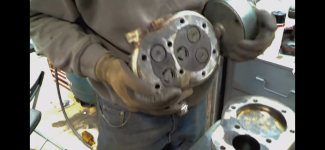
Here is the head and block. The 3 valves on the low pressure side are all inside the diameter of the cylinder. Two intake and one exhaust. You can see how small the recess is around the two intake valves. This has to be opened up for better flow. The air has to make a VERY sharp 90° turn inside that recess to enter the valve and then ANOTHER sharp 90° turn as soon as it gets inside the valve. I don’t remember how far I opened the recesses, but it was a decent amount. i also rounded the edges for better flow.
IMG_4183.png


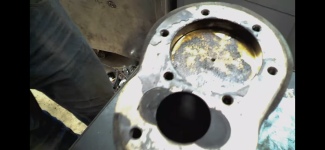
Here is the top of the block. The two high pressure valves are mostly outside the cylinder bore. This makes the previously mentioned problem even worse because the cylinder wall and valve body block the flow of air. I rounded the edges of the cylinder where the valves sit to allow better flow. I also opened the recess around the intake valve a LOT on the cylinder head. More on the side toward the cylinder and tapering as you get around the far side of the recess. The entire thing gets opened up, but more toward the cylinder.

The exhaust valve needs to have a shallow ramp cut into the block underneath it to allow better flow.
IMG_4184.png


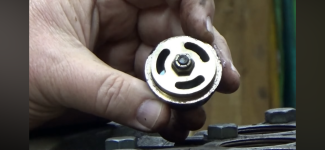
Here are the holes in the valve. They have sharp edges inside and out and are quite small. I opened them up a bunch and rounded/blended the edges inside and out. I flow tested with water before and after and the difference was staggering.
IMG_4185.png


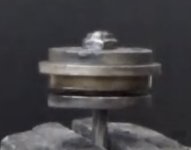
Here is a side profile of the valve. You see that gap? That’s how far the disc opens. It doesn’t leave much room for air to get by, especially when you consider the sharp edges on these surfaces.

The first thing I do is thin the disc retainer to allow more travel for the disc. This will increase the flow of air by a LOT. Google ‘valve curtain area’ if you want some good reading. Just leave enough room for the spring to compress without getting smashed by the disc. You could turn the valve body to increase the disc movement even more. I ended up with .1” just by thinning the retainer.

There are two edges you can round… the very bottom of the disc retainer, which lets more air into the recess in the head. And the inside lip on the main valve body where the air turns 90°, but make sure you leave enough flat surface for the valve to seal on. You have to leave enough that it doesn’t get beat up on a thin edge.
IMG_4187.jpeg


This is the metal ring with holes in it. I enlarged these holes for better flow, making sure to round the edges. The top and bottom surfaces of the ring must not be damaged because they are sealing/bearing surfaces.
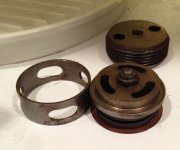
IMG_4194.jpeg


It’s a good idea to surface the block and head because they are not always flat. You can see in the first picture where the gasket was not making good contact and was very near failure. This will help increase your ‘compression ratio’ which clears more air from the cylinder on each stroke. You want the piston to be very close to the head at tdc because any air left in the cylinder will expand as the piston moves down and refill the cylinder, preventing more air from being sucked in on, which means less cfm. This is where real gains can be had once you have good flow through the valves/ports. Port/valve flow comes first because if you increase your compression ratio first, the compressor will just get hot because there is no way for the air to get out.

I used thinner gaskets when I assembled mine and measured the clearance as I went. I think the piston to head clearance was around .020” when I was done.

Opening the pockets/recesses in the head would be pretty easy with a bigger lathe or a mill. I used a dremel and a lot of patience.

The insides of the head passages are very rough on some castings. I try to remove as much roughness as I can reach. The same for the “coolers”. Those should also be gasket matched to the head. One of mine was way off and needed some serious work to line up. It was a knock off brand, but still something to look for.

All of these things will work together to increase flow and reduce back pressure, and that will help any air compressor live longer due to lower temps and less stress. A nice big air filter is a good idea too. The surge flow on these is 200-300 cfm, so every little bit helps. Air compressors GULP air in short pulses, and that’s why you hear “thump thump thump” when they run. Total intake/output might only be 10-20 cfm, but that’s not what the valves and passages have to handle. I mentioned earlier that an air compressor might only have 30° of crank travel to push the air out before the piston goes back down. That number gets lower as the pressure goes up because the air compresses more before it leaves the cylinder.
 

Attachments

  • IMG_4196.png
    IMG_4196.png
    1.2 MB · Views: 6
OP
I

Ike Carlson

Well-known member
Joined
Jun 14, 2019
Messages
168
Location
Wisconsin
I am getting close to installing the air compressor. The motor on my Westinghouse blew a capacitor, so I might as well plumb in the new compressor and motor. It’s cold again this week, but it should warm up a bit next week, so that’s likely when it will happen.
 
To avoid these ads, REGISTER NOW!
Top Bottom