To avoid these ads, REGISTER NOW!

Power to pole barn questions

theoldwizard1

Well-known member
Joined
Feb 22, 2011
Messages
43,248
Location
SE MI
Drill drainage holes in the conduit and face the holes down.
Whatever you do, do NOT install the conduit through the basement wall at the level of you trench ! Use a sweep to come up close to/above ground level so no water can find it way into your basement !! :shocking:
 
To avoid these ads, REGISTER NOW!
OP
B

bill1261

Member
Joined
May 16, 2015
Messages
24
CNGsaves said OP . . . you still need sparkies to tell you what BREAKER needs put in house to feed the garage as you're over 100 ft with the MHF 2-2-2-4 Al wire to the garage.

At MOST, it can be 90A but may be LESS due to your length.

Here is a rough aerial view of my layout. The house wasn't built when google earth took the shot so I drew in the house and distances (total 85' shortest distance). When I bought the 150' of MHF, I was thinking that would give me the freedom to put the load center farther down in the pole barn. If it was more centrally located, then I would pay less for romex runs to the other side of the pole barn. I can put the load center as tight to the shortest distance if you folks feel that is the smarter way to go.
 

Attachments

  • aerial pole barn01.jpg
    aerial pole barn01.jpg
    147.2 KB · Views: 25
Last edited:

checkthisout

Well-known member
Joined
Sep 5, 2008
Messages
5,232
It always amazes me how free people are withe someone elses money !

A 3" and a 2" Schedule 40 conduit would add about $20/foot to the cost, not including fitting, glue, and junction boxes.

ERROR !

Correction : $20/10 foot

I'll tell you why I arrived at that conclusion. I'm not a sparky nor in construction but have a few successful projects under my belt associated with helping friends and family.

Digging equipment is usually rented.

Do it yourselfers are generally still contemplating wire sizes and what not for their project.

With conduit all you have to have planned is your trench. You dig the trench, install the conduit and cover it back up. All done in less than a couple hours and just in time to get the excavator back to the rental shop for the 1/2 day rate.

This more than covers the extra cost of the conduit and possible planning errors that one would have to go and correct. Wire is expensive. If you get the wrong wire, you're stuck digging it back up and purchasing new wire.

I have good luck having inspectors pass trenches by leaving a small portion uncovered and/or using photographic proof of the depth of trench with the conduit or wire installed.
 

checkthisout

Well-known member
Joined
Sep 5, 2008
Messages
5,232
CNGsaves said OP . . . you still need sparkies to tell you what BREAKER needs put in house to feed the garage as you're over 100 ft with the MHF 2-2-2-4 Al wire to the garage.

At MOST, it can be 90A but may be LESS due to your length.

Here is a rough aerial view of my layout. The house wasn't built when google earth took the shot so I drew in the house and distances (total 85' shortest distance). When I bought the 150' of MHF, I was thinking that would give me the freedom to put the load center farther down in the pole barn. If it was more centrally located, then I would pay less for romex runs to the other side of the pole barn. I can put the load center as tight to the shortest distance if you folks feel that is the smarter way to go.

All conduit gets water in it.

I wouldn't put drain holes in the conduit. Dirt and sand can then get in that way. The wire you will be installing should be rated as such that it can sit in water.
 
OP
B

bill1261

Member
Joined
May 16, 2015
Messages
24
All conduit gets water in it.

I wouldn't put drain holes in the conduit. Dirt and sand can then get in that way. The wire you will be installing should be rated as such that it can sit in water.

The holes in the conduit was a fleeting thought.
Thank you.
 

wyliesdiesels

Well-known member
Joined
Aug 14, 2012
Messages
20,071
Location
Modesto, CA
I also live in area that has almost no rocks in the soil so that never came to mind !

Just because u have no rocks doesnt mean people in other areas dont. Thats bad advice to be giving because youre basing it on what u have! :headshake

OP . . . you still need sparkies to tell you what BREAKER needs put in house to feed the garage as you're over 100 ft with the MHF 2-2-2-4 Al wire to the garage.

At MOST, it can be 90A but may be LESS due to your length.


+1 to put 2" conduit at least 36" deep for the electrical feed the ENTIRE way (ie sch 40 conduit underground, and sch 80 above ground). Backfill 12" and then put in 1 1/2" conduit for your low voltage. Then another 12" backfill and your yellow caution tape.

No, You're thinking on that is wrong. Distance doesnt limit breaker size. He could still use a 90a breaker even over a long run. U dont lower a breaker size to compensate for distance! Instead, u increase your wire size....

At 150' and full load of 90a(which he will probably never hit) his voltage drop will be about 8.6v or 3.5%....he will be fine!

I chose a 90amp breaker based on what I read in this forum. If I misunderstood what amperage I'm allowed, I will return the 90amp and get the right breaker for my distance. I am not great with math. I've seen references leading to web pages but when I went to them, I got more confused.:confused:

Read above...the wire youre using is max 90a ampacity in the application youre using it at...

If your soil is all sand I would consider no conduit. One state over in Wis. we have plenty of of rock and plenty of trouble with underground wire. The frost brings rocks up from below and pokes holes in it. Any wire installed inside a building has to be flame retardant the RHH and RHW markings make your wire good to go. Something I've never seen mentioned here a pipe under ground with a sweep on each end is a big trap that will eventually fill with water.Something to think about.


No, conduit makes it so much easier when needing to replace the wire. Also, Any wire used underground should be rated for wet location. Sweeps are used all the time without issue. Not using a sweep is a HORRIBLE idea :headshake: and one that will cause ample frustration when pulling wire. It will be very hard to do so! What is your alternative idea? Im all ears!

Like I said in my original post, it is MOSTLY sand. If I were to estimate, I would say 10% rock. That being the case, I would hate to have frost push a sharp rock into my feeder.
Here's a (maybe) dumb :Homer:idea:
Drill drainage holes in the conduit and face the holes down. Any water accumulated would easily drain out into my sandy soil into the earth. This way the feeder is protected, and water can't form.
(I am in the process of drilling hundreds of 1/16" holes in schedule 40 pvc for my garden drip irrigation system-no big deal)
Any thoughts?

No dont do that! Horrible idea!! Even with drainage holes water will still stay in the conduit due to condensation, etc... MHF is rated for water so u dont even need to worry about this!
 
Last edited:
OP
B

bill1261

Member
Joined
May 16, 2015
Messages
24
Just because u have no rocks doesnt mean people in other areas dont. Thats bad advice to be giving because youre basing it on what u have! :headshake


No, You're thinking on that is wrong. Distance doesnt limit breaker size. He could still use a 90a breaker even over a long run. U dont lower a breaker size to compensate for distance! Instead, u increase your wire size....

At 150' and full load of 90a(which he will probably never hit) his voltage drop will be about 8.6v or 3.5%....he will be fine!


Read above...the wire youre using is max 90a ampacity in the application youre using it at...

[/b]

No, conduit makes it so much easier when needing to replace the wire. Also, Any wire used underground should be rated for wet location. Sweeps are used all the time without issue. Not using a sweep is a HORRIBLE idea :headshake: and one that will cause ample frustration when pulling wire. It will be very hard to do so! What is your alternative idea? Im all ears!


No dont do that! Horrible idea!! Even with drainage holes water will still stay in the conduit due to condensation, etc... MHF is rated for water so u dont even need to worry about this!

Thank you wyliesdiesels.....I needed that clarification! I can use the feeder that I purchased.
I won't drill holes in my conduit, just a thought.
I already bought the sweeps....just need to get the remaining conduit.

Thank you again.
 
OP
B

bill1261

Member
Joined
May 16, 2015
Messages
24
2: Sort of. The neutral and EGC(ground) is connected to the same bar in thr main panel. However, in the subpanel, the neutral bar needs to be isolated from the enclosure and EGC bar. Some panels DO NOT come with a grd bar which then needs to be purchased separately.

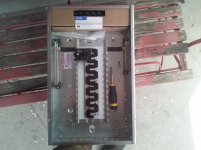
This is the subpanel I bought yesterday. It looks to me like the 2 isolated bars(ground and neutral?) are connected with a insulated black strap. Should I disconnect and discard the black strap and attach one to the chassis? Or do I need to leave those 2 isolated bars alone (call them neutral), and purchase an additional grd bar?
 

Attachments

  • box02.jpg
    box02.jpg
    144.9 KB · Views: 32
Last edited:
OP
B

bill1261

Member
Joined
May 16, 2015
Messages
24
The intention of the manufacturer is for you to add a ground bar kit.
Thank you Pattenp.
I see some holes on the lower right side of the box. I would assume that is for the the ground bar.I will pick up a kit today.
 

kd7gab

Active member
Joined
Aug 12, 2014
Messages
29
This is the subpanel I bought yesterday. It looks to me like the 2 isolated bars(ground and neutral?) are connected with a insulated black strap. Should I disconnect and discard the black strap and attach one to the chassis? Or do I need to leave those 2 isolated bars alone (call them neutral), and purchase an additional grd bar?
I have installed two of subpanels of the same kit (appears you bought the bundled kit with breakers). You do need to add ground bar kits. I highly recommend you get a pair of large ground bars and install them on both sides of the panel. Doing this will simplify your panel wiring. Also, you need to remove the neutral bonding strap for subpanel use...
 
To avoid these ads, REGISTER NOW!

theoldwizard1

Well-known member
Joined
Feb 22, 2011
Messages
43,248
Location
SE MI
... No, You're thinking on that is wrong. Distance doesnt limit breaker size. He could still use a 90a breaker even over a long run. U dont lower a breaker size to compensate for distance! Instead, u increase your wire size....

At 150' and full load of 90a(which he will probably never hit) his voltage drop will be about 8.6v or 3.5%....he will be fine!

First, thanks for your corrections. I am always learning !!

Second, you say "U dont lower a breaker size to compensate for distance! Instead, u increase your wire size...." Both achieve the same goal, limiting voltage drop so why isn't one a trade off for the other, assuming the load (sub panel) is would not exceed a lower breaker rating ?
 

pattenp

Well-known member
Joined
Jun 4, 2008
Messages
10,175
Location
Virginia - USA
First, thanks for your corrections. I am always learning !!

Second, you say "U dont lower a breaker size to compensate for distance! Instead, u increase your wire size...." Both achieve the same goal, limiting voltage drop so why isn't one a trade off for the other, assuming the load (sub panel) is would not exceed a lower breaker rating ?

You're right in a non typical way. It's just a matter of semantics. It's just when you compensate for voltage drop it's typically a matter of using larger wire because the amp load has already been defined.
 

theoldwizard1

Well-known member
Joined
Feb 22, 2011
Messages
43,248
Location
SE MI
...It's just when you compensate for voltage drop it's typically a matter of using larger wire because the amp load has already been defined.

Yeah, telling the customer, "I can save you some money on wire if you install a smaller motor !" isn't going to cut it !
 
OP
B

bill1261

Member
Joined
May 16, 2015
Messages
24
Okay, I think I have a grasp on the subpanel stuff.
Thanks again to those who gave their input!
Here's another question:
Does it matter if the rods are inside or outside the detached barn? In my pole barn, the floor is not finished yet. Because it's a dirt floor, can I pound the ground rods down inside the structure? (in the wall, between the posts)
 
Last edited:

buddyboy

Well-known member
Joined
Oct 8, 2007
Messages
616
i'm not an electrician

i think you can, but i wouldn't

you want the best ground possible, if you put your rods inside, the soil will be dry and only get drier as time goes on.

i was always told that a good place to put your ground rods is just a little past the drip line of the roof. now that might be easier said then done.
 

wyliesdiesels

Well-known member
Joined
Aug 14, 2012
Messages
20,071
Location
Modesto, CA
Okay, I think I have a grasp on the subpanel stuff.
Thanks again to those who gave their input!
Here's another question:
Does it matter if the rods are inside or outside the detached barn? In my pole barn, the floor is not finished yet. Because it's a dirt floor, can I pound the ground rods down inside the structure? (in the wall, between the posts)

You can do that but i like mine accesable for future use. So i would put them outside!
 

MagKarl

Well-known member
Joined
Oct 15, 2012
Messages
684
Location
Olympia, WA
I installed two rods inside, between the posts, before I poured the slab. I did not want them outside because I will also have concrete outside. I set the rod top elevation about an inch or so above the form board elevation so that I would have stubs to clamp to and verify the acorn clamp connection between the rod and bare ground wire. They would be within the wall thickness if the inside ever gets sheeted. Mine has not been inspected yet, so take that for what it's worth.
 
To avoid these ads, REGISTER NOW!
Top Bottom