To avoid these ads, REGISTER NOW!

Powermatic 1150 - HP Motor & VFD?

NT55693

Member
Joined
Dec 5, 2019
Messages
10
Location
DFW
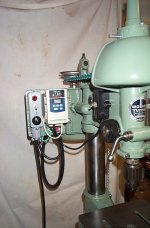
I've chanced upon and purchased a reasonably priced Powermatic 1150 drill press rebuild project.
Serial number (2-S820) dates it to a 1962 I believe.
It is a 1/2 HP 3ph, 5 speed step pulley, tilt table, bench-top, rounded pulley shroud version.

Though it ran just fine when I demoed before purchase, during dismantling at home in the garage I determined the motor to be quite far away from anything that the NEC/UL/OSHA would approve of so I will be doing a full replacement/update.

I will be operating in a 220v 1ph garage.
I prefer as many of my machines as possible to run 110v plugs, but 220v is OK if it saves me money on a VFD or motor.
This machine will see light/med duty home shop use, max chucked bit 1/2", on roughly 50% wood (6x6 timber down to plywood) and 50% Al & steel (5/16" tube, 5/8" plate, occasional thick stock bar of Al), maybe some light Al end milling if I'm feeling frisky.


Searching for a replacement motor has prompted a couple thoughts I can't seem to track down consistent answers on..

Should I double my motor HP to 1, or just one click up to 3/4?

I've seen some people discuss a 1/2" bit in 1/2" steel as this machines max... Is that with a 1 HP motor?


I thought a visit to my local electric motor shop would be helpful to rectify some of what I've read online thus far with real world sales/service experience, that sorta worked out.

My local shop said if I want vari-speed and reverse I have to have a VFD, but that VFD's can only be used on 3 ph motors, 1 ph cannot be controlled with VFD - Is this true, only 3 ph accepts VFD control?

They also said the motor has to have special internal wiring that is induction motor rated. I haven't seen/recognized this information in any of the motor upgrade posts Ive found on other sites/forums. - Did I miss a major point early on.


Thank for any input you can throw my way.
 
To avoid these ads, REGISTER NOW!

NC Rick

Well-known member
Joined
Oct 26, 2017
Messages
302
Location
Asheville
You can use your single phase power to run a VFD to make a three phase motor work great. The VFD may need to be uprated some and I would pick a bigger motor to make up for lost hp when you run lower RPM. You don’t want to under or over drive the motor by too much as it can be damaged. A VFD rated motor often has a cooling fan that runs full speed always so slow speeds can be achieved without overheating. If you are willing to also use the step pulley setup then any old 3phase motor could be good. Look for a compatible frame type to make mounting less trouble.
 
Last edited:

MattT

Well-known member
Joined
Feb 20, 2010
Messages
3,201
I prefer as many of my machines as possible to run 110v plugs, but 220v is OK if it saves me money on a VFD or motor.

You can use a 120V input 230V output VFD if you want. Never priced one so I'm not sure if they're more expensive than 240V input ones??

You'll need a 230V 3 phase motor either way so no cost difference there.

My local shop said if I want vari-speed and reverse I have to have a VFD, but that VFD's can only be used on 3 ph motors, 1 ph cannot be controlled with VFD - Is this true, only 3 ph accepts VFD control?

Correct, you'll have to use a 3 phase motor if you want VFD control.

They also said the motor has to have special internal wiring that is induction motor rated. I haven't seen/recognized this information in any of the motor upgrade posts Ive found on other sites/forums. - Did I miss a major point early on.

You're supposed to use "Inverter Duty" motors for VFD applications but it really isn't necessary for a drill press. Just keep the frequency at 20 Hz or higher and any new motor will be fine.
 

matt_i

Well-known member
Joined
Mar 14, 2008
Messages
10,728
Location
SE Michigan
Where you get into trouble with a VFD is you can run a motor at a (low) speed where the fan isn't providing enough cooling and can cook itself. Also there's "better" insulation quality for the non-smooth voltage spikes that a VFD regularly produces. But I've run some ancient motors on VFDs and they are fine. If you are building a conveyor that's supposed to run 16hr x 6 days a week then maybe you'd make a different choice.

If you want to mill something, I urge you to get a mill. A drill press is not built for the side loading nor holding the edge tool. All of which have a high probability of damaging the workpiece or even you.

I don't think I'd spend one extra penny on upgrading the motor, just use it as-is.
 

seber

Well-known member
Joined
May 31, 2016
Messages
4,198
Location
Deep East Tx.
Good and thorough advice in just a few posts. I agree with Matt. Make sure you have the machine properly grounded and just run it until you decide whether you have enough power and speed control. Reverse is really nice to have but not everyone needs it. As long as you are grounded, there is nothing that can happen that you can't fix. Even fire is not a big deal if you are already standing in front of it.
 

shawhite

Well-known member
Joined
May 28, 2014
Messages
1,519
Other than hp you also should decide what speed motor you want 1800rpm or 3600rpm.
 

Maui

Well-known member
Joined
Sep 16, 2012
Messages
2,871
Location
Upstate NY
Based on what you said you will be doing with this drill press, I’d just replace the motor with an older 1/2 hp or 3/4 hp single phase motor. You can change the speed by adjusting the belt to the different pulley positions. It should easily take less than a minute to adjust.

Maui
 
OP
N

NT55693

Member
Joined
Dec 5, 2019
Messages
10
Location
DFW
You can use a 120V input 230V output VFD if you want. Never priced one so I'm not sure if they're more expensive than 240V input ones??

I have seen that this is a widely available device type; however there are quite a few vendors for 120V 1ph IN & 220/440V 3ph OUT.
Since 3ph motors are generally cheaper and much more available that 1ph, I was wondering as well if there was a VFD spec type that is generally cheaper?
Digging around all those Eastern hemisphere websites is challenging.

You're supposed to use "Inverter Duty" motors for VFD applications but it really isn't necessary for a drill press. Just keep the frequency at 20 Hz or higher and any new motor will be fine.

Thanks for providing a floor value, though isn't speed directly proportional to Hz? If I want control down to say 75-100 rpm for tapping, is that more related to controller capabilities, or only Hz driven?

Where you get into trouble with a VFD is you can run a motor at a (low) speed where the fan isn't providing enough cooling and can cook itself. Also there's "better" insulation quality for the non-smooth voltage spikes that a VFD regularly produces. But I've run some ancient motors on VFDs and they are fine. If you are building a conveyor that's supposed to run 16hr x 6 days a week then maybe you'd make a different choice.
So a fully sealed motor is out of the question, my search should only consider "open" or unsealed motor casings?
Is there an industry term for a "fan all ways on full speed" motor cooling system?

Based on what you said you will be doing with this drill press, I’d just replace the motor with an older 1/2 hp or 3/4 hp single phase motor. You can change the speed by adjusting the belt to the different pulley positions. It should easily take less than a minute to adjust.
Maui

I'd like the capability to tap, run sub 400 speeds with the turn of a knob, and have a digital readout of my exact rpm.

From what I've read thus far, in this modern age you can do all that for as little as $100 more, or $250 if you want a really reliable control unit. That is very worth it IMO since I'm approaching this rebuild as a family heirloom build and finish.
 

MattT

Well-known member
Joined
Feb 20, 2010
Messages
3,201
Other than hp you also should decide what speed motor you want 1800rpm or 3600rpm.

If the press is designed for a 2 pole, 3,*** RPM, motor then changing to a 4 pole, 1,7xx RPM, would be worthwhile. It'll double the torque & halve nameplate RPM. Then you can get most of the lost speed back by running above 60 Hz when needed.

I have seen that this is a widely available device type; however there are quite a few vendors for 120V 1ph IN & 220/440V 3ph OUT.
Since 3ph motors are generally cheaper and much more available that 1ph, I was wondering as well if there was a VFD spec type that is generally cheaper?
Digging around all those Eastern hemisphere websites is challenging.

220/440 out is unlikely. And if you think their websites are bad just wait 'til you see their user manuals:wtf: Better to pay a little more for a low end name brand drive IMO.

Thanks for providing a floor value, though isn't speed directly proportional to Hz? If I want control down to say 75-100 rpm for tapping, is that more related to controller capabilities, or only Hz driven?

Correct on speed/Hz so 20 Hz will be 1/3 of nameplate RPM. Most VFDs are capable of running standard motors at speeds which will damage them. Too slow causes thermal problems. Too fast and you'll run into mechanical problems. A lot of drives will output 400 Hz which is over 6 times nameplate RPM.

And yes 400 Hz is on my to-do list. 2 pole motor wired for 230 and a 480V drive:bounce:

So a fully sealed motor is out of the question, my search should only consider "open" or unsealed motor casings?
Is there an industry term for a "fan all ways on full speed" motor cooling system?

For mixed metal & wood working I wouldn't consider a motor that isn't sealed. TEFC is what you need.

The term for motors with independent cooling fans is "expensive". And overkill for a drill press.
 

seber

Well-known member
Joined
May 31, 2016
Messages
4,198
Location
Deep East Tx.
Fans don't actually run any different speed than the armature. The difference in VFD rated motors heat tolerance. The fan is usually larger, more open space, better insulation and whatever proprietary mods the manufacturer might include.
 

dutchgray

Well-known member
Joined
Sep 28, 2014
Messages
6,467
Location
Dorset. England.
I really would bung a single phase motor on there and use it with the step pulleys as is, if like most 5 speed drills slowest pulley is 400 to 500 rpm you will be able to get to 100 rpm but it won't be making much power and will be fairly miserable to use for anything that actually needs those slow speeds, as the whole machine isn't built for such use.
My 5 speed drill, its slowest pulley was 340 rpm and I take it down to half that with the vfd but even there and with the maximum output turned up on the vfd more than I should it still lacks power. The variable speed is nice as for a lot of work it can be left in the middle speed, but its pretty much only good for wood and the 1/2 in steel it was rated for.
Other factors that need considering, bigger motors will often not fit well as the drive pulley ends up fouling the back of the pulley guard or will not fit on the mounting plate well, some of these smaller drills are not intended to run backwards and the chuck mounting taper (hopefully its a morse and not a male jacobs of some type) is not big enough to support the loads larger drilling in metal produces, I would not bothered going over 1/2 hp if you haven't got a morse no2 or better.

The motor speed is tied to the Hz you dial in on the VFD.
You could run a sealed motor if you wish, not really necessary on a drill, but it will be much larger and heavier than a standard motor.
 

Davefr

Well-known member
Joined
Jan 7, 2010
Messages
11,833
Location
OR
I would go with 1 or 1.5HP 1725 RPM 3 phase motor and set the VFD to overclock the motor by no more then 50% (ie 90 Hz). That HP will give you lots of torque at very low spindle speeds and the overclock will give you a nice boost at the high end.

You can probably set the pulleys/belt at the highest speed setting and never have to change the step. (but still can if the need ever arises)

A Teco L510 VFD is a good choice. (either 120v or 220v) The 1 HP L510 will power 1.5 HP motors just fine. I have two set up this way. Use sensorless vector mode and perform an autotune.

You will not burn out a good quality TEFC motor at low speeds for short to medium durations. I've never observed heat rise at low speeds. TEFC is recommended for DP's. DP's rarely run continuously for hours at a time.
 
Last edited:
To avoid these ads, REGISTER NOW!

matt_i

Well-known member
Joined
Mar 14, 2008
Messages
10,728
Location
SE Michigan
TEFC = Totally Enclosed Fan Cooled is your most common industrial 3 phase motor imo. Match frame size first and then look at HP and the nameplate (synchronous) speed. Most common 3 phase motors are configurable between 208-240/480 vac by specific arrangement of the 9 wires inside of it.

There are exotic TENV = Totally Enclosed Non Vented but its an exotic spec and so is its price.

ODP open drip proof is more of a residential motor and probably not a 3 phase motor.

If you want true spindle RPM you should look at some type of tachometer. I would think you could use a prox switch and a toothed wheel or maybe a photoreflective square on the spindle shaft. I don't have a specific direction to send you in, but that accounts for both effects of Reeves drive and the VFD's output.

Edit: excellent post Dave, you beat me to it! :beer:
 
OP
N

NT55693

Member
Joined
Dec 5, 2019
Messages
10
Location
DFW
Thanks for the replies guys. I've been doing a little digging with your comments in mind.

The tapped holes on my motor plate are 3" OC Vertically, and 5" OC Horizontally.
Using NEMA Electric Motor Frame Reference Chart - This would make my dimensions closest to:
'E' at 2-7/16" and '2F' at 3" - So only frames 56, and 56C are a direct bolt on - Correct?

The OEM motor has a 5/8" shaft that is 1-15/16" long.
Judging how the pulley sat on the motor OEM fit, you can go as low as 1-11/16 and as much as 2-5/16"

The OEM motor spun at 1725 RPM.

So my Grainger search for General purpose AC motors was as follows:
Motors > General Purpose AC Motors > 3 Phase > Frame 56 & 56C > Rigid Base Mounting Type > 208-230/460 & 230/460 Voltages > TEFC Enclosure Design > RPM Range 1701 - 1800 > HP 3/4 & 1.

This yielded the following as available that fit the mold.

MFG - Motor HP - Price (Model):

Dayton - 3/4 HP - $179 (2N866)
Baldor - 1 HP - $707 (EM3546)
Baldor - 3/4 HP - $377 (M3542)
Baldor - 3/4 HP - $706 (VEM3542)
Marathon - 1 HP - $357 (056T17F15666)
WEG - 3/4 HP - $177 (.7518ES3E56-S)

If you look at a comparison of the 3/4 HP models there are a couple details that I think might be significant:
1) Both Baldors are listed as 'Horizontal Install Only' - guess this is for the bearings?
2) The cheaper Baldor is not listed as 'Inverter Rated', only the more expensive is YES 'Inverter Rated' - for use with VFD...?


I'm partial to Baldor if I can get or afford them - the 'bay has several that are NEW NEW, and Open Box NEW for 75% less than above Grainger pricing.

But if this horizontal rule is hard and fast that knocks them off the list.

Any opinions on Make/models above?
Did I set my search terms correct, or too stringent?
 

blue95glide

Member
Joined
Feb 6, 2010
Messages
6
Location
Nottingham, Pa.
I've done a few repowers and VFD installations on older machine tools, mostly lathes and vertical mills. I'm currently working on a WW2 vintage Leblond regal 13 " lathe. I purchased a Siemens inverter rated motor and Teco VFD for it. I usually stay away from Grainger because they usually want 3much for everything. A vendor I do like and have had good luck with is Dealers industrial equipment. they specialize in motors and drives. A lot of times they have sales and package deals. I believe they are located in New York some where. A Google search should get you their website. I've used VFD's on step pulley Bridgeports and have made them variable speed. About 15 years ago I put a vfd with a 110 volt input that had a 230 3 phase output on a 1950's vintage South Bend heavy 10 lathe. That unit worked really well. When you put it in back gear and cranked the cycles down on the VFD the chuck turned super slow. Great for threading and knurling. that's my experience anyway. Good Luck.
 

blue95glide

Member
Joined
Feb 6, 2010
Messages
6
Location
Nottingham, Pa.
Dealers Industrial Equiptment is hillside NJ.


.75 HP, 1800 RPM, 56 Frame Baldor Motor with 1 HP, 115 V, 1 Phase, Teco L510 VFD

5% Off Motor & Drive Packages - Online Only
Model #: Package-P56X4109-and-L510-101-H1-U
Package-P56X4109-and-L510-101-H1-U

Quantity In Stock: 11
VFD Manufacturer : Teco
VFD Model : L510-101-H1-U
VFD HP : 1
VFD Input Voltage : 115
VFD Input Phase : 1
VFD Output Voltage : 230
VFD Output Phase : 3
VFD Enclosure : IP 20
VFD Condition : Factory New
Motor Manufacturer : Baldor
Motor Model : P56X4109
Motor HP : .75
Motor RPM : 1800
Motor Frame : 56
Motor Enclosure : XPNV
Motor Condition : New Surplus
Weight: 56.7 lbs
Our Price: $244.00

This package is on their website for a Baldor 56 frame motor and VFD
 
OP
N

NT55693

Member
Joined
Dec 5, 2019
Messages
10
Location
DFW
Dealers Industrial Equipment

Thanks for the recommendation.


That looks to be an explosion proof non ventilated motor - This seems exotic (read finicky), but I haven't researched this class before; also, I've never run one before.
F class insulation is nice, but I imagine thermal issues are perhaps more common with this type of enclosure?
Reliance, but not Baldor badged - is this an old stock model or the new label for B-R under the ABB name since 2018?

They are valuing the VFD at $138 - Very reasonable.
Thanks for the light reading of the user manual tonight :)

Off the top of my head, does Teco/WH offer a compatible remote controller to mount in the head piece hole for OEM switch?
 

ndnchf

Well-known member
Joined
Jan 9, 2012
Messages
1,556
Location
Fredericksburg, Virginia
When I restored my Walker Turner I used a 3 phase, 3/4hp 220v motor and a TECO FM50 VFD. It works great for me. I created a Frequency = spindle speed table that hangs on the wall next to it. Makes it easy to set the exact spindle speed.
 

Attachments

  • rstWT1.JPG
    rstWT1.JPG
    92.8 KB · Views: 10

Davefr

Well-known member
Joined
Jan 7, 2010
Messages
11,833
Location
OR
I created a Frequency = spindle speed table that hangs on the wall next to it. Makes it easy to set the exact spindle speed.


You can program your VFD to display spindle speed directly. You just set a parameter that maps frequency to spindle speed by telling it 60Hz = *** RPM and then it will display spindle speed vs Hz.

This is obviously only accurate for one belt pulley setting, however I don't think I've ever had to change belt/pulley steps from the highest RPM setting.
 

ndnchf

Well-known member
Joined
Jan 9, 2012
Messages
1,556
Location
Fredericksburg, Virginia
You can program your VFD to display spindle speed directly. You just set a parameter that maps frequency to spindle speed by telling it 60Hz = *** RPM and then it will display spindle speed vs Hz.

This is obviously only accurate for one belt pulley setting, however I don't think I've ever had to change belt/pulley steps from the highest RPM setting.

Thanks- it's been a long time since I put this together. I need to dig out my Teco manual.
 

MattT

Well-known member
Joined
Feb 20, 2010
Messages
3,201
That looks to be an explosion proof non ventilated motor - This seems exotic (read finicky), but I haven't researched this class before; also, I've never run one before.

The power wiring should be same as a conventional motor. There will probably also be some thermal monitoring/protection wiring in the peckerhead that you'll have to cap off. Or you could use it if you're concerned about overheating the motor at low speed.

Other than that it'll probably be a good bit heavier & larger than a regular motor but should work about the same as a TENV.

Off the top of my head, does Teco/WH offer a compatible remote controller to mount in the head piece hole for OEM switch?

They make one that might fit the hole. Though personally I'd rather use a flush start raised stop button on the front of the machine. Keypads aren't that great when you need to stop in a hurry. Maybe also add a speed pot if there's room.

You can program your VFD to display spindle speed directly. You just set a parameter that maps frequency to spindle speed by telling it 60Hz = *** RPM and then it will display spindle speed vs Hz.

Some drives can do custom RPM and some can't. Took a quick look at the FM50 manual and it looks like it's one of the ones that can't.
 
OP
N

NT55693

Member
Joined
Dec 5, 2019
Messages
10
Location
DFW
Thanks- it's been a long time since I put this together. I need to dig out my Teco manual.

From what I've read you can program the VFD to show within 1% actual spindle speeds.

Applicable to many other machine types are LED digital tachometers with a "Hall type" magnetic proximity sensor. $10-$15 EB/AMZN. Glue a small rare earth magnet near the shaft of pulley or drive shaft and it gives direct rev measures.


On the Teco VFD thought:

If the product brochure for the TECO L510-101-H1-U is correct:
AC input current is 19A - at 115V 1 ph input source.
I'll take that to be max current draw at stall conditions for the motor being driven?
Seems quite high and would necessitate a 30A shared outlet circuit breaker, or a dedicated 20A correct?

The L510 series does offer Teco JN5-CB-02M 2M Extension Wire for remote keypad installs; though I haven't found a picture anywhere showing an actual L510 remote keypad install.
The extension wire looks to be a special 8 pin shielded cable.
 

MattT

Well-known member
Joined
Feb 20, 2010
Messages
3,201
From what I've read you can program the VFD to show within 1% actual spindle speeds.

Applicable to many other machine types are LED digital tachometers with a "Hall type" magnetic proximity sensor. $10-$15 EB/AMZN. Glue a small rare earth magnet near the shaft of pulley or drive shaft and it gives direct rev measures.

You can program that drive to display RPM but it'll only be correct for one of the pulley steps. A tach would be the better way to do it.

If the product brochure for the TECO L510-101-H1-U is correct:
AC input current is 19A - at 115V 1 ph input source.
I'll take that to be max current draw at stall conditions for the motor being driven?
Seems quite high and would necessitate a 30A shared outlet circuit breaker, or a dedicated 20A correct?

That 19A input is for the drives rated output which is a bit over FLA for a 1 HP motor. The drive will almost certainly be able to draw more than 19A for short periods but nowhere near LRA, which you're calling stall. The drive will fault on overcurrent before the motor stalls. With a 3/4 HP motor on a drill press it'd probably work fine on a 15A plug but that isn't the "by the book" right way to do it.
 
To avoid these ads, REGISTER NOW!
Top Bottom