
You are using an out of date browser. It may not display this or other websites correctly.
You should upgrade or use an alternative browser.
You should upgrade or use an alternative browser.
Preferred "tool" to clean gasket mating surfaces?
- Thread starter Jacobson
- Start date
Codejack
Banned
Um, your fingers?
I've always thought that gasket scrapers were weird; I wonder if it's a regional thing. The worst one I ever had just came apart a little, and I had to peel some pieces off with my fingernails.
I've always thought that gasket scrapers were weird; I wonder if it's a regional thing. The worst one I ever had just came apart a little, and I had to peel some pieces off with my fingernails.
ssdave
Banned
I have a few old Proto gasket scrapers. Lot like wood chisels. I keep them sharp by using my planer blade sharpener, just like a wood chisel. Saw a lot of other people recommending wood chisels.
Just picked up a Snap-on one at the Restore last week for $1.
Just picked up a Snap-on one at the Restore last week for $1.
sberry
Banned
I have air powered too, don't use it a lot but every once in a while its just the thing. I had an in truck pan gasket that was about impossible any other way, was super stuck and overhead.
Thumbs up----Same hereRight Angle Die Grinder with a Scotchbrite cookie
Sent from my NS-15AT08 using Tapatalk
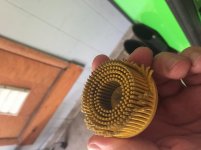
paulsomlo
Well-known member
I won't say it's not possible, but it's not likely. Are you cleaning a block or a head, and if it's a block, is it in or out of the vehicle? I just did this on a Subaru, block in the car, and it was miserable work.I'm afraid to use a metal blade.
I was using a plastic scraper, and could swear I was gouging the metal.
Teenager with old tools
Well-known member
Angle grinder with a grinding disk or cut off wheel works excellent. Sarcasm aside I just use my pocket knife works good for me
Sent from my P027 using Tapatalk
Sent from my P027 using Tapatalk
bochnak
Well-known member
Titan scraper handle with .020" HD blades, super scraper, or if part will fit in my cabinet....SODA BLAST it right off.
Super scraper works well except it won't "lift" gaskets well. It plows through residue great though.
Super scraper works well except it won't "lift" gaskets well. It plows through residue great though.
Jp267
Well-known member
Any suggestions for Triton aluminium intake manifold gaskets? The shop manual states Motorcraft Metal Prep my dealer never heard of it.
Sent from my XT1635-02 using Tapatalk
Sent from my XT1635-02 using Tapatalk
Jp267
Well-known member
Rather gaskets mating to aluminum.
Sent from my XT1635-02 using Tapatalk
Sent from my XT1635-02 using Tapatalk
https://www.amazon.com/dp/B0009OR96U/?tag=atomicindus08-20
My favorite by far. I bought the Craftsman scrapper with points, but I find myself going back to the Lisle each time.
Craftsman scapper - maybe not the best, but since paying with points, that's the best bang for the buck for me. I am cheap

paulsomlo
Well-known member
From the SDS for Motorcraft Metal Prep:Any suggestions for Triton aluminium intake manifold gaskets? The shop manual states Motorcraft Metal Prep my dealer never heard of it.
Sent from my XT1635-02 using Tapatalk
Chemical name Common name and synonyms CAS number %
ORTHOPHOSPHORIC ACID 7664-38-2 0.1 - 1
Loctite Aluminum Jelly is phosphoric acid and probably a lot cheaper and easier to get.
Jp267
Well-known member
Very smart! Thanks!!From the SDS for Motorcraft Metal Prep:
Chemical name Common name and synonyms CAS number %
ORTHOPHOSPHORIC ACID 7664-38-2 0.1 - 1
Loctite Aluminum Jelly is phosphoric acid and probably a lot cheaper and easier to get.
Sent from my XT1635-02 using Tapatalk
Going thru this myself and have a question...
I'm at the stage where only a fingernail and a brass wire brush are removing the last bits of old water pump gasket, and at that rate, it's gonna take about a week!
If I'm ok using the brass brush (and so far, it's not harming the surface--iron block) then should I "progress" to using a brass wire wheel attachment on a rotary tool?
I'm at the stage where only a fingernail and a brass wire brush are removing the last bits of old water pump gasket, and at that rate, it's gonna take about a week!
If I'm ok using the brass brush (and so far, it's not harming the surface--iron block) then should I "progress" to using a brass wire wheel attachment on a rotary tool?
ez-duzit
Well-known member
Use a gasket scraper or razor blade on cast iron.
shoggoth80
Well-known member
I use a razor blade. It's worked for years.
At work, when I was still a tech, I would scotch brite iron blocks. But always got as much as I could with a razor. Put rags in the bore, and a thorough wipe down. Aluminum.. one of the rubber widgy wheels after getting everything I could with a razor or scraper. Lots of caution.
At work, when I was still a tech, I would scotch brite iron blocks. But always got as much as I could with a razor. Put rags in the bore, and a thorough wipe down. Aluminum.. one of the rubber widgy wheels after getting everything I could with a razor or scraper. Lots of caution.
Thanks. I started with the plastic razor blade/scraper, was (still am!) nervous about a metal version, but I may need to get over it!Use a gasket scraper or razor blade on cast iron.
I'm seeing a pattern here...I use a razor blade. It's worked for years.
I tested the Dremel white nylon brush on the aluminum water pump, it did in fact start to burnish it, so I guess if nylon can do that to aluminum, brass may do the same on iron. I think caution and patience are gonna hafta prevail.Aluminum.. one of the rubber widgy wheels after getting everything I could with a razor or scraper. Lots of caution.
Willie Makeit
Well-known member
- Joined
- Dec 30, 2013
- Messages
- 921
Another vote for a Super Scraper. Once you use one you will wonder how you ever did without it.
This has got to be the most contentious topic in all of car wrenching. I been reading arguments for years and honestly I still don’t know the right tool. I heard different people online and irl say any of these
plastic scraper
metal razor blade
carbide scraper
scotchbrite pad brown
die grinder with steel wire wheel
die grinder with brass wire wheel
die grinder with the plastic noodle roloc attachment
It sounds like it depends on if your doing this to aluminum or steel surfaces. But still I hear a dozen different ways and idk what your supposed to do
honestly I always used a plastic scraper because I figure use the softest material that will do the job and move up to harder stuff only if you need it. If you can do it with plastic then why risk it with a die grinder. I been lucky and only have had to scrape off a handful of gaskets in my life so far and always aluminum and the plastic HF scraper did the job.
plastic scraper
metal razor blade
carbide scraper
scotchbrite pad brown
die grinder with steel wire wheel
die grinder with brass wire wheel
die grinder with the plastic noodle roloc attachment
It sounds like it depends on if your doing this to aluminum or steel surfaces. But still I hear a dozen different ways and idk what your supposed to do
honestly I always used a plastic scraper because I figure use the softest material that will do the job and move up to harder stuff only if you need it. If you can do it with plastic then why risk it with a die grinder. I been lucky and only have had to scrape off a handful of gaskets in my life so far and always aluminum and the plastic HF scraper did the job.
I'm looking into this now, thanks!Another vote for a Super Scraper. Once you use one you will wonder how you ever did without it.
RoninB4
Well-known member
I always start with a plastic scraper. If that doesn't do it I'll go for a single edge tool like a razor blade or wood chisel. What's important here, especially with aluminum, is to have the proper "feel" for when you're lifting gasket and when the edge starts to dig in. Angle of the edge, relative to the work surface, fingertip pressure, and trying to lift off the entire gasket in one go are all part of the technique I use. When it doesn't lift, I move on and leave the trouble spots for last. I avoid using chemicals or abrasives on an open engine but might run a trusted file lightly over the surface to ensure there's no raised divots. I was told a long time ago by a good mechanic NOT to use Scotch-brite pads on open motors, he had a couple come back on him and attributed the failure to particles falling into the motor. It takes a lot longer to scrape by hand but saving time just isn't worth the risk using power tools or abrasives. JMO
This.It takes a lot longer to scrape by hand but saving time just isn't worth the risk using power tools or abrasives.
I have to ask myself "if the engine were on a stand, what method would I use?", so I can't "punish" the engine (and myself) by rushing, doing something out-of-the-norm, in the name of "it's really cramped in here and I'm tired of having to fight with this radiator support."
Schurkey
Well-known member
GM and, I suppose, most other manufacturers disavow use of abrasives--the infamous Scotchbrite "cookies", the Chinese knock-offs of those "cookies", and the abrasive-finger jobs that are all powered by a drill motor or die-grinder.
What hasn't been said is that the abrasive dust is not only going into the engine you're working on, it's also drifting into the open engine in the stall next to you, and into the transmission valve body two stalls down, and it's ruining all three.
But even more important than the thousands of dollars of damage it's doing to vehicles, is the tens- or hundreds-of-thousands of dollars of damage that abrasive dust is doing to your LUNGS.
I've got many scrapers, including a Gearwrench unit that scrapes on the "pull" instead of the push. I rarely use any of them except the Lisle 52000 that clamps a single-edge razor blade. As said previously, dress the corners of the razor blade so the sharp corner doesn't gouge the work.
www.amazon.com/Lisle-52000-Razor-Blade-Scraper/dp/B0002SR88C/ref=sr_1_2?
What hasn't been said is that the abrasive dust is not only going into the engine you're working on, it's also drifting into the open engine in the stall next to you, and into the transmission valve body two stalls down, and it's ruining all three.
But even more important than the thousands of dollars of damage it's doing to vehicles, is the tens- or hundreds-of-thousands of dollars of damage that abrasive dust is doing to your LUNGS.
I've got many scrapers, including a Gearwrench unit that scrapes on the "pull" instead of the push. I rarely use any of them except the Lisle 52000 that clamps a single-edge razor blade. As said previously, dress the corners of the razor blade so the sharp corner doesn't gouge the work.
www.amazon.com/Lisle-52000-Razor-Blade-Scraper/dp/B0002SR88C/ref=sr_1_2?
Excato knife with a chisel blade,
Looks interesting...making me look for a flattish-style handle...Excato knife with a chisel blade,
(Update...switched to the steel brush, much better, not harming the surface, that I can tell...also ordered the hobby knife chisel blades, still nervous about using those, but may hafta get over it if the brush (sprayed with brake cleaner) alone can't cut the REALLY embedded spots!)
The standard holder, is pretty thin and the angle of approach is low, you'll only do damage if you're a animal, lol(Update...switched to the steel brush, much better, not harming the surface, that I can tell...also ordered the hobby knife chisel blades, still nervous about using those, but may hafta get over it if the brush (sprayed with brake cleaner) alone can't cut the REALLY embedded spots!)
theoldwizard1
Well-known member
A new blade from a "box cutter"/utility knife is stiffer. Soak the old gasket with WD-40 first.I use a razor blade. It's worked for years.
Carbide scrapers work well, but just like the utility knife blade, they can gouge aluminum very easily.
On iron/steel, the quickest is a 90° die grinder with a Scotch Brite/Roloc disc. You can use it on aluminum but be very careful !At work, when I was still a tech, I would scotch brite iron blocks. But always got as much as I could with a razor. Put rags in the bore, and a thorough wipe down. Aluminum.. one of the rubber widgy wheels after getting everything I could with a razor or scraper. Lots of caution.
shoggoth80
Well-known member
Yeah the Scotch Brite disc on a die grinder was the norm. But mostly used on 2.5 iron dukes.A new blade from a "box cutter"/utility knife is stiffer. Soak the old gasket with WD-40 first.
Carbide scrapers work well, but just like the utility knife blade, they can gouge aluminum very easily.
On iron/steel, the quickest is a 90° die grinder with a Scotch Brite/Roloc disc. You can use it on aluminum but be very careful !