To avoid these ads, REGISTER NOW!

Pros & Cons of Various Floor Types

nolimits76

Well-known member
Joined
Jul 11, 2013
Messages
959
Location
Oklahoma
I'm starting my research on flooring types for my 3 car garage and hoping everyone can list the pros/cons of the various flooring types. I start to think one way is better and then read about this or that. I know it would be beneficial to me, and probably other guys starting this process, to have a list of the various pros/cons that can be referred to when deciding. If this goes well, feel free to make it a sticky.

I'm not looking for "fanboy opinions", but rather real world experiences, preferably with pictures of the good and bad.

While I am open to hearing about other products, here is what I have been considering and researching:

- Plastic tiles (RaceDeck or similar);
- VCT tiles;
- Ceramic tiles;
- Porcelain tiles;
- Epoxy coating;
- Painted floors;
- Stained concrete;
- Polished/sealed concrete

Thanks in advance for your help. :)
 
To avoid these ads, REGISTER NOW!

factoryd

New member
Joined
Sep 4, 2013
Messages
3
Location
Phoenix, AZ
My first post here and I'm subscribing to this one.

I just bought a house with a two-car attached and a detached 2000 sq/ft. I'm diggin all the know-how around here.
 
OP
N

nolimits76

Well-known member
Joined
Jul 11, 2013
Messages
959
Location
Oklahoma
I appreciate the link, and have started reading a lot of the information. While it is good, I still hope to get some actual user input. Below is a copy & paste of information I found regarding RaceDeck and SwissTrax. This is the type of information I envisioned when I started this thread, and I hope others will contribute.

The idea is not only to help me, but to have a resource others can go to in the future to read. While this site is loaded with loads of good information, one shortcoming is the use of a stickies or databases to help users find the information better. Yes, I know how the search button works but it's not very useful if I don't know the correct key terms to search, and someone didn't label their post obvious enough so we would identify it.

Anyhow, hope to hear more comments. And I hope MSG C5 doesn't mind the copy & paste of the quote below. The original thread can be found in the link below. As an example of what I'm talking about with the searches...to find this information I actually searched for VCT information, and while reading another thread this was linked.

http://www.garagejournal.com/forum/showthread.php?t=215227

I'm in my garage flooring R&D phase as well. :lol:

I have samples of RaceDeck Freeflow, RaceDeck Diamond and Swisstrax Ribtrax (Similar to Freeflow).

A few observations...

Anyone who is concerned about the hollow or "click-clack" sound should consider the open face Freeflow or Ribtrax design as it significantly reduces the echo sound associated with the solid surface tiles. I performed a test where I dropped a quarter on each tile. The sound when the quarter hit the RaceDeck Diamond was very loud. Sort of like dropping a quarter on a pergo faux wood floor. When I dropped the quarter on the RaceDeck Freeflow tile, the sound was a lot quieter and more muted. Sort of like a softer, rubber surface. So if the hollow sound is an issue for you, the Freeflow is the better choice as the sound will be a non-issue on a full floor. In fact, I bet the overall garage echo will probably be muted as the floor tiles will probably help absorb sound.

IMO, the Swisstrax product is geared more torward commercial or industrial applications. It is a beefier product, larger in size (15.75 inch squares vs. 12 inch RaceDeck squares) and thicker as well. While this is good, I also noticed it was more difficult to vaccum up dirt and other garage floor junk through the Swisstrax than it was the RaceDeck. You can slightly bend the smaller RaceDeck Freeflow tiles but you cannot bend the larger Swisstrax Ribtrax tiles at all. Also, the Ribtrax grid-like pattern seems to show less of the floor underneath than the RaceDeck Freeflow tiles probably due to the thicker tile and the additional cross-beams underneath. Unlike the RaceDeck Freeflow, the Swisstrax Ribtrax also have an X-pattern that appears on the top of the tile which IMO sort of distorts the 3D cross-pattern visual effect of the tiles so I personally like the looks of the RaceDeck Freeflow better.

What I cannot understand is why Swisstrax decided to engineer their tiles in such odd configurations. Why 15.75 inches?! IMO, it makes it more difficult to measure out and design a floor. Plus their other style tiles cannot mix/match and they come in different sizes based on the design. The RaceDeck tiles can be intermixed. It would be a lot easier comparison if I was comparing a 12" RaceDeck tile to a 12" Swisstrax tile.

The RaceDeck tiles also tend to lock in a little tighter than the Swisstrax tiles primarily because their hook and loop tabs are larger than the tabs on the (larger) Swisstrax tiles. :dunno:

It makes for a really tough decision, however I think both brands are high quality and will work well for any residential application. The Swisstrax will be more expensive per tile, but you will need less of them to cover the same square footage. However as mentioned, they are beefier and feel more commercial. I think their colors are a little more muted than RaceDeck also. The RaceDeck beige is almost an exact match to my existing floor epoxy and I like their graphite color as well. The Swisstrax ivory is the closest to the beige I can find and it has more of a yellow-ish tint and their gray tiles are not very dark compared to the RaceDeck graphite. I guess it comes down to a matter of personal taste.


OP
N

nolimits76

Well-known member
Joined
Jul 11, 2013
Messages
959
Location
Oklahoma
Thanks Paul!

For ease of reading, I copied and pasted your original post below:

All the different flooring options are very confusing and I think all have pros and cons. Cost is one of them. Cheaper generally is less robust or has limitations. But not exclusively so. Here is my take:

Epoxy: Tough and durable and can have pretty flakes or other things added to it. Generally you need a nice 100% solids basecoat and a clear IF you do flakes. Best clear for anti-scratch is a Polyurethane, but they are thin so you really need two coats of clear. Epoxy itself can get scratches/scuffs over time, but it is very tough. Polyurethane clear might be 2x or maybe 3x better at scuff/scratch than clear epoxies, all depending on the products, but it is very thin, so if you do scratch it, it will go through 1 coat of it. So use 2 coats if going with Poly clear. Cheaper option is no flakes and no clear, just a basecoat. All epoxy will amber over time, whether it is in the sun or not. Faster in the sunlight. UV protection in a coating helps but that will eventually go away and evaporate out. I would never ever use an epoxy clear in a garage for the amber reasons. Some epoxy basecoat colors handle the ambering better than others. Light colors like white not good over time. Complete DIY cheap install for me with epoxy basecoat/clear (in basement without windows)/chips/self grinding of floor came to about $2.5 a sq foot for me. Would have been less if I did a larger area floor on a square foot basis. It goes up from there. Pro install at $4 would be a good deal, many are $5 or $6 a sq foot. One more thought on damaged /scratched /chipped /worn /ambered epoxy over time: Nice thing is you can always scuff it up a little and put a new or different coat on top and start over, but with an even thicker "base" floor than you had before. So even if ambered, can be restored with just another layer fairly easily. Can also do 100% chip coverage on it, so ambering is never ever an issue then if you like that look. Be sure too to always use anti-slip silicon oxide for the top layer or it can be very slippery. Chips if you use them also will add anti-slip to the floor as your rubber soles will grab around each chip, increasing friction and anti-slip a good bit. Epoxy or Poly without anti-slip or chips standing proud is like a skating rink when wet.

Epoxy Prep: Diamond grinding is best. Hard and time consuming to do for lowest cost with a hand grinder (4.5 or 7" diamond grinding wheel on angle grinder), still hard and less but not insignificant time consuming for higher cost with a pro standing upright grinding machine rental (or several days rental). Hiring out just the grinding of the floor to a contractor might make a lot of sense for larger floor areas, not so much for smaller floor areas. The grinding and other filling/patching/repairing prep is the hardest part of the job for sure.

Primer Layer under Epoxy Basecoat: Primers are a great idea under any basecoat layer except that they add cost and you don't always need them! Here is what they do: 1. Reveal any adhesion issues from the 1st coat put down vs. in the basecoat. 2. Reveal any gas bubble issues from 1st coat put down vs. in the basecoat. 3. Reveal what texture or flatness you are going to get when done with the job before the basecoat is put down. 4. Help to fill in the small holes/ cracks/ pits / etc. before the basecoat goes down (although anything more than 1/8" deep really needs special attention before the primer coat anyway). 5. Custom seal a higher water vapor level floor with special primer so you can do an epoxy coated floor when this is needed. 6. Will act like a paint primer in maintaining a consistent color over the whole floor for the next layer of basecoat if needed. 7. Can improve the bond between floor and basecoat, helping to avoid tire pulloff problems. So all great stuff. If you use one it has to be epoxy! No paint type primer will work with epoxy! Water based epoxy makes a good primer or diluted 100% solids so it will **** in the concrete and grab better. Another approach is to just not do a primer if you don't have high water vapor level, don't have bubble issues, don't have adhesion problems, etc. and just do your basecoat to save cost. If these issues show up, just buy more basecoat and put it over the first basecoat level and that is your primer then! I used a "partial primer" just to fill in holes/cracks/pits where needed using some Rustoleum 100% solids patch kit. That worked great for me and I had no other needs for a primer on the whole floor and saved cost this way. If you want to be sure it is great and don't care about the cost, use a primer for sure. Otherwise, use the 2nd basecoat layer primer method above only if you have issues from the 1st basecoat layer. Good to just buy extra basecoat epoxy in the first place for use as a primer coat to save money on it up front if you are going to do it. You can also just buy extra main epoxy upfront to fill in all those cracks/pits, etc., and not need any Rustoleum 100% solids patch kit then. I needed it because I already had the main epoxy and needed a local solution to provide more without waiting to have things shipped. Menards carries the Rustoleum and was local.

Polyaspartic/Polyurea: Basecoats for a garage vs. epoxy make a lot of sense. Except that these are not even close to user friendly for the DIY to install. I know how to do epoxy well now but I would not think of trying to do this one myself. Won't ever amber so good choice I think for a garage with sunlight. I'd hire a pro if this were considered. Same prep otherwise as above for epoxy.

VCT: Nice patterns but not so tough as epoxy. Alpha recommends an epoxy/polyurethane clear over it, but then could eventually amber and you are pretty pricey at that point. Lots of maintanaince and waxing required every year otherwise.

Ceramic Tile: Jack has started this one as a cheap alternative to epoxy but tougher by far and free of many of its issues/limitations. Doesn't actually crack or fail if installed well. May be lowest cost most durable option for the money. There may be a reason pretty models hang out in Jack's garage (see recent magazine article if you haven't seen that yet!) Could be done for a little over $1 a sq foot if you get a good deal on cheap closeout tile to use.

Porcelin Tile: Higher end but better tile that people seem to love. Ultimate floor? Maybe.

Tile Prep/Installation: Not easy to do and time consuming for the DIY. But can be done by most DIY with effort, like floor grinding prep for epoxy this way. Can also be done in stages and not all at once generally.

Cement Densifier/Acrylic Type Sealer: Can protect the basic cement and make it harder to be chip resistant and spill resistant. Cheaper option than most of above except perhaps basic ceramic tile, depending on what you buy and where. Probably a good option for the working shops or very large floors to do with the lower cost, but you don't get the fancy colors or patterns with it and might have to touch up the sealer every so often.

Acid Etch Stain: Similar to epoxy above but with different colors and patterns, generally used with a polyurethane clear over it, but no ambering worries ever with this recipe, unlike an epoxy. Could be cheaper than epoxy/clear coat depending on cost of the stain/etch.

Racedeck or other plastic tile: More expensive than some of the above but a good alternative in some cases where there are issues doing other options successfully. Not my area so that is all I'll say on this one. Many other experts on this on the forum.

Hope this helps some newbies or others on the fence. Also, I do recommend visiting Shea's little flooring website. He has pulled together info from this forum and other places into one site that has alot of good info on it now. Check it out. All the above are my opinions folks, so take them as such. Others are free to have other opinions as you may like. -- Paul
 

pauls_workshop

Well-known member
Joined
Mar 7, 2013
Messages
2,788
Location
Indiana, USA - Underappreciated Place to Live!
Thanks Whitefeather, but I keep editing it and adding even more! (My wife says I like to talk alot. I guess I like to write alot too!). I like to help others whenever I can in life and pay it forward always. We need alot more of that in today's world to try to keep it together... - Paul
 

thegarageguy

Well-known member
Joined
Oct 24, 2007
Messages
1,489
Location
NJ
My 2 cents (for what it's worth)

- Plastic tiles (RaceDeck or similar);
good way to cover up nasty deteriorated concrete where resurfacing or complete demo would be much more costly. Has a clankity-clank sound, especially in the cold. Does get dirty and is difficult to remain looking new after some use.
- VCT tiles;
not recommended for garages...cheap diy alternative
- Ceramic tiles;
good diy alternative...depending on the tile bought, can last for years. Choose a dark grout or it will eventually dirty and darken. Can become very slippery when wet.
- Porcelain tiles;
a little more expensive than ceramic but has same cons as ceramic
- Epoxy coating;
diy intalls are usually paint jobs with insufficient prep. Pro installs are costly and difficult to find a reputable installer. Installed properly, should last for years on end with low maintenance.
- Painted floors;
paint will just sit on the surface of the concrete...it will not penetrate of anchor. It is not meant to be used as a wear surface
- Stained concrete;
for a garage, you still need to diamond grind. When that is done, acid stains do not work as well since you just grinded of the lime that makes it react. Pro's use acetone based dyes to give transparent colors. Stained concrete still need to be sealed with epoxy and polyurethane or 2 coats of polyaspartic.
- Polished/sealed concrete
In dry or non winter settings, polished concrete works well in garages. In the North East or any area where you will have snow and salt intrusion, polished concrete will not fair well. After a good storm, your shiny concrete and or color will wear and go away.

Though I am a seamless flooring fan, I understand that cost and convenience always play a role in our decisions. If you are attempting diy, inform yourself well. If you are looking to hire a pro, make sure you check references well and see actual jobs that date 3 plus years.

Good luck!
 
Last edited:
OP
N

nolimits76

Well-known member
Joined
Jul 11, 2013
Messages
959
Location
Oklahoma

Attachments

  • garage floor.jpg
    garage floor.jpg
    120 KB · Views: 149
OP
N

nolimits76

Well-known member
Joined
Jul 11, 2013
Messages
959
Location
Oklahoma
I had RaceDeck, but it was a major pain to clean under. Now I have epoxy in both garages...couldn't be happier.

Yeah, I think most will agree it's hard to beat the look of the RD tiles; however, this too was one of my concerns. I won't pretend I'm Mr. Mechanic but when I unleash my (amateur) wrench turning "skills", fluids will be spilled!

It bothers me fluid can leak beneath the floor. Granted you can pop the tiles out and clean, but seriously, who wants to do that on a frequent basis?

Just curious what epoxy did you go with, and why....and any cons to it?
 

MSG C5

Well-known member
Joined
Jan 11, 2011
Messages
193
Location
Sarasota Area
Yeah, I think most will agree it's hard to beat the look of the RD tiles; however, this too was one of my concerns. I won't pretend I'm Mr. Mechanic but when I unleash my (amateur) wrench turning "skills", fluids will be spilled!

It bothers me fluid can leak beneath the floor. Granted you can pop the tiles out and clean, but seriously, who wants to do that on a frequent basis?

Just curious what epoxy did you go with, and why....and any cons to it?

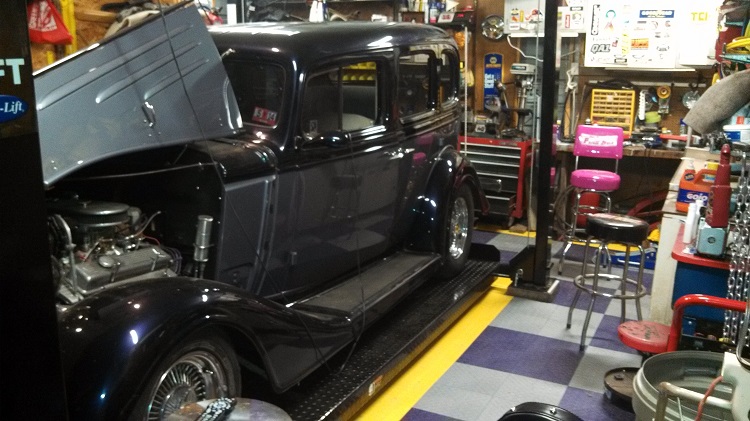
Below is a picture from another forum. The owner of this Racedeck floor created a portable/collapsable cardboard work area for when he worked with fluids under his 4-post lift. Pretty good idea even if you don't have a RD floor.


donnie

Well-known member
Joined
Jan 24, 2007
Messages
953
Location
North Carliona
My 2 cents (for what it's worth)

- Stained concrete;
for a garage, you still need to diamond grind. When that is done, acid stains do not work as well since you just grinded of the lime that makes it react. Pro's use acetone based dyes to give transparent colors. Stained concrete still need to be sealed with epoxy and polyurethane or 2 coats of polyaspartic.
[

This comment is confusing me...that does not take much :headscrat

Why do you have to grind a floor for stain? It looks like you are saying you have to grind, but than say it will not take the stain as well.
 

thegarageguy

Well-known member
Joined
Oct 24, 2007
Messages
1,489
Location
NJ
This comment is confusing me...that does not take much :headscrat

Why do you have to grind a floor for stain? It looks like you are saying you have to grind, but than say it will not take the stain as well.

Well, IMO, for excellent penetration of an epoxy primer, one must diamond grind or shot blast, regardless of anyone tells you. Sure you may get away with just acid washing or some citrus cleaning concoction...but you are definite with proper diamond grinding.

With that said, acid staining is a reactive stain. It reacts with the lime in your concrete. The most concentration of lime is usually found in your cream layer, which is typically the softest part of your concrete slab and what is usually grinded off when diamond grinding or shot blasting.

Acid stain will still color your grinded concrete but you will not get great marbling, like it is known to give. Because of that, most people use acetone or water based dyes to recreate the look of acid stains.
 
To avoid these ads, REGISTER NOW!

Armorpoxy

Well-known member
Joined
Aug 18, 2013
Messages
3,735
Location
NJ
Hi,
Regarding the 'click and clack' mentioned here another option is a full solid tile from PVC polymer. We offer this under our SupraTile line www.supratile.com. They are very quiet which is a running comment on the hollow type tiles.
 

RaceDeck1

Well-known member
Joined
Oct 8, 2007
Messages
3,001
Location
Salt Lake City , Utah
For 99.9% of our customers the "sound" is not an issue as every floor has their own unique sound. For those who do want to muffle the sound, we have found that simple landscape felt under the floor will deaden it, avoiding the expansion and odors issue found with rubber and PVC.
Also our patent ShockTower technology will deaden sound & offer anti-fatigue..plus you can use in specific locations within your floor.
 

Garage Flooring

ALLIANCE MEMBER
Joined
May 21, 2011
Messages
5,288
Location
Grand Junction, CO
Both RaceDeck and Armorpoxy make great points. It really depends on how you use your garage and what you want to accomplish with your floor. Our neighbors have theirs set up as a game room and noise would be a factor. If you are just parking your car...

Lots of options. No 'best product' for all just a best product for you and your needs. Call me if you need some help sorting through it
 
OP
N

nolimits76

Well-known member
Joined
Jul 11, 2013
Messages
959
Location
Oklahoma
In regards to the Race Deck (and similar) floor tiles, it seems there are (2) variants. One that is solid rather it be diamond plate, dots, etc. And the other is a free flow system.

My understanding is the free flow is primarily for regions where owners might experience lots of snow, ice, salt, etc and want that to melt and drain away. Also, I presume it will be easy to spray away? The downside I see to this is dropping a quart of oil would have the same "benefit" meaning the concrete floor still gets exposed to such contaminants.

Sounds like the solid tiles would work better in warmer climates, where snow, ice and salt isn't as much of a concern. However, how "waterproof" are the joints where the tiles join? Using the spilled quart of oil theory, obviously oil would stay on top of the solid tiles, but would they leak into the joints? Essentially creating the same problem as the free flow tiles, but on a smaller scale and probably undetected until you remove a tile.

Can the experts further clarify?
 
OP
N

nolimits76

Well-known member
Joined
Jul 11, 2013
Messages
959
Location
Oklahoma
For 99.9% of our customers the "sound" is not an issue as every floor has their own unique sound. For those who do want to muffle the sound, we have found that simple landscape felt under the floor will deaden it, avoiding the expansion and odors issue found with rubber and PVC.
Also our patent ShockTower technology will deaden sound & offer anti-fatigue..plus you can use in specific locations within your floor.

Nice. Are these just pieces you can simply add to existing tiles?
 
Joined
Nov 5, 2012
Messages
23
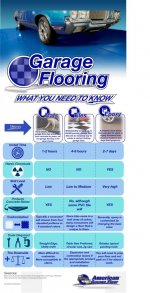
This graphic breaks down the pros and cons of each garage flooring type pretty well

garage-flooring-what-you-need-to-know.sml.jpg


You are welcome to share this using the code below

HTML:
<img src=http://www.americangaragefloor.com/_images/garage-flooring-what-you-need-to-know.lrg.jpg /> 
<a href=http://www.americangaragefloor.com/garage-flooring-what-you-need-to-know/ title="Garage Flooring: Your Options" width="550"> What You Need To Know About Your Garage Floor</a>
 

RaceDeck1

Well-known member
Joined
Oct 8, 2007
Messages
3,001
Location
Salt Lake City , Utah
Interesting chart and nicely laid out. But , not sure on what "tiles" that they are referring to? but with RaceDeck in a standard two car garage that is cleaned out, you are looking at 2-3 hr max with trimming in ( exceptions would be elaborate cuts, or taking a nap in the middle of the install ;) ) . Our 2 man crew here can install a two car garage with two walls of trimning in just about an hour, but we have done a few over the last few decades :)
 
Joined
Nov 5, 2012
Messages
23
Jorgen,

I have worked with every major brand on the market and some not so major ones :) We sell everything from PVC to polypropylene. Our numbers are meant to be total install times and it has been my experience that it is better to leave a little extra time then to tell a customer they can be done in 2 hours and have them working into the night.

For example, in a lot of cases a garage mat can be installed in under 30 minutes. Less than 10 minutes if you are not going wall to wall. BUT you have to get everything opened up, laid out, and we all know stuff comes up.

Someone one once told me that averages are like putting one foot in boiling hot water, one foot in freezing cold water and saying on average your comfortable... BUT we based on thousands of installs, we believe these numbers to be accurate for an inexperienced DIY customer --besides you have to leave time for drinking a cold beer while your working :)
 
OP
N

nolimits76

Well-known member
Joined
Jul 11, 2013
Messages
959
Location
Oklahoma
Someone one once told me that averages are like putting one foot in boiling hot water, one foot in freezing cold water and saying on average your comfortable... BUT we based on thousands of installs, we believe these numbers to be accurate for an inexperienced DIY customer --besides you have to leave time for drinking a cold beer while your working :)

Haha, just A cold beer? As in single? You need to adjust your charts w/ more time. :)

Seriously though, you are right. Anyone performing DIY work probably isn't a speed demon unless they've done it before. I always take recommended install times with a grain of salt. Of course, I tend to stew over details sometimes too, so I know that slows me down. Usually by the time I actually do something, I've already done it 10x in my head.

And based on the chart, it sounds like the answer to my initial question is NO the tiles (regardless if free flow or not) doesn't offer any real chemical protection.
 

Cruisinthe34

Active member
Joined
May 22, 2013
Messages
27
Location
West Virginia
I've been working on my Racedeck floor for a month and a half or so now, and yes the is a clicking/clacking while walking around on it. I'm fine with that as mine is a working garage and I do not find it annoying or distracting.....there's going to be SOME sound regardless of floor finish.

As for install time....I'm a poor witness as I had to undo and redo my floor (my own fault), but I never completely emptied my garage to install the tiles.

rear_front.jpg


Front_left.jpg
 
OP
N

nolimits76

Well-known member
Joined
Jul 11, 2013
Messages
959
Location
Oklahoma
I've been working on my Racedeck floor for a month and a half or so now, and yes the is a clicking/clacking while walking around on it. I'm fine with that as mine is a working garage and I do not find it annoying or distracting.....there's going to be SOME sound regardless of floor finish.

Thanks for sharing your experience.

You bring up a good point about most floors making a noise. My ears are extremely sensitive to high pitched noises. Things like forks on plates, wet tennis shoes on certain floors, etc pierce me. :shocking:

While I can deal with clicking and clacking, do the RD (or other brand) tiles make any high pitched squeaky noises? Perhaps when wet?

What about epoxy floors? I could see them being problematic, but maybe I am wrong.
 

Cruisinthe34

Active member
Joined
May 22, 2013
Messages
27
Location
West Virginia
I do not have any 'high pitched' noises.......more like the sound of walking across a wooden porch maybe.....never really tried to describe it before.

I do weld and run a torch in my shop so I do take care to put welding blankets down when needed.

I would caution to be careful to NOT step on a loose racedeck tile which is lying on installed tiles...... THAT results in a bad experience...... dont ask me how I know... :)

I had concerns when I did my evaluations about how epoxy holds up to things like brake fluid. I have seen epoxy floors peel when exposed to brake fluid. It may have been poor prep work, but I have seen it several times. In my experience so far the tiles seem to be pretty resilient to most auto related chemical spills. Oil, Trans Fluid, gasoline, antifreeze and brake fluid.
 
Last edited:
OP
N

nolimits76

Well-known member
Joined
Jul 11, 2013
Messages
959
Location
Oklahoma
I was thinking more about the chemical resistance of the different tile floors. I found the following PDF from Race Deck stating their tiles are 100% polypropylene.

http://www.joewilde.com/files/products/garage-screens/RaceDeck-FAQ.pdf

What are the RaceDeck tiles made out of?
RaceDeck is made of 100% polypropylene, a premium, high-impact copolymer. This means no fillers, foam agents, lead or other foreign materials to compromise the integrity of the flooring.

Being in the environmental business for awhile, I understand that different materials such as polypropylene (PP), high density polyethylene (HDPE), polyvinyl chloride (PVC), etc all have different chemical resistances. Truthfully I understand HDPE the best as that is 99% of what we sold and installed. When speaking about those type of liners or custom fabricated structures (sumps, manholes, etc) the real concern for contaminate leakage is at seams. For the most part, these liners are considered "leak proof". However, leak proof is typically defined by a small acceptable amount of leakage after a certain period of time.

I suspect PP is the same. Therefore, I found a chemical resistance chart to give me an idea how resistant to chemicals the RD tiles should be. Below is a link to the data I found:

http://www.gilsoneng.com/reference/ChemRes.pdf

Using my previous "spilled oil example", I decided to check on petroleum since that is the major content of motor oil and probably the most likely to be dropped on a garage floor. Look on page 20 of the attached link, and we can quickly see that PP has a good chemical resistance of petroleum up to 68 degrees. At 104 and 140 F the grade goes down to a 2 (limited resistance). There is no rating at 141+ F.

Other chemicals can be cross referenced. This is the one I chose to analyze.

So to me it looks like the solid tiles should offer some protection to the floors underneath, with the mindset each joint would be your weak point. While I mention Race Deck in this analysis, this would be true with any tile manufacturer of PP material. It's the properties of PP we are comparing.

Anyhow, not sure if this will benefit others, but I found it interesting.
 

RaceDeck1

Well-known member
Joined
Oct 8, 2007
Messages
3,001
Location
Salt Lake City , Utah
quote "While I mention Race Deck in this analysis, this would be true with any tile manufacturer of PP material. It's the properties of PP we are comparing"

There are still variables where this is not true in comparison. Many competing products use various fillers and/or foaming agents in their product to either save money, compensate for design flaws or both. These agents can react to various petroleum and chemical products.
 
OP
N

nolimits76

Well-known member
Joined
Jul 11, 2013
Messages
959
Location
Oklahoma
quote "While I mention Race Deck in this analysis, this would be true with any tile manufacturer of PP material. It's the properties of PP we are comparing"

There are still variables where this is not true in comparison. Many competing products use various fillers and/or foaming agents in their product to either save money, compensate for design flaws or both. These agents can react to various petroleum and chemical products.

Thanks for clarifying this. I am glad to see you guys use PP material. 100% PP is icing on the cake.

I know some other brands utilize PVC material, but from my stint in the business, I have a hard time getting excited about it. PVC was always the cheapest and poorest quality material mainly due to its inability to do well with UV exposure. While my garage does not see frequent long term sun, it's just not something I would want to deal with.

While on the topic of raw materials, am I correct to assume you guys purchase colored PP resin chips? So basically the color is integral to the product once the chips get melted down and formed during the manufacturing process? It might be interesting to see your plant in operation.

Lastly, are there any good answers on how leak proof the seams are with your solid tiles? Not sure an ASTM method exists, but in my head I envision testing that would involve an installed floor system and different chemicals (with different thicknesses and consistencies) being intentionally spilled on the tile seams and then observed to see how well the joints hold up and how long it takes for the chemicals to leak through the joints? I think most guys will be rather quick to clean up a mess as long as they know it's present. What might be problematic is something like a hose busting loose and leaking fluid while a vehicle is stored. If it leaks like a sieve, maybe something could be developed to help the tiles seal better and provide better protection to underlying floors?
 

Hencini

Well-known member
Joined
May 26, 2013
Messages
338
Lastly, are there any good answers on how leak proof the seams are with your solid tiles? Not sure an ASTM method exists, but in my head I envision testing that would involve an installed floor system and different chemicals (with different thicknesses and consistencies) being intentionally spilled on the tile seams and then observed to see how well the joints hold up and how long it takes for the chemicals to leak through the joints? I think most guys will be rather quick to clean up a mess as long as they know it's present. What might be problematic is something like a hose busting loose and leaking fluid while a vehicle is stored. If it leaks like a sieve, maybe something could be developed to help the tiles seal better and provide better protection to underlying floors?

This has always been my hesitation with Racedeck. Ideally, I'd like to be able to wash my cars in the garage. I don't want to have a bunch of stagnant grimy water festering beneath the tiles.
 

Cruisinthe34

Active member
Joined
May 22, 2013
Messages
27
Location
West Virginia
I have spilled antifreeze on my floor and I have a pesky power steering fluid lead (I park a car on my lift daily). I have not pulled a tile to check underneath, but I have also used a power washer to clean my floor. There are 'channels' built into the underside of the tiles and with a properly sloped floor I have no worries about fluid setting under the tiles.

I am simply stating my personal feelings after installing and working with these tiles.

iris.jpg
 

kent_323is

Well-known member
Joined
Nov 13, 2009
Messages
274
Location
South Dakota
When we built our shop back in 2001, we got a bunch of epoxy floor coating, unfortunately, we didn't wait long enough for the concrete to fully cure, and as the moisture came out of the concrete, it blistered the coating and most of it came off. So we learned the hard way on that one.
When we poured additional concrete a few years later, we taped a square of plastic to the floor, about 12" square, and when there was no more water beads, then it was ok to coat the floor. That batch of epoxy worked great, and it's had lots of forklift traffic, heavy equipment, vehicles, welding, oil, hydraulic oil, etc on it with no issues.
I like the epoxy for cleanup of oils: spread on some floor dry, and sweep it with a broom.
I haven't tried any of the other mats, so I won't make any opinions on them.

Good luck!
 
To avoid these ads, REGISTER NOW!
Top Bottom