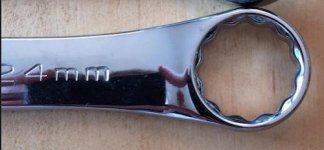
The point is not to illustrate the 'best solution' but to highlight that the problem you are denying exists. The broach shapes of box wrenches matter for fastener access. You cannot simply dismiss people when they point that out. The flush fastener friendly box ends come in 15 degree offsets, so that is no the issue.
The real issue is whether or not these problems show up in your workflow. Some people work with flush or maybe more often semi-flush or partially recessed fasteners. So they are very aware of the limitations of box-end broaching. Brand X,Y,Z may not all work as well for semi-flush placements, and rather than having duplicate sets its sometime better to invest in the tool with wider (more reliable) range of applications.
As far as I can tell the SK shape is just brand identity--its not an engineering solution--you can see this as it was carried over into their latest ratcheting wenches.
On the topic of ratcheting wrenches, most people are familiar of course with the inability to use them in many places because of the shape of the broach is much closer to SK type combos.
I'm not dismissing anyone, I'm providing pictures and measurements to say the criticisms being made by several aren't necessarily accurate or appropriate (especially in terms of who the OP is, and that he is looking for occasional use tools).
You're right that the Facom wrench would be able to get where the SK could not. It also would get where a Snap On, Proto, or pretty much any combination wrench would not be able to get. There is no other combination wrench (besides that nicely picked out Facom) I know of that would be able to get at recessed fasteners is what I am trying to show. Again, the design of the Facom wrench is similar to the Snap On DBE wrench you posted a picture to, not most combination wrenches. Combination wrenches have the handle beam meet the middle of the box end, making it useless to reach recessed fasteners. The Facom engineers obviously noticed this, and changed their wrenches so that the beam meets at the top of the box end, allowing it to have greater reach in terms of depth for the removal of recessed fasteners. However, since nearly every other (if not all other) combination wrenches use the design where the beam meets in the middle of the box, it's a test that Proto, Snap On, Wright, etc would also fail. If you want to prove that the Facom wrenches can do something the SK can't, I'd totally agree with you. But that also applies to every other readily available wrench we in the US can buy.
Re-read the section I wrote about how much depth a Snap On combination wrench would have to access a recessed fastener. For a 14MM wrench, having 2MM of depth to get to a fastener is not enough to be able to successfully remove a 14mm nut/bolt, unless it was already loose (you'll round off the very top portion of the nut/bolt). Evaluating a combination wrench on how well it removes recessed fasteners is like evaluating a rifle on how well it does with duck hunting. They were never designed or intended to removed recessed fasteners (at least with the exception of that Facom you posted).
The biggest issue with ratcheting wrenches is not the shape of the broach (broaching is the punching of the box end, has nothing to do with how the box end is attached to the handle beam), it's the diameter of the head. A 14MM gearwrench has a 26MM diameter head (72T), while a SK or Snap On 14MM non ratcheting combination wrench have a 21MM head (measurements taken from each companies' respective catalog). That extra diameter of the ratcheting wrench is what doesn't allow it to fit. The SK and Snap On have the same diameter thickness in the broached area.
Futhermore, I attached some photos that show the taper from the beam to the box on the Snap On High Performance box end wrenches. You can see that those taper sections are also quite thick and wide (just like the SK), but yet, as you admitted, these are the best wrenches for a recessed fastener. That taper looks awfully like the SK from the top being very wide! But again, it's not the width of the tapered section, it's how much the box end sticks out down below the beam the determines how good it is at reaching recessed fasteners, and pretty much every combination wrench has next to no stick out below the beam (sorry, 2MM just isn't adequate to remove a fastener on a 14MM wrench, Snap On Fails that test too).
Ultimately, the issue is that only wrenches that have the beam join with the top of the box end are good for removing recessed fasteners. Those are the only wrenches that have enough depth in the box end heads to reach down to get those fasteners. That leaves the Facom combination wrenches or various brands of High Performance DBE wrench (Snap On, Nepros, Genius, Mac, and a few others). The Facom you showed me is the only combination wrench I've seen designed in this manner, and every other combination wrench would fail this recessed fastener test, not just an SK.
Cliff Notes: People say SK are bad because they wouldn't be able this particular task, when pretty much every alternative brand of combination wrench would also be unable to the same task.
*On a side note, in the photo from the Facom brochure, I'm not sure why they wouldn't just use a socket instead of a wrench for those photos. There may be a point about caring around less tools, but it's all hypothetical arguments at that point.
Plus, the reason for the SK taper from beam to box is because the offset is forged into the wrench, not forged straight and then bent separately like a lot of brands.*