To avoid these ads, REGISTER NOW!

PVC elbow

FredWanaker

Well-known member
Joined
Mar 27, 2021
Messages
1,470
Location
NorCal
Have 4" PVC elbow as part of the shed, roof, and awning drainage system. One of the contractors hit it with something about 10 years ago and broke it. I glued the thin pieces together but it needs to be replaced. I am trying to think of a way to cut it at the ground where it goes into concrete, insert some kind of coupling and hook it back up to the drain. One solution is to chisel out the concrete around it. Another might be to cut another elbow slightly longer than the piece coming off, heat the bend area and try to shrink it to fit inside the piece in the concrete. Anyone else have any ideas, PVC sheet that rolls or up and can be glued as a tube, flexible tubing that would fit inside both pieces. The piece that comes out of the ground immediately is glued to a piece the drain spout goes into. I'll try to get a photo tomorrow. The problem is that on an elbow, each end is expanded to fit the 4" PVC. Then it necks down at the bend. One of the expanded sides is in the concrete so some chiseling is needed if the whole piece were to be replaced. Digging is required if I have to get down to the 4" PVC or it could be styrene. I don't recall but PVC glue held it together when it was assembled 25 years ago. Its purpose is to carry runoff from the spout into the drain then to the street.
 
To avoid these ads, REGISTER NOW!

DHCrocks

Well-known member
Joined
May 2, 2008
Messages
1,349
Location
Hawaii
try a heat gun and soften up a piece of 4" pipe then press it into the cutoff section at the surface. you should be able to mold it into shape. may take several attempts as you work it into shape. Leave it in place for a couple of minutes to cool down and harden then you can remove it and it will be formed to shape so you can apply the PVC cement. leave it sticking up then you can cut it off after and use a regular coupling to join to leader coming down. The idea is to make an insert that will go inside the existing pipe that is imbedded in the concrete so you don't need to chip it out.
 
OP
F

FredWanaker

Well-known member
Joined
Mar 27, 2021
Messages
1,470
Location
NorCal
I think we are seeing the same solution. If I get two elbows same as the one in the ground, and cut ends off the first one, I can slit the outside radius of the narrower bend, set it in hot water almost boiling and fold it to a reduced OD, cool and cut the excess off, heat it again and bring the ends of the slit to abut. It should slide into the elbow in the ground and stick out. It would be a thin tube. Then cut the other elbow to match the piece at the ground and slide it over the insert. I could glue all the pieces together or leave them free standing in case I have to do it again someday. I don't really even have to abut the pieces, they could sit inside like a rollered up tube and no one would see it. with glue in the right spot it would not leak.
 

Walkers

Well-known member
Joined
May 17, 2021
Messages
3,912
Location
Cave Creek Az
Get a 4x2 pvc bushing. Turn the OD down on half of it to slip into the 4" pvc pipe. The other half will fit into the 4" elbow. Then bore out the center.
 

CraigStu

Well-known member
Joined
May 22, 2014
Messages
4,034
Location
Blacksburg, Va
I mess around w/ kydex plastic making holsters. I had ordered a kydex cement to use which worked fine but dried up. I tried using pvc glue and it wasn't quite as strong but seemed to work the same way- kind of an acid melting the two pieces together. Kydex is available in several thicknesses including 1/8 inch. I get mine here.
These guys ship as small as 8"x8" pieces. It is easy to warm in a toaster oven to about 300deg F. Nice thing is it leaves no odor at all. Warm it, use leather gloves to remove it, and wrap it around something that will give you the diameter you want. If first attempt isn't quite right warm it again. It will try to go back to flat though so be aware of that.
 
OP
F

FredWanaker

Well-known member
Joined
Mar 27, 2021
Messages
1,470
Location
NorCal
Not sure if this suits your needs but there are PVC fittings that go inside a pipe instead of outside them for repair work. https://www.pvcfittingsonline.com/fittings/schedule-40-pvc/inside-pipe-connector.html
I don't know if this will work on a bend but it is a good idea.

Get a 4x2 pvc bushing. Turn the OD down on half of it to slip into the 4" pvc pipe. The other half will fit into the 4" elbow. Then bore out the center.
I have nothing to turn it down with other than working a day with a file,

The crack in question is the line in the bend in the elbow. half is above ground, half is in the concrete.

pvc.jpg
 

housewolf

Well-known member
Joined
Feb 3, 2021
Messages
1,144
Location
East Texas
I’m sure it’s not what you want to hear but you’re not getting a proper fix on that without busting some concrete. Even after The concrete is busted out, getting a new identical fitting in that exact spot won’t be child’s play.

I can’t imagine that area being bone dry during rain so is a little leakage a problem? Most of the water should still flow inside the pipe. Try epoxy in the crack 🤷‍♂️
 

Walkers

Well-known member
Joined
May 17, 2021
Messages
3,912
Location
Cave Creek Az
The picture helps a lot. Try breaking the upper piece off of the short piece of pipe using a pair of pliers. Just use a saw and cut it close, then pinch and try to peel it away. I have successfully done this a couple times, then scuff it with emory cloth, then glue on a new piece.
 
OP
F

FredWanaker

Well-known member
Joined
Mar 27, 2021
Messages
1,470
Location
NorCal
The wide part of the pipe is below the concrete. I could maybe get the old one out with heat to soften the PVC and glue, and peeling it, but the concrete has to be busted up to get a whole new fitting in.

The moisture is where we hose it after the male dog visits. But it does leak at the thin crack, and the last roofers busted chips off the area the drain goes into. Any flexible hose that could go between the drain and hole in the ground would work. Maybe I could get some 3" PVC, heat it to bend and adapt the gutter adapter to it. Some thing like this? I like smooth wall stuff because it doesn't clog up with stuff.

fa5555e0d9bc07ad1a2e7c39e6154d32_200x.jpg

or one of these? I'll cut it with the sawsall and take some more photos. But I do understand there may be some concrete busting here to do it right.

 
Last edited:

backupbeeper

Well-known member
Joined
Mar 21, 2023
Messages
132
I’d try some two part epoxy
Like the kid for anchoring bolts in concrete .

Or some good urethane glue or RTV from an auto parts store
 

Shiftless

Well-known member
Joined
Mar 9, 2014
Messages
14,550
Location
East Bay SFO
Another vote for patching the crack. Clean and rough up the old plastic with medium grit sandpaper, Apply a thin coat of epoxy putty and then apply more epoxy putty over some fiberglass mesh drywall tape and it should last a really long time. Paint it after it hardens up.
 
OP
F

FredWanaker

Well-known member
Joined
Mar 27, 2021
Messages
1,470
Location
NorCal
Ok. I can consider epoxy - seriously. I was thinking about that earlier today. It one of those things that may only give me one shot at it before busting concrete which I really do not want to do. It could turn into the guy changing the faucet washer that ends up replumbing half the house ...

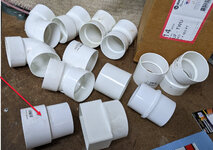
Went out to the shed to grab all the PVC parts I started collecting when I knew someday it would have to be addressed. One of my adapters is a 4" ID to 4" OD adapter. It almost fits inside the bend section on some of the elbows I have. If I can make it fit, the old one can be cut off at the ground, and a removable one built so next time there is no worry of a contractor kicking it.

How would folks here reduce the adapter size by maybe 1/32- 3/16 inch, don't think it will be as much as 1/8th. The adapter is thick PVC, like 1/4" or more thick. I have a grinder and can put a coarse wheel on it but my concern is that the plastic will melt as it is ground and just make a mess. I do not have a lathe or belt sander. Also I will wear a mask but I'd like to keep the dust down, maybe move the grinder outside and wet the concrete around it? I've glued and bent PVC pipes for years but never had to thin one, no idea how it will react.

pvc2.jpg
 
Last edited:

no704

Well-known member
Joined
Apr 27, 2016
Messages
5,221
Can u get to the other end of the pipe? Plug it with something, and duct tape this end to your shopvac. With the vac running feed pvc glue into the crack.
 
OP
F

FredWanaker

Well-known member
Joined
Mar 27, 2021
Messages
1,470
Location
NorCal
Can u get to the other end of the pipe? Plug it with something, and duct tape this end to your shopvac. With the vac running feed pvc glue into the crack.
no, there are too many underground tees into the pipe but it is a really great idea. I'll have to remember that trick in my book of tricks. I might be able to get the rest of the pieces off it and reach the inside of the crack but that PVC is 25 years old and my guess quite brittle. I had to cut a 3/4 piece of underground PVC last year that was the same age. It was away from the sun, and yet it was nearly impossible to get straight cuts with the blade because it would just shatter from being brittle.

Maybe cut flush at concrete and use a 45* street elbow.

Still have the problem of getting the piece inside the bend. It is less than 4"
 

welder4956

Well-known member
Joined
Apr 8, 2010
Messages
3,071
Location
Birmingham, AL USA
I think you are overthinking this. No big issue to chip out the concrete around the elbow with a hammer and chisel, replace the elbow, then patch the concrete. Once you cut the elbow even with the end of the pipe, split the remaining piece with a chisel and seperate it from the end of the pipe with a chisel or flat screwdriver. The glued joint works in shear, but the tensile strength of the bond is low enough to peel it off the end of the pipe.
 
OP
F

FredWanaker

Well-known member
Joined
Mar 27, 2021
Messages
1,470
Location
NorCal
Maybe cut flush at concrete and use a 45* street elbow.

the vac running feed pvc glue into the crack.

I think you are overthinking this. No big issue to chip out the concrete around the elbow with a hammer and chisel, replace the elbow, then patch the concrete. Once you cut the elbow even with the end of the pipe, split the remaining piece with a chisel and seperate it from the end of the pipe with a chisel or flat screwdriver. The glued joint works in shear, but the tensile strength of the bond is low enough to peel it off the end of the pipe.
you think that will work? The concrete was high strength and is at least 4" thick. I was thinking that if I did this I would have to use a hammer drill to make a series of holes around it, then use an air chisel to bust it out a little at a time. I have never had good luck breaking concrete when it is supported underneath by earth or gravel. There is no way I can spend an hour on my knees these days with an air chisel, and these days trying to hire a contractor or handyman around here to do work is a total joke. No one will even return calls. They want like $300 - $400 an hour minimum to work. The people who worked hard have all retired out, and those behind them aren't interested in anything close to what my generation might have accepted for our time - inflation adjusted. I just had a screen guy walk away from a job I offered that would have yielded him $250,000 a year if he worked 5 days a week at what was offered. They seem to want to work three days 9am to noon, and make $350,000 a year at that pace. Do you think a chisel will go thru 4" concrete very quickly?
 
Last edited:

MikeC55

Well-known member
Joined
Nov 1, 2020
Messages
425
Location
CT
I would try the epoxy first. It's not a pressurized joint and should work fine as long as you clean/prep the surfaces.
 
To avoid these ads, REGISTER NOW!

CraigStu

Well-known member
Joined
May 22, 2014
Messages
4,034
Location
Blacksburg, Va
I would try the epoxy first. It's not a pressurized joint and should work fine as long as you clean/prep the surfaces.
I agree. The problem I see w/ chipping the concrete and trying to replace the elbow is that the pvc pipe that the elbow attaches to is also going to be just as brittle as the underground piece you delt with last year. Go to your favorite hardware store and stand in the glue/epoxy section for a while reading all the labels looking for what each is listed to stick to. Look at construction adhesives too. There has to be a product that you can get that you could mold into the interior of that elbow to seal the crack. Even better- I just searched 'epoxy for pvc'. Just in the first 6 results I saw JBWeld and Loctite have epoxies for plastic. I also saw three links to articles on how to repair pvc pipe. Get an epoxy or 2 and do a test on some of your fittings. You can see how well it actually sticks and it will be good practice for technique for your actual repair.
 
OP
F

FredWanaker

Well-known member
Joined
Mar 27, 2021
Messages
1,470
Location
NorCal
Thank you to all. After all your suggestions I have an initial plan. If it goes well I will remove the downspout and use a small tooth blade on the sawsall to cut off the 4" piper where the downspout piece goes into. Then use heat to peel the inner 4" pipe off the elbow. If the elbow separates no harm done. I can reglue or epoxy. With access to the inside of the elbow, epoxy or prime and PVC glue the broken parts. Then add a new piece of 4" and downspout adapter. Then paint to keep sun off it. That should fix it for many more years.

When the 4" piece is removed, I can get a good view inside the pipe to see what is on the other side of the elbow. As I recall, there is a 45 below it a few inches that heads back under the sidewalk. A gutter guy broke another one of the pipes on the side of the house three years ago and I had to pull the pieces apart to replace them so I have a pretty good idea how it will react to heat. Fortunately, those went into dirt.

pvc.jpg
 
OP
F

FredWanaker

Well-known member
Joined
Mar 27, 2021
Messages
1,470
Location
NorCal
so much for that idea. The second the fine blade touched it, the piece took off. Now to think it thru again. I think it will come apart with heat on the vise, clean the pieces and glue will still work. The elbow below the concrete butts up to the elbow above so regardless of how the two pieces are separated the concrete will have to be chipped out if I go that route. Worst case is I think I could peel the 4" piece used as coupling and then chip just enough to get the elbow out - and put some DG or something like that back in with a loose fit in case it ever needs to be replaced again. You'll notice much of the break is new and not along the crack I glued before.

Concrete chipping experts chime in here. My fear is that the PVC in the concrete may not like chipping concrete. I have an air chisel gun with several different points. Also a hammer drill I can drill some relief holes around it if need be. I worked a big jack hammer for a couple summers in high school for a mason so I am not afraid of busting things up, just don't want to bust the wrong things up - and I am not 17 and athletic anymore but rather a 72 year old with arthritis. :) I also have some diamond saw blades but would rather not get concrete dust all thru a new makita skill saw I have.
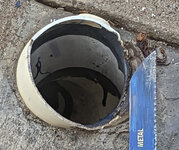
pvc3.jpg

pvc4.jpg
 
OP
F

FredWanaker

Well-known member
Joined
Mar 27, 2021
Messages
1,470
Location
NorCal
So here is one plan. Heat the connector inside and peal it free. Stuff some rags on a string into the opening to catch any pieces and bust the top elbow since at that point it will be free of the elbow below it. Take it out in pieces. Then chip the concrete until a new elbow can go in all the way to the piece below it. Glue a 4" piece of pipe into the lower piece but not the upper. Finish with the drain spout part. Backfill with DG or sand, e.g., something that will allow the piece to be removed if it ever needs to be again. Any votes on that vs epoxy at this point. I haven't decided yet. My only concern is using the propane torch at an angle like that may make it hard to only get heat on the connector and not the elbow below it.
 

welder4956

Well-known member
Joined
Apr 8, 2010
Messages
3,071
Location
Birmingham, AL USA
you think that will work? The concrete was high strength and is at least 4" thick. I was thinking that if I did this I would have to use a hammer drill to make a series of holes around it, then use an air chisel to bust it out a little at a time. I have never had good luck breaking concrete when it is supported underneath by earth or gravel. There is no way I can spend an hour on my knees these days with an air chisel, and these days trying to hire a contractor or handyman around here to do work is a total joke. No one will even return calls. They want like $300 - $400 an hour minimum to work. The people who worked hard have all retired out, and those behind them aren't interested in anything close to what my generation might have accepted for our time - inflation adjusted. I just had a screen guy walk away from a job I offered that would have yielded him $250,000 a year if he worked 5 days a week at what was offered. They seem to want to work three days 9am to noon, and make $350,000 a year at that pace. Do you think a chisel will go thru 4" concrete very quickly?
Are you trying to remove just the 45° elbow that is partially in the concrete or both elbows? It does not look like the 45° elbow goes 4" deep. Now that the 45 has been cut, you can slit the pipe between the two elbows lengthwise from the inside with the saw and peel it away. Once the pipe is broken loose, the top elbow should come out with minimal damage to the concrete.
 

welder4956

Well-known member
Joined
Apr 8, 2010
Messages
3,071
Location
Birmingham, AL USA
So here is one plan. Heat the connector inside and peal it free. Stuff some rags on a string into the opening to catch any pieces and bust the top elbow since at that point it will be free of the elbow below it. Take it out in pieces. Then chip the concrete until a new elbow can go in all the way to the piece below it. Glue a 4" piece of pipe into the lower piece but not the upper. Finish with the drain spout part. Backfill with DG or sand, e.g., something that will allow the piece to be removed if it ever needs to be again. Any votes on that vs epoxy at this point. I haven't decided yet. My only concern is using the propane torch at an angle like that may make it hard to only get heat on the connector and not the elbow below it.
Sounds like a good plan. Good luck.
 
OP
F

FredWanaker

Well-known member
Joined
Mar 27, 2021
Messages
1,470
Location
NorCal
Are you trying to remove just the 45° elbow that is partially in the concrete or both elbows? It does not look like the 45° elbow goes 4" deep. Now that the 45 has been cut, you can slit the pipe between the two elbows lengthwise from the inside with the saw and peel it away. Once the pipe is broken loose, the top elbow should come out with minimal damage to the concrete.

yes. The upper only. If one looks at an elbow it necks down at the bend so the concrete will have to be chipped just a little. I am thinking of using a heat gun on the pipe used as a connector between the upper and lower, and peeling it away from both the upper and lower elbow, then breaking the upper elbow to get it out and chipping the hole to enlarge it for the new one. No idea how the air chisel will work though, there could be pieces of stone and gravel in the concrete that are up against the elbow so it may not chip as easily as one thinks. The concrete was a commercial delivery when it was poured, 6 bags as I recall. Bad thinking on my part when I built it by not allowing for something like this to happen.
 

CraigStu

Well-known member
Joined
May 22, 2014
Messages
4,034
Location
Blacksburg, Va
I like the cut off at the ground except...can you get a nice cut or will it fly apart like it did above ground? I know it will take longer but maybe a hand powered hacksaw. Some kind of small rotary cutting blade on a drill? Recip saws are so difficult to control for fine accurate cuts, and the blade always gets bent, etc.
 

kaymccampbell

Well-known member
Joined
Feb 27, 2015
Messages
29,518
Location
Upstate New York
Cut it off smooth with the sidewalk. They sell downspout adapter fittings that fit inside the 4 inch pipe. Right at Blowes and Dome Hepot. Then your gutter guy, or you, can fit up a new piece of downspout.

This time, don't glue the adapter in. Make it easily removable so, when you weedwhack it, it's an easy fix. It's how all mine are set up.
 
OP
F

FredWanaker

Well-known member
Joined
Mar 27, 2021
Messages
1,470
Location
NorCal
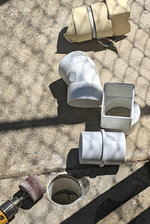
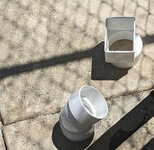
First let me say thank you for all the thoughts and ideas. Thank You. It helped with a plan. I am closing out the thread. All is done except for painting to block the UV on it. I got incredibly lucky - one of the adapters fit. I went out to heat gun the old piece out and realized one of the adapters would be really close in size. We are on clay and hardpan here so getting the water out to the street really helps control ponding, rot, mosquitos, muddy feet etc..

Sawed off at ground level with fine blade sawsall. Used drum sander in drill to slightly enlarge hole. Then built the drain. Glued and installed. The adapter is not glued to the PVC in the ground so that it can be removed. Had to cut about 1 1/2 inch off the downspout length to get it to fit since the replacement is that much higher than the original. I must admit that 20 or 30 years ago this would have been a piece of cake. Now I could barely bend over to put the screws back in. But it is done, and it is removeable, something I should have done originally on all of them.

pvc repair1.jpg

PVC repair2.jpg

pvc repair 3.jpg


pvc dpne.jpg
 
Last edited:

mike93lx

ALLIANCE MEMBER
Joined
Dec 9, 2013
Messages
37,575
Location
Richmond, VA
Those downspout adapters hurt flow and can catch debris if the pipe doesnt go past the lip in it. I'd eliminate it and just have the downspout run into the pipe
 
To avoid these ads, REGISTER NOW!
Top Bottom