
To avoid these ads, REGISTER NOW!

Question about air compressor pump up time

md21722

Well-known member
Joined
Nov 30, 2015
Messages
1,840
Location
Mt Juliet, TN
I have a very old dual stage Champion air compressor, but I think this question may apply to all types of compressors.

Basically the first 20 psi of pressure it generates in about 1:37-1:45. Every subsequent 20 psi takes about 3:00.

This occurs if the tank is empty and its starting from zero psi (for example 0-20 would take 1:40 and 20-40, 40-60, 60-80, ... would each take 3 minutes), or if the tank has 80 psi and its starting from there (for example, 80-100 would take 1:40 and 100-120, 120-140, .. .would take 3:00).

Is this somehow built into the design or possibly related to a valve problem or other?

Pump is an RE-7 without unloaders. There is a check valve with an unloader line to the pressure switch.
 
Last edited:
To avoid these ads, REGISTER NOW!

jallyn

Well-known member
Joined
Jun 29, 2015
Messages
448
Location
Fort Wayne, Indiana
This is true for every compressor. It is a matter of physics.

The dual stage air compressor is a piston pump. It compresses a (bore x stroke) volume of air at atmospheric pressure into a smaller volume based on the compression ratio. So for argument's sake let's say one "pump" of the cylinder creates a small pocket of air that is 200 psi. When the tank is empty (0 psi) a large percentage of that pocket goes over to the tank. As the tank pressure increases to say 100 psi, only 50% of the compressed pocket goes into the tank. The pressure difference between the compressed air pocket and the tank dictate what percentage actually makes it to the tank. The rest is wasted and just hangs out in the compressor not able to decompress further than the tank pressure. So a tank will fill fastest at first and gradually taper off, filling slower and slower as you reach the actual compressor maximum pressure.
 

zkling

Well-known member
Joined
Jan 23, 2007
Messages
16,939
In order to get a more linear pump up rate, you need to increase the driving motor power*. As pressure increases on the back side (tank side) of the check valve the more power it takes to turn the pump and add more air to the receiver to overcome the force on the backside of the check valve due to the pressure in the tank. .

*It gets to a point of why bother and or just bragging rights.

If you really care you can calculate the volumetric flow through the pump vs pressure by doing as you did, measuring in ~10psi increments and then evaluating at those intervals.
 
Last edited:

jallyn

Well-known member
Joined
Jun 29, 2015
Messages
448
Location
Fort Wayne, Indiana
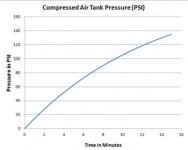
I made a graph of what the pressure looks like as it builds in your compressor. Like I said there is a drop off in filling rate as the tank pressure builds because it "pushes back" on the compressor.

Now if your compressor has slowed down noticeably over the years it may be time for a new set of reed/flapper valves. You probably know you can order a kit that comes with new valves and fasteners.
 

Attachments

  • Compressor Pressure vs Time.jpg
    Compressor Pressure vs Time.jpg
    12.1 KB · Views: 13
To avoid these ads, REGISTER NOW!
OP
M

md21722

Well-known member
Joined
Nov 30, 2015
Messages
1,840
Location
Mt Juliet, TN
What I am saying is that the first 20 psi it builds no matter where it starts, always take less time than every other 20 second interval.

Example #1: Tank starts from zero
0-20 psi 1:40
20-40 psi 3:00
40-60 psi 3:00
60-80 psi 3:00
80-100 psi 3:00
100-120 psi 3:00
120-140 psi 3:00

Example #2: Tank starts off with 100 psi
100-120 psi 1:40
120-140 psi 3:00

Example #3: Tank starts off with 80 psi
80-100 psi: 1:40
100-120 psi: 3:00
120-140 psi: 300

No matter the starting point, the first 20 psi interval is always faster. It actually builds the first 10 psi of that interval in about 20-30 seconds and the next 10 psi takes about 1 minute.
 
Last edited:

MacMcMacmac

Well-known member
Joined
Oct 21, 2014
Messages
1,593
Location
canada
The previous explanation is correct. As the pressure builds, your effective stroke is getting shorter due to the necessity to build increasing pressure before the discharge valve begins to open. Whatever doesn't get pushed out of the cylinder, that which is trapped in the clearance space between the piston crown and the cylinder head, also re-expands, requiring the piston to travel further down the bore before cylinder pressure drops far enough for the intake valve to open. All of this plus heat results in a drop of volumetric efficiency.
 
OP
M

md21722

Well-known member
Joined
Nov 30, 2015
Messages
1,840
Location
Mt Juliet, TN
I am hearing what you all are saying but its not making sense to me. Maybe you can humor me a bit and explain it a bit differently. To put it in perspective, I can completely understand why a compressor would "slow down" from 0-160 psi. I have single stage compressors that perform well until 110 psi and after that drop... But what I am having trouble understanding is why this one, no matter when the pump starts pumping, pumps the first 20 psi that it pumps, regardless of what's in the tank, so much faster than any subsequent 20 psi. Clearly when the tank is at 0 psi its "easy pumping" but this one performs the same even if I turn it on while the tank already has 100 psi. So maybe the key is "what changes in the pump after it pumps 10, 20 psi" ? This pump runs pretty cool, and even after running for 20 minutes straight the head hovers around 175F and at the discharge at the tank is about 140F.
 
To avoid these ads, REGISTER NOW!
Top Bottom