To avoid these ads, REGISTER NOW!

question about painting after electrolysis

1982fxr

Well-known member
Joined
Jan 7, 2012
Messages
10,012
Location
Phoenix
if I don't get all the black oxide(?) off the drill press vise I just did, and go ahead and prime and paint it, what will happen?

Not sure I want to completely disassemble, so I just hit it best i could with a steel wire brush. Am I good to go, or is this not gonna cut it?

thanks
 
To avoid these ads, REGISTER NOW!

lrhredjb

Well-known member
Joined
Jul 27, 2012
Messages
110
Location
Central IN
The black oxide is loosely adhered to the surface. It should brush off easily. I would remove all of it before painting.
 

Outlawmws

Well-known member
Joined
Aug 9, 2011
Messages
39,275
Location
The Badlands
I usually use a cup brush on an angle grinder and it comes off easily.
Craig

:+1: on this ^^^

And a small cup on a drill helps get into nooks the big cup won't,then small wire brush in corners. ( I cut one of the "tooth brush" sizes in half to get bristles to the end)
 
Last edited:
OP
1

1982fxr

Well-known member
Joined
Jan 7, 2012
Messages
10,012
Location
Phoenix
I have heard, but not yet tried, that vinegar works to remove the black coating.

maybe I'll try that. This blackness is really on there...steel brush is very coarse but not getting much done...really hoping to avoid the wire wheel on this one, but I guess we'll see
 

Outlawmws

Well-known member
Joined
Aug 9, 2011
Messages
39,275
Location
The Badlands
if I don't get all the black oxide(?) off the drill press vise I just did, and go ahead and prime and paint it, what will happen?

Not sure I want to completely disassemble, so I just hit it best i could with a steel wire brush. Am I good to go, or is this not gonna cut it?

thanks

Just noticed this; Most DP vises only have 2 screws and a set screw retaining the main screw in the dynamic jaw, Whats the big deal? :dunno:
 

BionicSniper

Member
Joined
Jan 3, 2012
Messages
23
Like others have said, grind/polish the surface, hit it with acetone or something similar, etching primer, then paint.
 
OP
1

1982fxr

Well-known member
Joined
Jan 7, 2012
Messages
10,012
Location
Phoenix
Just noticed this; Most DP vises only have 2 screws and a set screw retaining the main screw in the dynamic jaw, Whats the big deal? :dunno:

I'm just pressed for time during the school year with work and everything. If I had a little more time I'd tear it apart in a second, and may just end up doing it anyway. Trying not to get too much disassembly going at once, I'm out of bench space as it is.
 
To avoid these ads, REGISTER NOW!

EDGAR

Well-known member
Joined
Aug 21, 2010
Messages
437
About electrolysis and hydrogen embrittlement.

From what I have read in this and other threads, everyone is happy about the electrolysis method of removing rust, but no one has mentioned anything about a "little" detail called hydrogen embrittlement. There are a few ways for hydrogen to get into steel and one of them is electrolysis. One article about this subject mentions that hydrogen, which in this case is introduced in the metal when doing the electrolysis derusting, can "greatly amplify the stress of applied forces within the basis metal which can produce catastrophic fracture at loadings much lower than the typical yield strenght of the material. Hardened steels are particularly susceptible to this phenomena..." It also mentions that hydrogen is easily removed from the metal by baking it immediately after the process that introduced the hydrogen into the metal. A typical baking cycle is to bake at 375 F for 4 hours. There are many other articles about hydrogen embrittlement that mention the same thing about baking the metal part for a few hours.

So I am guessing that everyone may be missing one final step when using electrolysis. Maybe in the case of vises it is not important to bake the vise afterwards, maybe the weakening of the metal is not significant but, at least it is good to know that such a thing as hydrogen embrittlement exist and that it is taken seriously by the metal industry and metal processors. Below is just one of the many articles about this subject.

http://www.artisticplating.net/Hydrogen-Embrittlement-Baking.php

Another article about hydrogen embrittlement:

http://corrosion-doctors.org/Forms-HIC/embrittlement.htm

I have found that most articles about electrolysis derusting itself, written by do-it-yourselvers, do not mention the fact about hydrogen embrittlement. I am guessing they simply do not know about this. :dunno:
 
Last edited:

mrbreezeet1

Banned
Joined
Dec 6, 2010
Messages
3,694
Location
Moundsville, WV, 15 miles South Of Wheeling WV
About electrolysis and hydrogen embrittlement.

From what I have read in this and other threads, everyone is happy about the electrolysis method of removing rust, but no one has mentioned anything about a "little" detail called hydrogen embrittlement.
I have found that most articles about electrolysis derusting itself, written by do-it-yourselvers, do not mention the fact about hydrogen embrittlement. I am guessing they simply do not know about this. :dunno:

1st. I ever heard of it.:dunno:
 

admranger

Well-known member
Joined
Feb 16, 2012
Messages
482
Location
Las Vegas, NV
Good info, EDGAR.

Hydrogen embrittlement is known, but with vises, we're not talking high strength steel so the reduction in strength is at best, minimal. There are much bigger problems in cast iron to worry about than HE. Impurities and dislocations piling up at the grain boundaries for one. However, I'll be stunned if anyone cracks a vise without putting a massive cheater bar on the handle (and even then I'll be somewhat surprised).

Now, I certainly wouldn't use electrolysis on a car frame without a subsequent baking process to deal with hydrogen embrittlement.
 

Gidge

Well-known member
Joined
Sep 19, 2012
Messages
2,308
Location
New England
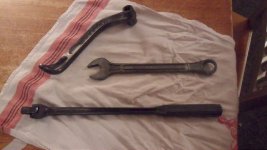
Not painted yet, but here is a recent Electrolysis job on some rusty old tools :

Before --
101512 001.jpg

After --

101512 002.jpg

I started doing this from the thread on the vises of GJ (P. 193)
and have been very satisfied with the results.

I am using bailing wire [to connect the battery charger to the item and sacrificial steel ] which looks to be aluminum -- I have read all the cautuins on NOT using SS (I doubt bailing wire is SS, galvinized, most likely, but not stainless steel).

Question -- does anyone know what the tool on the far left of the before picture is ?
 
Last edited:

Outlawmws

Well-known member
Joined
Aug 9, 2011
Messages
39,275
Location
The Badlands
Gidge, It's best to keep any metals, plating, etc. out of the soup when doing electrolysis. Galvanize will leave heavy metals in the solution, chrome will be peeled off the part you are trying to save...

You can get a roll of steel mechanics wire cheaply at any hardware or home improvement center. look near the rebar, they use it all the time tying rebar together.
 

Gidge

Well-known member
Joined
Sep 19, 2012
Messages
2,308
Location
New England
Thanks for the tip Outlaw. Do you have any idea on the tool to the far left -- I'm thinking some kind of early ratchet (The hole on the business end of the tool is square) ?
 

Outlawmws

Well-known member
Joined
Aug 9, 2011
Messages
39,275
Location
The Badlands
Does the square drive part actually ratchet?

I've never seen one like that and from the original pic, I thought it was an old gas valve wrench. It might still be, even if it does ratchet...
 

Gidge

Well-known member
Joined
Sep 19, 2012
Messages
2,308
Location
New England
No, the wrench does not ratchet. I'll go with a gas valve wrench (It also fits the top of my new [to me] coal stove, so I very well might use it for that).

Thanks !
 
To avoid these ads, REGISTER NOW!
Top Bottom