There is a very large sliding scale of quality from the worst to the best in terms of kitchen cabinets. And, quite often the price does not accurately reflect the quality. Here's a personal example: in my workplace, we spent nearly $100,000 on what was ultimately three kitchens' worth of custom cabinets. All were made with particle board (not even MDF), cheap plastic laminate and edgebanding, glued and doweled joints, cheap sidemount drawer slides, and everything made by machine. The cabinets are less than five years old and many of them are failing due to daily use and a very poor resistance to moisture. Probably the worst quality cabinets I have ever seen in my life, and I have seen some really **** stuff.
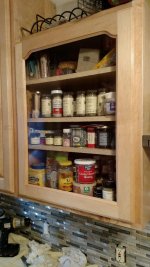
In my own kitchen, I used 3/4" birch plywood and solid cherry for all of the boxes and face frames, 1/2" and 1/4" baltic birch ply for all of the drawers and bottoms, and solid cherry for all of the drawer fronts. Cabinet door joints cut by a router with Shaker-style profile, 1/4" cherry plywood flat panels, and everything assembled with glue. Accuride sidemount full-extension slides and nickel-plated hinges and pulls. The only thing I went cheap on was that I assembled the cabinet boxes and drawers with pocket hole screws and glue, which are strong as any other joint when done properly. Total cost for my whole kitchen was less than $3000 including all the hardware.
In a high-end kitchen you are likely to find solid maple or possibly poplar drawer sides that are nicely dovetailed and glued. Solid core plywood with quality face veneers, No MDF or particle board anywhere. Full-extension or overtravel soft-close slides. Quality brass, nickel or stainless hardware. All joints securely fastened and glued, plenty of bracing, all interiors finished to the same standard as the outside.
So, here's one way to look at your kitchen, especially if it's your own work - think of it as a workshop with a different set of tools. My kitchen gets used hard and often, it's a functional workshop for meals. Make the exterior as appealing as you can, it's just for appearance. Make the interior as utilitarian as you can, it does the work. You do not need the finely dovetailed drawers and fancy $80 undermount slides - make it useful and efficient. Besides, the next guy that owns your house is going to hate the kitchen no matter how nice you build it, and will tear it all out and start over anyway.