To avoid these ads, REGISTER NOW!

Question for you engineers or tool experts?

kartracer55

Well-known member
Joined
Jun 21, 2005
Messages
5,317
Is there an easy way to calculate how torsion affects torque being transfered on a long hex socket?

Heres the situation... I need to torque 5 socket cap screws to 95 inch lbs. There are two methods to do this, one involving a standard hex socket, the other with a long hex socket. To use the standard hex socket means quite a bit more work in this process, and the time adds up because these screws are replaced and retorqued quite often.

As I go to torque these screws, I can see the hex stock actually twisting on me, and im guessing this is somehow affecting the torque being transfered through. So is there an easy way for me to calculate how much torque is actually being lost because of it? When I am home I can do it the correct way with the standard hex socket, but at the track I simply dont have the time to go through all this so I would like to know if, instead of setting the torque wrench to 95 in/lbs, I can set it to 95+X in/lbs to compensate for anything being lost through the long socket.

Also, If anybody could help me understand something a bit better it would be great... Is this length of hex stock in the socket absorbing a certain percentage of the torque proportionally as applied torque is increased? Along those same lines, is there a point where this begins to happen or does it only become more apparant at higher loads? Or, does it reach a certain point where it simply cant transfer anymore torque and begins to twist like this?

Thanks

Jim
 
To avoid these ads, REGISTER NOW!

Brian

Well-known member
Joined
Apr 11, 2005
Messages
145
Location
colorado
You are right that you do lose some torque when you use a long socket or extension on the torque wrench.
I had a way to figure it out written down back when I used to wrench professionally. Send me 20$ and it might make it worth my while to dig through my garage and find it for you. :rolleyes:
In the mean time I did a quick search for "torque loss equasion". You may find the answer to your question in this rambling post.
 

bmwpower

Super Moderator
Staff member
Joined
Apr 24, 2005
Messages
12,578
Location
NJ
I don't see why there would be a difference. The wrench clicks when it sees the proper torque. So you're saying it's clicking earlier than it should?
 

Sundowner

Well-known member
Joined
Aug 15, 2005
Messages
356
Location
West Milford, NJ
the torsion in the key is irrelevant. if you're applying 95 inch pounds to the wrench, then SOMETHING has to be providing 95 inch pounds of resistance to that wrench, or the handle would spin around and smack you in the face.
the key can't absorb any of of that torque, it has no external means to resist it. it's just a link between two points in space. the bolt takes all the torque. plain and simple.

now the damping effect from the torsion action is a different matter and it will screw with your torque numbers. how do you fix it? easy. go slow when you're approcahing your target torque figure. let the tosion happen and don't let the handle bounce against it like a trampoline. that's it.
 

CraigFL

Well-known member
Joined
Nov 1, 2005
Messages
704
Location
Panama City, FL
From an engineering standpoint, there should be no change in torque if an extension or deep well socket is used. Just because the extension twists doesn't mean that TORQUE is lost. Torque could only be lost if there is increased friction/resistance to turning(e.g. the extension is dragging on something making it harder to turn).

From a practical standpoint, adding an extension could cause you to slightly change the length of the torque arm. The torque wrench is calibrated based on it's length to the center of the socket. Say its one foot long, which means for 50 ft-lb, you would be pushing/pulling 50 lb on the handle. If you put a deep socket and an extension on, you could **** the socket/extension on the tightened member in such a way to increase the one foot length by even an inch which is about 8%. This means even though the indicator said 50 ft-lb, it was closer to 54 ft-lb, higher than you expected!

The reality is that torque is a VERY inaccurate way to assure proper bolt tightening. People use it because tools are available and cheap. There is probably a greater error associated with the friction between the threads as well as the turned element on the fixed surface.
 

Brian

Well-known member
Joined
Apr 11, 2005
Messages
145
Location
colorado
It may only be with a beam type torque wrench that the reading becomes innacurate with an extension. The longer the socket or extension is the more of your force applied to the handle becomes diverted into trying to bend the socket over onto its side. Imagine you have a one foot long torque wrench but a 5 foot long socket on it. When you pull on that handle most of the force is going towards trying to bend that socket over and very little will go into twisting the fastener. However with a clicker type wrench it will probably still only measure the pure twisting force on the socket.
With the wrench set to 50 ft lbs you may have to actually pull on the handle with 60 ft lbs to achieve the desired setting and 10 lbs is wasted on trying to bend the socket. With a beam type it will measure all the pulling force you apply to the handle.
Or something along those lines. Hey I'm almost 30, my memory is getting fuzzy in my old age. :confused:
 

chet

Well-known member
Joined
Apr 14, 2005
Messages
45
Location
cobble hill, BC, canada
The only way you would loose some to torsion is if you did it way to fast. You wouldn't allow time for all the torsion to get taken up and transfer all the torqu to the bolt head.
 

Senorpablo

Well-known member
Joined
Jun 21, 2006
Messages
411
Location
SoCal
Might help to think of it this way: as the long socket is twisting under load, it's acting like a spring--it's in turn trying to un-twist and transfer the twisting load to the fastener. No torque lost.
 
OP
K

kartracer55

Well-known member
Joined
Jun 21, 2005
Messages
5,317
Hmm, Im getting conflicting opinions from people and sources!!

I think I kind of have it though, but the thought dawned on me today... Ill just tap a piece of steel and experiment for myself. I really have to learn this stuff...

BMW, Imagine your tightening a bolt with a shallow socket and a 10 inch 1/4 drive extension... as your tightening the extension itself is twisting. This is what Im experiencing, only with a long hex bit socket... the piece of hex stock itself is twisting on me as Im torqueing it

Thanks for the help guys!

Jim
 

Charles (in GA)

Well-known member
Joined
Jan 11, 2006
Messages
12,489
Location
50 mi south of Atlanta
Sundowner said:
the torsion in the key is irrelevant. if you're applying 95 inch pounds to the wrench, then SOMETHING has to be providing 95 inch pounds of resistance to that wrench, or the handle would spin around and smack you in the face.
the key can't absorb any of of that torque, it has no external means to resist it. it's just a link between two points in space. the bolt takes all the torque. plain and simple.

now the damping effect from the torsion action is a different matter and it will screw with your torque numbers. how do you fix it? easy. go slow when you're approcahing your target torque figure. let the tosion happen and don't let the handle bounce against it like a trampoline. that's it.

I agree with this, the key, no matter how much it twists, is transfering the torque to what it is attached to at the other end, the allen headed bolts. Nothing is lost, just a little springier than normal.

Charles
 
OP
K

kartracer55

Well-known member
Joined
Jun 21, 2005
Messages
5,317
But now Im curious... is the length of hex reaching a point where the torque of the bolt is overcoming the strength of the steel hex-stock so that it cannot transfer the torque anymore? I mean, Say the hex socket begins to twist at 80 in/lbs, but the screw needs 95... does this mean that once the screw hits 80, the hex stock wont be able to transfer anymore torque and will simply twist on me?

Im 16... cut me some slack :lol_hitti

Jim
 
Last edited:

strizzy

Well-known member
Joined
Apr 4, 2006
Messages
572
Location
Western NY
Well I was brain washed for the little amount I paid attention in my engineering materials class that "for every force there is an equal and opposite (‘equilibrium’, such as the torque setting your trying to achieve)." Although if your trying to apply a load greater then what the material is design for (such as the hex piece), depending on the size you may yield the whole piece and it will start to "flow" and you wont be able to return the material back to its original "state".
So I’m going to say, at least with a clicker cause I’m not sure what a beam wrench is (the one with the needle?) that if you apply X amount of force, that the bolt has to be applying X amount back. And like Charles said, it will probably be a bit "springy" (I’m sure there is a term for this) with some extensions you experience as the pieces flex and deflect. But all in all I think the easiest way to think about it, is that you have just a bar that is attached at one end and a meter on the other reading the amount of force applied.
 

Sundowner

Well-known member
Joined
Aug 15, 2005
Messages
356
Location
West Milford, NJ
GearHead_1 said:
I didn't read all of this thread but saw a couple of responses that disturb me. Most everyone has seen Torque Sticks (they're used a lot in tire shops with impact wrenches), some have sockets fixed on the end some just receive a socket like an extension. The discussion on whether this is a good idea is a whole different thread. The impact wrench supplies the same amount (fixed amount) of force regardless of which stick is on it. The sticks are different diameters. The sticks provide an output that varies one to the next. The length of an extension, the diameter of an extension the type of material the extension is made of all affect the the output of that extension.

this is an incorrect assumption. An impact gun does not apply torque via a static force. it applied a series of impacts to drive the rotation. the torque sticks are designed to act as torsional dampers. the smaller the diameter, the more of the impact from the gun is dissipated. this is very easy to prove. tighten a wheel lug with an impact gun and a torque stick.then use a breaker bar on a second lug with the torque stick. tighten it as much as you can. then check the lugs with a torque wrench. you'll find that you blew right past the target torque with the breaker bar.
 

Ironcrow

Well-known member
Joined
Sep 30, 2005
Messages
1,169
Location
Arizona
kartracer55 said:
... is the length of hex reaching a point where the torque of the bolt is overcoming the strength of the steel hex-stock so that it cannot transfer the torque anymore? I mean, Say the hex socket begins to twist at 80 in/lbs, but the screw needs 95... does this mean that once the screw hits 80, the hex stock wont be able to transfer anymore torque and will simply twist on me?...
I am an engineer. And judging by some of the responses, some of the posters are not. There is no effect on the torque setting of the wrench due to the length of the hex. As long as the hex does not break off, the amount of its twist has no effect on the torque it applies to the bolt. If it starts to visibly twist at 80 in-lbs (it will start to twist at 1 in-lb, you just don't notice) and even twist a whole bunch, 90 degrees, 180 degrees or even more - as long as it doesn't break off before you get the 95 in-lb set on the wrench - the screw gets its 95 in-lbs. The hex could even twist so much it stays somewhat twisted when you remove the torque load. Doesn't matter, if it doesn't break off, the screw still sees 95 in-lbs.
 
Last edited:

Fast Orange

Well-known member
Joined
Aug 27, 2005
Messages
861
Location
Hightstown,N.J.
Jim-
As several people have already posted,as long as the bolt,socket,extension and torque wrench remain in alignment with no offset or increased leverage,the torque applied by the TW will be transfered to the bolt-as long as the torque is applied in a smooth,steady manner.The wrap-up in the socket and extension only manifests itself as increased degrees of swing of the torque wrench,but the aplied torque remains the same to the bolt.Instead of turning ,say 45 degrees to hit set torque,the socket and extension may absorb 15 degrees of motion,requiring the torque wrench to turn 60 degrees to hit the set point,but the torque transmitted to the fastener stays at the set point.

George

Edit: This motion absorbtion is why when using a torque-angle method of torquing fasteners,the shortest possible socket that fits the fastener tightly and NO extensions are used.
 
Last edited:

AdamMopar

Well-known member
Joined
Jul 18, 2005
Messages
182
Location
United States
Most of these guys are 100% correct, it doesn't make any difference if it twists or not. The bolt is still receiving it's full torque value assuming the wrench clicks at whatever torque value you want. Take it from the engineer's. Adam
 

bmwpower

Super Moderator
Staff member
Joined
Apr 24, 2005
Messages
12,578
Location
NJ
kartracer55 said:
...

BMW, Imagine your tightening a bolt with a shallow socket and a 10 inch 1/4 drive extension... as your tightening the extension itself is twisting. This is what Im experiencing, only with a long hex bit socket... the piece of hex stock itself is twisting on me as Im torqueing it

Thanks for the help guys!

Jim


Yea, I get you, I just don't see how there would be a difference in torque. The wrench clicks when it sees a certain torque. The torque is transmitted through the extension/socket/etc on down the line. If the bolt see X torque, so should the wrench. As long as there is no delta in the "twist" of the socket at any given point, the torque on the bolt should equal the torque on the wrench. In other words, smooth, slow motion on the wrench should give you exact results. No calculation needed.
 
OP
K

kartracer55

Well-known member
Joined
Jun 21, 2005
Messages
5,317
Alright, thanks guys. Things just got a bit easier for me.

I appreciate the help

Jim
 

Brian

Well-known member
Joined
Apr 11, 2005
Messages
145
Location
colorado
I still say with a beam type torque wrench the reading would become inacurrate with use of long sockets or extensions. However few people use that type and they aren't really the best kind of torque wrench anyways.
 
To avoid these ads, REGISTER NOW!

sberry

Banned
Joined
Jun 18, 2005
Messages
35,747
Location
Brethren, Michigan
The reality is that torque is a VERY inaccurate way to assure proper bolt tightening. People use it because tools are available and cheap. There is probably a greater error associated with the friction between the threads as well as the turned element on the fixed surface.
I like this statement, we spray almost every bolt we install due to this.
Good info here! I was always under the assumption that extensions meant lost torque.
The do with impacts but by hand it would be irrelevent.
Now at 95 inch pounds on a small engine I might be tempted to get the feel for it and toss the wrench in the scrap anyway and depending on the application not every bolt needs exact torque anyway, I have service manuals that list the figure for every bolt but very few may really need exact figures.
 
OP
K

kartracer55

Well-known member
Joined
Jun 21, 2005
Messages
5,317
The link that was posted on the first page goes into extensions and impact guns.

The reason I am so curious about this is because they are for my kart clutch. At about 300$, it costs more than a good number of car clutches

Jim
 

DIGGER_DAVE

Well-known member
Joined
May 19, 2006
Messages
124
Location
Calgary AB Canada
If your going for absolute accuracy; measure the STRETCH of the bolt.

High performance engine builders seldom use torque wrenches; they use a dial indicator on the end of the fastener to determine when the fastener has reached it's optimum "clamping force", by the amount the fastener has stretched.

The threads are coated with a lubricant to insure that "friction", (between the fastener thread and the object the fastener is being threaded into) does NOT cause "false" readings.
 

Fast Orange

Well-known member
Joined
Aug 27, 2005
Messages
861
Location
Hightstown,N.J.
While bolt stretch is the most accurate method to achieve optimal accuracy when tightening threaded fasteners,how can it be measured when working with blind hole situations such as head and manifold bolts? In most situations,bolt stretch can't be measured,nor is that degree of accuracy necessary.When dealing with extremely touchy situations such as connecting rod bolts in a high RPM high performance or race motor where the tolerance of the torque value is tight,bolt stretch is both prefered and practical to use.For gasketed applications such as head or manifold bolts,proper use of either a torque wrench or a torque angle guage will suffice,due to a larger tolerance for variance in clamping pressure.
If you want to see just how much variance is allowable in stock OEM engines,check the torques on a brand new GM crate motor-I have.On one motor I installed,I'd estimate every head,main bearing cap and rod bolt was off by 20-40% of the value given in the shop manual.I marked the orientation of each fastener,removed the fastener,cleaned and lubed/sealed each bolt as per the manual and reassembled the motor using fresh GM gaskets and torqued as per the manual.Most of the fasteners were between 1/3 and a full turn short of the spec'd value when the motor was reassembled.I know that doing this on a brand new motor may seem excessive,but I did it to make a point to the owner of a fleet of trucks to justify the higher cost of a locally custom rebuilt motor versus just tossing a cheap crate motor into his trucks.
The last I heard from him,the crate motors were lasting about 60-80,000 miles and the locally rebuilt motors were doubling that.There were many other differences between the crates and the rebuilts such as the parts chosen and thier quality,so the torque variation is not totally the problem,but was one of several items I used to make my point.

George
 
OP
K

kartracer55

Well-known member
Joined
Jun 21, 2005
Messages
5,317
Im working in a blind hole, whats most important is consistency... they dont need to be super accurate just fairly even, as well as snug. If these come loose Im going to munch the 300$ clutch as well as my pto side crank half, 30$ chain, 20$ sprocket, and possibly a 70$ carrier. Not fun, I want to make sure I get it right.

George, I have a friend who works for a machine shop and you wouldnt believe the horror stories about crate motors. As he puts it, they arnt quite mass produced but they dont spend the time on them like alocal builder to ensure all the specs and tolerances are correct.

Jim
 

CraigFL

Well-known member
Joined
Nov 1, 2005
Messages
704
Location
Panama City, FL
One of the most accurate ways to set clamping force(and this is really what you are trying to do!) is to use the "turn-of-the-nut"(or screw-but less accurate), method. For a given clamping force, the bolt needs to be stretched so far. Once you know the pitch of the threads, it's very easy to determine exactly how far(how many turns-degrees) the element needs to be turned to give the proper stretch. Unfortunately, this is a different amount for each element that depends on the diameter as well as the length. For cases where clamping force is very critical, this method is used. Specifications are typically, so many turns(e.g. 2-1/4) past "snug-tight".
 
OP
K

kartracer55

Well-known member
Joined
Jun 21, 2005
Messages
5,317
Craig, do you have any links to where I can read up a little bit on this? Im curious now. This is kind of like the theory that an angle gauge works off of, right?

Jim
 

sberry

Banned
Joined
Jun 18, 2005
Messages
35,747
Location
Brethren, Michigan
Im working in a blind hole, whats most important is consistency... they dont need to be super accurate just fairly even, as well as snug.
If it was me I would be spraying them lightly with penetrating oil and running them by hand so I could feel them and call it a day.
 

sberry

Banned
Joined
Jun 18, 2005
Messages
35,747
Location
Brethren, Michigan
I just glanced at that site and would have to agree, there are a lot of working mechanics that dont have a clue about how a bolt works or how to tighten one. There was another engineer I met on a forum that has some great data in easy to use format. I will see if I can find the link.
 

CraigFL

Well-known member
Joined
Nov 1, 2005
Messages
704
Location
Panama City, FL
I didn't want to use www.boltscience.com for a reference since I found quite a few inaccuracies due to bad assumptions on their part. Specifically related to my reference of the turn-of-the nut method, they call it "angle tightening" and dismiss it because they say the angle is "experimental" which is not true. Preload is directly proportional to the stretch, although a compressible gasket would cause some concern unless it was pretightened/compressed.

They also say this method tightens to beyond the elastic range so you can only do a limited number of reapplications which is also not true. The connection designer determines how much clamping force the connection requires. Typically, for maximum clamping, the bolt/stud is stretched to within 90% of its yield point but not over or clamping force is lost.
 

pgreen

Well-known member
Joined
Jun 3, 2006
Messages
181
Location
Venus, TX
I'm an engineer, and I also sell production torque guns and equipment for a living now. So, I have done a bit of hands on experiments with customers using different analysis methods.

Extensions, loose fitting sockets, etc. will not affect torque if you are not using an impact type tool. Smooth consistent tightening is what you want to do with this. Using a click type or a beam torque wrench will give you the same reading (within their own tolerances). The beam torque wrench will not be affected by the extensions any more than the click one.

One thing that we just found surprising though.... using a universal joint can change your torque a HUGE amount. We were using an Apex universal socket, and were seeing about a 30% or more variation on the torque actually applied to the fastener, depending on which direction the cross-bar in the universal joint was facing compared to the bend in the U-joint. Obviously when this is occurring, more angle on the U-joint the higher the effect. Using it straight made no difference.

We were using about $50,000 worth of equipment to do this test, so I will stand behind my "assumptions" as fact. We were using a fully transducerized screwgun, and a rotary torque transducer between the universal-joint socket and the bolt head. This showed the torque that the screwgun was seeing vs. what the bolt was seeing.

Phil
 

Theo

Well-known member
Joined
Oct 8, 2007
Messages
475
Location
Oakville, On Canada
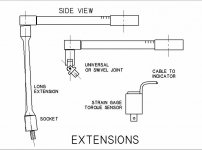
This diagram shows an application where an extension can effect the torque value.

As long as the extension doesn't change the over all length of the torque wrench all is good. If the extension is not kept perpendicular to the fastener you'll throw off the torque value.
 

Attachments

  • Picture2.jpg
    Picture2.jpg
    35.1 KB · Views: 136

rsanter

Well-known member
Joined
Dec 22, 2007
Messages
18,492
Location
visalia ca
I would say that if the bit or extension is twisting then it is adsorbing some of the torque you are applying through the torque wrench. if you are using a torque wrench then you must remember that you are actually measuring an aproximation of the force required to give the desired stretch in the fastener as well as overcomming the friction in the threads and between the bolt head and the part surface. if you recall there are often two torque specs for fasteners, one dry and one with lube. this data was derived through testing and not just calculaton

first thing I would look at doing is to switch to a larger dia extension and a short hex bit. otherwise you would need to measure the degrees of twist in the bit and find out how much torque it took to get that twist. one problem is that if the bit is not retaining the twist after the torque is released, then it is acting as a spring. when acting as a spring, it will hold a certain amount of torque and when that torque exceeds the frictional force under the head of the fastener then it will release an amount of that force when the fastener turns. good luck finding out how much that is without extensive testing. best idea is to avoid it and use a tool that had enough meat to minimize this effect

bob
 

XJ1100

Member
Joined
Feb 17, 2008
Messages
15
...There is no effect on the torque setting of the wrench due to the length of the hex. As long as the hex does not break off, the amount of its twist has no effect on the torque it applies to the bolt. If it starts to visibly twist at 80 in-lbs (it will start to twist at 1 in-lb, you just don't notice) and even twist a whole bunch, 90 degrees, 180 degrees or even more - as long as it doesn't break off before you get the 95 in-lb set on the wrench - the screw gets its 95 in-lbs. The hex could even twist so much it stays somewhat twisted when you remove the torque load. Doesn't matter, if it doesn't break off, the screw still sees 95 in-lbs.


I will have to respectfully disagree with you on the items in bold. If the material stays in the elastic region these statements are true. But if the material goes past its yield point into the plastic region then the statements are not true. Once the material starts to yield it will no longer transmit 100% of the torque that is applied.
 
Last edited:

Crasen

Well-known member
Joined
Nov 9, 2007
Messages
157
If the shaft, extension twists and doesn't recoil there has to be an energy loss somewhere. If the memory effect of the metal returns it to the normal shape then all it did was store the energy.
 

Ironcrow

Well-known member
Joined
Sep 30, 2005
Messages
1,169
Location
Arizona
I will have to respectfully disagree with you on the items in bold. If the material stays in the elastic region these statements are true. But if the material goes past its yield point into the plastic region then the statements are not true. Once the material starts to yield it will no longer transmit 100% of the torque that is applied.
Holy ancient thread resurrection, Batman!

Sorry to say, my post is correct. What you are thinking is that the yielding material does indeed limit the torque that can be applied. Say, if you want 100 ft-lbs and the extension yields at 80 ft-lbs - Then the fastener can only get 80 ft-lbs....but, note that as the extension is yielding you have 80 ft-lbs AT BOTH ENDS, on the torque wrench AND on the bolt. Please re-read my post and consider it carefully.
 
To avoid these ads, REGISTER NOW!
Top Bottom