To avoid these ads, REGISTER NOW!

Question on using vinegar to clean tools

rustynbent

Active member
Joined
Jul 6, 2013
Messages
43
Location
S Indiana
I have used vinegar successfully for years. I had stored my vinegar in a 55 gal barrel and just dipped out what I needed for a job and went from there. Well, I ran out this fall and bought 6 gallons of distilled white vinegar at wallyworld, refilled my working bucket and dropped in a few tools. After 3 hours I removed a Pulaski axe head and put it to the buffer. No good, I had some other long handle tool heads in the solution so I left them for 24 hour, just put one of them to the buffer and there was little difference than if I had not used the vinegar at all.
On the jug the vinegar came in it is listed as 5% acidity. If I had left those tool heads in the old solution for 24 hours, you could have pressure wash the rust and about 1/16" of the surface off of them. My question, do you think that I had reduced the water content of the original solution in the 55 gal barrel to increase it's acidity or the new stock is just not any good. Any help is appreciated. Rusty
 
To avoid these ads, REGISTER NOW!

Sawdustmaker

Well-known member
Joined
Jan 15, 2017
Messages
928
Location
Placentia, Orange Co., California
55 gallon drum? Must have been industrial strength stuff, if I am understanding you correctly. Might check where you picked up that much vinegar. I know there is vinegar that is 7% acidity, called cleaning vinegar.
 

thehorse13

Well-known member
Joined
Mar 15, 2015
Messages
3,479
Location
Jefferson County, WV
Most of the organic wholesalers have 55 gallon drums of 10% acidity. The highest content that I'm aware of is 14%.

The stuff you get at Walmart is for salads, not cleaning.
 

Davefr

Well-known member
Joined
Jan 7, 2010
Messages
11,839
Location
OR
I'd switch to feed grade Molasses unless you're in a hurry.
 

rlitman

Well-known member
Joined
Oct 18, 2010
Messages
24,642
Location
Long Island
Most of the organic wholesalers have 55 gallon drums of 10% acidity. The highest content that I'm aware of is 14%.

The stuff you get at Walmart is for salads, not cleaning.

I don't know about what comes in most drums drums, but I know that I've worked with both "glacial" and "anhydrous" acetic acid in laboratory settings (some sources will incorrectly state that the two are the same, but there is a slight distinction between them that is not really important for this discussion's purposes). The odd and interesting thing about 100% acetic acid is that it is LESS acidic than it is once it has been diluted some. This is due to the fact that it is a weak acid that weakly dissociates without sufficient amounts of water.

Vinegar I've seen sold in stores varies from stuff marketed only for food use, which is often 5% or as little as 4%, to vinegar marketed strictly for cleaning purposes, which is often 6%, but is sometimes 10%.

As for storing it, all the sources I can find state (and personal experience confirms) that vinegar weakens slowly over time. This is partly through absorption of water from the air (strong acetic acid solutions are hygroscopic), or through decomposition.

As for why you have differing results in using vinegar, I would guess that it is temperature related. The temperature will have a great effect on the speed of the chemical reactions taking place.
 
OP
R

rustynbent

Active member
Joined
Jul 6, 2013
Messages
43
Location
S Indiana
Davefr, I have used Molasses in the past and thought it was too harsh, may have to give it a retry.
rlitman; I would have to say it was the temp. the last time I used my solution it was in the low 50's the time before the mid 60's.
Thanks guys I have some new angles to see where I am at on cleaning.
 

454ragtop

Well-known member
Joined
Mar 24, 2008
Messages
5,011
Location
Carver, MA
Using cleaning vinegar, which is 6%, do you dilute it, or use it full strength? I want to try this for light rust removal. Haven't been able to find feed grade molasses around here, and was less than impressed with Evaporust, for how much it costs.
 

Davefr

Well-known member
Joined
Jan 7, 2010
Messages
11,839
Location
OR
Davefr, I have used Molasses in the past and thought it was too harsh, may have to give it a retry.

Did you dilute it around 10:1 water to Molasses?

Most complaints about the Molasses method is that it's gentle (ie removes rust only) but takes several weeks to do it's thing.
 

gungatim

Well-known member
Joined
Jan 8, 2013
Messages
8,101
Location
west mich
I concentrated my store bought vinegar because it was too weak. I used my still and distilled it. if you go that route, too much for too long will literally eat the copper (learned the hard way) but once I was done and re-diluted, that stuff worked awesome...you can easily do it yourself with a SS stock pot on the stove if you google for plans. then adjust it to whatever concentration you want.
 

davethorik

Well-known member
Joined
Sep 14, 2013
Messages
4,992
Location
Norka, Ohio
Using cleaning vinegar, which is 6%, do you dilute it, or use it full strength? I want to try this for light rust removal. Haven't been able to find feed grade molasses around here, and was less than impressed with Evaporust, for how much it costs.

I used store bought 5% and let 2 rusty hammer heads soak for approximately 48 hrs. It worked well.
 

kbs2244

Well-known member
Joined
Nov 11, 2006
Messages
14,065
A janitorial supply store will have what you need.
(Along with some other neat stuff you didn’t know you needed.)
 
OP
R

rustynbent

Active member
Joined
Jul 6, 2013
Messages
43
Location
S Indiana
Using cleaning vinegar, which is 6%, do you dilute it, or use it full strength? I want to try this for light rust removal. Haven't been able to find feed grade molasses around here, and was less than impressed with Evaporust, for how much it costs.

I agree on evaporust, way too costly. You can buy stronger vinegar at greenhouses that is about 25%, it is used for killing weeds.
 
OP
R

rustynbent

Active member
Joined
Jul 6, 2013
Messages
43
Location
S Indiana
Just finished searching on google and came up with this connection to Wal-Mart for 30% vinegar, thought some of you guys might want to check out it's ability to clean tools. I am ordering some tomorrow to see how it works. Rusty

could not get the link so here is the search I used.

30% Vinegar Concentrate - 300 Grain White Vinegar - 1 Gallon of Natural and Safe Multi-Use Concentrated Industrial Vinegar
 
Last edited:

454ragtop

Well-known member
Joined
Mar 24, 2008
Messages
5,011
Location
Carver, MA
Just finished searching on google and came up with this connection to Wal-Mart for 30% vinegar, thought some of you guys might want to check out it's ability to clean tools. I am ordering some tomorrow to see how it works. Rusty

could not get the link so here is the search I used.

30% Vinegar Concentrate - 300 Grain White Vinegar - 1 Gallon of Natural and Safe Multi-Use Concentrated Industrial Vinegar
Looks like it is about the same cost as Evaporust? I picked up a couple gallons of the 6% cleaning vinegar, going to give that a try.
 

Jazz1

Well-known member
Joined
Jan 3, 2016
Messages
4,188
Location
Thunder Bay On.
I have a 20 gallon tote filled with Buck Store 5% acidity vinegar. Takes about a week to dissolve rust but I'm patient. Anything that needs cleaned right now gets sandblasted.
 
To avoid these ads, REGISTER NOW!

6PTsocket

Well-known member
Joined
Mar 12, 2014
Messages
4,593
Most of the organic wholesalers have 55 gallon drums of 10% acidity. The highest content that I'm aware of is 14%.

The stuff you get at Walmart is for salads, not cleaning.
Regular "salad" or distilled white vinegar is 5% and should work. It is really good for cleaning up the corrosion from a leaking alkaline battery. I just use it on a Q tip and what looks like a horrible mess cleans right up.

Sent from my SM-G900V using Tapatalk
 

6PTsocket

Well-known member
Joined
Mar 12, 2014
Messages
4,593
A number of mild acids work. Rust is iron oxide. Vinegar is acetic acid and it converts the rust to iron acetate. Phosphoric acid is widely used and converts the rust to iron phosphate, which is not as porous as rust so it acts as black barrier coat to prevent further corrosion. It is also found in Coke, which is why some people use it as a rust remover. Oxalic acid which is weak nitric acid and a available at the big box store as wood bleach, also works. The problem with all of them is they do not know when to quit and will etch into clean iron or steel. I prefer Evaporust or another of the chelating chemicals, that only go after rust and do not react with good iron or steel. They are also less irritating to use and can be dumped down the drain. The poor man's version is feed grade molasses diluted 10:1. Very slow, very cheap but it eventually works.

Sent from my SM-G900V using Tapatalk
 

pendragon1998

Well-known member
Joined
Mar 24, 2012
Messages
3,733
Location
NE Georgia
Regular vinegar seems to work fine for me when I use it. I wonder if the OP had his vinegar bath out where it was cold? It's a chemical reaction, so it'll be slower in a cold environment. Any grease, oil, or paint will also slow or block the desired reaction.

FWIW, I prefer electrolysis if I can do that instead.
 

driftpin

Well-known member
Joined
Dec 22, 2016
Messages
11,292
Location
Miami-Dade/Broward Co. Florida
I've been using 10% cleaning solution vinegar available locally. It works well for me.

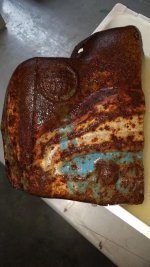
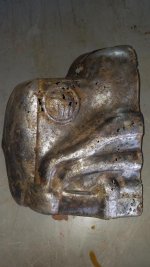
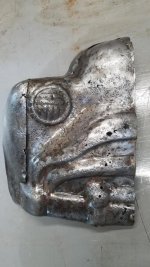
Here's a light-gauge sheet metal project I did recently. Hopefully the progression of cleaning will be evident. The timeframe was about 3 days. When I removed it from the tank (pic #3), I blasted it w/a water hose, and most of the residual paint that wasn't removed in the solution, came-off (pic #4). I was left with a mostly-clean surface. I dried it, and then used a wire wheel to hit the entire surface. I wasn't looking to get to virgin metal everywhere, or I would have used a friend's blast cabinet.

The last pic(#5) shows it when I considered it 'clean-enough,' I shot it with WD40 and have just been letting it sit. When I get around to it, I probably will use some clear paint on it, matte or flat finish, to stop further retardation/rusting of the metal.

I've used the vinegar for rusty tools, and it works well, no need for evaporust. I do seal the top of the container w/a plastic bag or use a snap-on lid & its 5 gallon plastic bucket. Pics to follow, I have to load them from my phone, a pain.
 

Attachments

  • pedalcar rust removal.01.jpg
    pedalcar rust removal.01.jpg
    97.8 KB · Views: 48
  • thumbnail.jpg
    thumbnail.jpg
    81.2 KB · Views: 45
  • pedalcar rust removal.03.jpg
    pedalcar rust removal.03.jpg
    105.4 KB · Views: 42
  • pedalcar rust removal.04.jpg
    pedalcar rust removal.04.jpg
    86.3 KB · Views: 42
  • pedalcar rust removal.05.jpg
    pedalcar rust removal.05.jpg
    103.7 KB · Views: 55
Last edited:

Maui

Well-known member
Joined
Sep 16, 2012
Messages
2,893
Location
Upstate NY
Um, oxalic acid (C2H2O4) is not weak nitric acid (HNO3). They are completely different from one another. Oxalic acid is poisonous.
 

tym

Well-known member
Joined
Mar 5, 2016
Messages
2,445
Location
MA
I didn't know Peter Lorre needed to be de-rusted!

I use straight 5% vinegar, and soak 8-12+ hrs depending on how rusty the item is. I don't vinegar soak plated tools, however.
 
Last edited:

driftpin

Well-known member
Joined
Dec 22, 2016
Messages
11,292
Location
Miami-Dade/Broward Co. Florida
My wife and I were watching a film with him in it, and I took a shot off the screen. To me, the 'sad-face' pedal car and Peter Lorre look somewhat-alike! That's why I included it. http://www.imdb.com/title/tt0026663/?ref_=nm_flmg_act_96 If you like old film dramas, this is a good one, b & w, and a great plot.

I was pleased with the level of rust removal the extended soak gave me.

I didn't know Peter Lorre needed to be de-rusted!

I use straight 5% vinegar, and soak 8-12+ depending on how rusty the item is. I don't vinegar soak plated tools, however.
 

tym

Well-known member
Joined
Mar 5, 2016
Messages
2,445
Location
MA
My wife and I were watching a film with him in it, and I took a shot off the screen. To me, the 'sad-face' pedal car and Peter Lorre look somewhat-alike! That's why I included it. http://www.imdb.com/title/tt0026663/?ref_=nm_flmg_act_96 If you like old film dramas, this is a good one, b & w, and a great plot.

I was pleased with the level of rust removal the extended soak gave me.
I'm not familiar with that one! I was going to guess "M" based on Lorre's age.
 

6PTsocket

Well-known member
Joined
Mar 12, 2014
Messages
4,593
Actually, just got some 6% cleaning vinegar at Walmart.
Regular cheap supermarket distilled white vinegar is diluted to 5%. Is another 1% going to be that different? The only stuff I have seen higher are some of the imported Italian wine vinegars at 7%. Far too expensive for rust temoval. If you want to go higher you would probably have to buy it as acetic acid. You could probably take some of the 5% and heat it to evaporate some of the water and raise the concentration but I have no idea what optimum is.

Sent from my SM-G900V using Tapatalk
 

DadsTools

Well-known member
Joined
Jul 27, 2017
Messages
1,852
Not too long ago I conducted a side-by-side comparison with a mess of rusty tools I had accumulated over time and had been procrastinating about de-rusting them.

I should mention that these tools had been acquired at yard/estate sales and flea markets to clean up and re-sell. There was a time I bought anything if the price was right. Now I stay away from anything that is beyond light surface rust, If I get something really rusty in a lot, those pieces go into the donationware bin. At times if they're really rough, I will just....I know this is a sacrilege of the highest order.....throw them away. Even if it's a rare antique wrench from the 1800s, collectors still don't want them if they're all roached and pitted out--that something is in nice condition is what makes it desirable no matter how rare.

One small tub each (about 10" x 15" x 7"H) of vinegar, oxalic acid and Evaporust. The oxalic acid was mixed 3 tbsp per gallon, the vinegar was the standard white sold for cleaning, Heinz brand, bottle does not give the percentage but just states it's special cleaning strength. Cleaned everything first with that purple degreaser to get all the grease off. Soaked for about 24 hours outside in temperatures that ranged from the 70s during the day to the 50s at night. Then the tools were rinsed in fresh water to remove any residual. There were more tools than what would fit, but I decided I'd use the winner to do the rest.

All removed rust. Original finishes on some of the tools were affected while others not. At first I thought this might have been a function of the particular remover and I'm sure some of it was, but on close examination it also seemed related to the condition of the tool prior to treatment as well as the quality of the finish and steel (I found a surprising variance in the latter among different mfrs and brands).

The winner, by a significant margin in my opinion, was Evaporust. It did the best job of removing the rust more thoroughly while not harming surfaces and leaving the least tarnish. I found that both the vinegar and the oxalic acid was aided by periodic agitation to keep fresh liquid up against the rusty surfaces. I could tell this by the lack of overall color change in the OA and vinegar over time. The oxalic acid produced a white particulate from its combining with the rust that needed to be stirred away from the surfaces to get fresh liquid to the tool. The Evaporust seemed to change color on its own. This probably has something to do with its formulation--remember that EV can be used over and over again. Another difference was that the EV tub would get and stay slightly warm, again from its composition, that showed it was continually at work without needing agitation.The EV also seemed to get into the nooks and crannies better, at least to continue its action in these confined spaces where the action of the vinegar and OA would get exhausted in that localized confinement (this is reflected on another thread where members soaked frozen ratchets in EV to successfully free them up).

Another difference was that the tools from the OA and vinegar had a strong metallic stench. The vinegar left the most of that smell even after rinsing. The EV tools came out with kind of an oily feel to them. You could tell when you had them completely rinsed off when the surfaces started feeling 'squeaky' instead of 'greasy'. Once washed and dried, the EV tools had the least metallic smell to them.

The vinegar and OA had to be disposed. I finished the next three tubs of tools I had with the EV. All cleaned up equally well. Still have what remains for the next job, which will be much smaller due to my amended buying habits. Another advantage is time. After the initial test, which I had to conduct for an equal time period, I found that the next batches in the EV were done in about 4-6 hours.

The vinegar appears to have been gentler on the tools than the oxalic acid but not as efficient at rust removal. Perhaps a weaker OA solution might even this out a bit.

I have a pre-war Stanley #4 hand plane needing some surface rust removal. I wouldn't think of using anything on this valued artifact but EV.

Yes, the EV is much more expensive. But in my situation--buying tools of value with a minimal of rust for resale--it's well worth it. I no longer get piles of rusty junk needing treatment--if that's what you need to do, then the resale value of them is already trashed so it doesn't matter that much, and the cheapest solution makes the most sense. If it's only going to be a user, there's always the bench grinder wire wheel.

Anyway, that's my findings. Yours may vary. And no, I don't work for Evaporust, or even Heinz for that matter.
 
Last edited:

driftpin

Well-known member
Joined
Dec 22, 2016
Messages
11,292
Location
Miami-Dade/Broward Co. Florida
That would have been a good guess. This was a 1935 movie, a horror classic that of-course has passed into history for the most-part. The premise is a great one, and Lorre's character is flawed, consumed by unrequited love for a beautiful married singer whose husband is horribly injured in a train accident. Lorre, a gifted surgeon, makes a surgical repair to the husband which carries with it a horrible burden.

If you're 'of a certain age,' and you watched Martin Milne and George Maharis in Route 66 on TV, you'll get a kick (on Route 66, thanks to its composer, Bobby Troup) out of this episode, it has some very famous movie stars you will recognize: http://www.imdb.com/title/tt0690468/?ref_=ttpl_pl_tt
None need de-rusting, they all roll-along, nicely!

I like your avatar '69 Camaro, looks like a SS? One of my friends in high school had a '69 SS/RS 4-speed convertible white/blue interior when we were about to graduate, that same year.

The pedal car was crusty-rusty and I had doubts about being able to end-up with anything worth saving, before I treated it to the vinegar bath. The driver's side was pretty-much non-existent for the 'nose' of the body. That's why I cut it off.

I'm not familiar with that one! I was going to guess "M" based on Lorre's age.
 
Last edited:

evercl92

Well-known member
Joined
Jun 16, 2017
Messages
186
Location
Columbus, OH
Answering the OP
It's likely that the new vinegar you got isn't the same quality (either in purity or acidic properties) as your previous batch. Though more expensive, chelating agents such as evaporust is a safer option to use, especially on materials / tools that are sensitive or fragile.
 

tym

Well-known member
Joined
Mar 5, 2016
Messages
2,445
Location
MA
I like your avatar '69 Camaro, looks like a SS? One of my friends in high school had a '69 SS/RS 4-speed convertible white/blue interior when we were about to graduate, that same year.
Thanks! It's my dad's '69 SS 350 that he factory ordered new. Obviously it's seem some use since then, but we've been working on getting it back into working shape over the last few years. I kinda dig the rat rod vibe it has currently.

Back to the OP's question, I've found that when vinegar soaking (just did it to a couple of other tools earlier this week), a scrubbing with a stiff brush when rinsing it with water helps a lot. Crumpled aluminum foil even works. Then a wipe down with WD-40 or the degreaser of your choice, or a BLO coating.
 

bubinga

Well-known member
Joined
Jul 26, 2014
Messages
12,744
Location
Bridgeport Ohio. (Across River From Wheeling WV)
Answering the OP
It's likely that the new vinegar you got isn't the same quality (either in purity or acidic properties) as your previous batch. Though more expensive, chelating agents such as evaporust is a safer option to use, especially on materials / tools that are sensitive or fragile.
Yeah, for real...........
Forgot a Stanley chisel for IDK maybe a month........Tore it up!!:evil:
 
To avoid these ads, REGISTER NOW!
Top Bottom