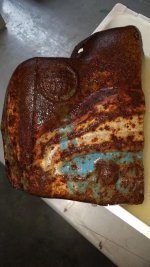
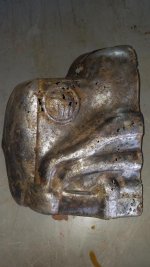
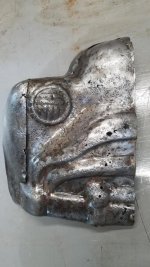
Not too long ago I conducted a side-by-side comparison with a mess of rusty tools I had accumulated over time and had been procrastinating about de-rusting them.
I should mention that these tools had been acquired at yard/estate sales and flea markets to clean up and re-sell. There was a time I bought anything if the price was right. Now I stay away from anything that is beyond light surface rust, If I get something really rusty in a lot, those pieces go into the donationware bin. At times if they're really rough, I will just....I know this is a sacrilege of the highest order.....throw them away. Even if it's a rare antique wrench from the 1800s, collectors still don't want them if they're all roached and pitted out--that something is in nice condition is what makes it desirable no matter how rare.
One small tub each (about 10" x 15" x 7"H) of vinegar, oxalic acid and Evaporust. The oxalic acid was mixed 3 tbsp per gallon, the vinegar was the standard white sold for cleaning, Heinz brand, bottle does not give the percentage but just states it's special cleaning strength. Cleaned everything first with that purple degreaser to get all the grease off. Soaked for about 24 hours outside in temperatures that ranged from the 70s during the day to the 50s at night. Then the tools were rinsed in fresh water to remove any residual. There were more tools than what would fit, but I decided I'd use the winner to do the rest.
All removed rust. Original finishes on some of the tools were affected while others not. At first I thought this might have been a function of the particular remover and I'm sure some of it was, but on close examination it also seemed related to the condition of the tool prior to treatment as well as the quality of the finish and steel (I found a surprising variance in the latter among different mfrs and brands).
The winner, by a significant margin in my opinion, was Evaporust. It did the best job of removing the rust more thoroughly while not harming surfaces and leaving the least tarnish. I found that both the vinegar and the oxalic acid was aided by periodic agitation to keep fresh liquid up against the rusty surfaces. I could tell this by the lack of overall color change in the OA and vinegar over time. The oxalic acid produced a white particulate from its combining with the rust that needed to be stirred away from the surfaces to get fresh liquid to the tool. The Evaporust seemed to change color on its own. This probably has something to do with its formulation--remember that EV can be used over and over again. Another difference was that the EV tub would get and stay slightly warm, again from its composition, that showed it was continually at work without needing agitation.The EV also seemed to get into the nooks and crannies better, at least to continue its action in these confined spaces where the action of the vinegar and OA would get exhausted in that localized confinement (this is reflected on another thread where members soaked frozen ratchets in EV to successfully free them up).
Another difference was that the tools from the OA and vinegar had a strong metallic stench. The vinegar left the most of that smell even after rinsing. The EV tools came out with kind of an oily feel to them. You could tell when you had them completely rinsed off when the surfaces started feeling 'squeaky' instead of 'greasy'. Once washed and dried, the EV tools had the least metallic smell to them.
The vinegar and OA had to be disposed. I finished the next three tubs of tools I had with the EV. All cleaned up equally well. Still have what remains for the next job, which will be much smaller due to my amended buying habits. Another advantage is time. After the initial test, which I had to conduct for an equal time period, I found that the next batches in the EV were done in about 4-6 hours.
The vinegar appears to have been gentler on the tools than the oxalic acid but not as efficient at rust removal. Perhaps a weaker OA solution might even this out a bit.
I have a pre-war Stanley #4 hand plane needing some surface rust removal. I wouldn't think of using anything on this valued artifact but EV.
Yes, the EV is much more expensive. But in my situation--buying tools of value with a minimal of rust for resale--it's well worth it. I no longer get piles of rusty junk needing treatment--if that's what you need to do, then the resale value of them is already trashed so it doesn't matter that much, and the cheapest solution makes the most sense. If it's only going to be a user, there's always the bench grinder wire wheel.
Anyway, that's my findings. Yours may vary. And no, I don't work for Evaporust, or even Heinz for that matter.