I'm no expert, but here are
my opinions on concrete:.
1. a Monolithic pour is just ASKING for major cracks. with a normal footing/ wall/ slab foundation, the slab can actually "float" up or down slightly independently of the foundation walls. sounds crazy but it's true... the slab will move up or down depending on moisture or water conditions in the ground and obviously temperature extremes. on a monolithic pour, the slab cannot move independently without cracking first, so it will likely crack.
2. control joints or grooves should be cut or made in 10x10 squares. I work in a large shop and they cut joints every 20 feet. you can almost measure exactly halfway between each cut joint the concrete made another joint
(crack) on it's own. they also have metal joints that can be installed that will reside just below the surface of the slab. they don't leave surface grooves so you don't see them after the pour, but if the concrete needs to crack, it should do so in a straight line directly above the metal joint. you can fill them with special joint caulk or epoxy later
(after adequate curing time), they'll still do their job.
3. I would recommend using
high psi concrete (
especially since you will be using a lift). if you look into it the cost of stepping up from 3000 to 3500 or 4000 is VERY little.
4. ideally you'll
have the concrete checked for "slump" on site at the time of the pour. this ensures that the concrete truck driver or the contractor doesn't add too much water. truck drivers are paid by the delivery, so they are notorious for jumping out of the driver seat and turning on the water hose and adding water to the mix. it pours faster and they can get back to get the next load faster. extra water makes the concrete easy to pour but makes the concrete weaker.
repeat: TOO MUCH WATER IN THE MIX MAKES THE CONCRETE WEAKER! the workers like to have the concrete "nice and soupy" as it's easier to work with, however, when they are gone you have to keep the inferior slab. don't believe the "water will evaporate" ****. the correct amount of water is ESSENTIAL. The concrete needs the water during the curing process, but too much water will weaken the pour. some people will argue with this untill they are blue in the face, but they are WRONG.
ex: lets say you are going to fill a box with concrete. the box is 1 foot wide, 1 foot tall, and 1 foot deep. now just start adding water to the box with the concrete mix. the problem is, the more water you add into the box, the less room there is for the actual concrete.
5. I'd recommend using
fiberglass IN ADDITION to your rebar or mesh. The fiberglass adds strength
(similar to rebar or mesh and harder/impossible for the workers to screw up). The concrete company will know what you mean, just ask for fiberglass in the mix and they will add it in for you.
6. depending on your climate and weather conditions at the time of the pour you may want to
add a retardant or retarding agent to the mix. this will slow the curing time down. the longer concrete takes to cure, the stronger it is. BTW, providing it has access to some moisture, concrete will continue to cure, harden, and strengthen practically forever.
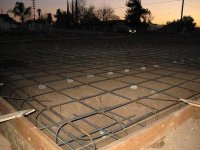
7. as someone else mentioned, have the mesh or rebar sitting on "chairs" to keep it a few inches off of the bottom of the pour.
rebar or mesh sitting on the bottom of the slab is useless. it needs to be IN the slab.
8. make sure that they do a good job on the vapor barrier.
(plastic sheeting between the gravel base and the poured concrete). the plastic poly sheeting is very cheap and it's impossible to "do over". just get it right the first time. tape any seams and do a second layer if desired. again, it's cheap stuff.
9.
KEEP IT DAMP AFTER THE POUR. again, too much water at the time of the pour is a bad thing. However, after it starts to set up, the longer you keep it moist the better. Generally speaking it is recommended that you keep the slab moist about
7-10 days after the pour. the moisture will help SLOW the curing process which again will make the slab stronger. common techniques are to simply cover the slab with poly plastic or even burlap to help prevent moisture from evaporating. however both of these methods can leave cosmetic blemishes on the surface of the slab. some people use sprinklers, some people damn the perimeter of the slab and keep a thin coat of standing water on top. I simply wetted mine with a water hose several times a day. after it's wet enough to walk on keep it damp.
10. insulate in, under, around the slab and foundation now, it's cheap and can't be done later. also seriously decide if you want to install radiant heating in the slab, again something that can't be
(easily or cheaply) done later.
11. when properly mixed and cured, 6" should be plenty thick for any automotive lift that I can think of. I don't believe that you need any special transition if you make a thicker area than the rest of your slab, althought it might be wise location for a control joint. Just make sure that it is thick in an adequate area around the lift.
ex: for a rotary two post lift at least a 6'x6' "pad" of 6" thick concrete is suggested under each post of the lift. but consider the manufacturers specs as the minimum. a rotary 10,000lb lift actually only calls for a 4 1/4 inch slab, but when installing the lift "if the fastners don't tighten to spec", they recommend you cut out 6'x6' squares of the slab and repour 6" thick under the lift posts... I ask why not just do it 6"+ the first time around?
I think that's all I've got to say about concrete...
good luck!


 i have some very very small cracks that showed up but thats all that i see. i did put sawcuts in mine. i also did it as a mono pour and just kept it damp for a few days.