To avoid these ads, REGISTER NOW!

Questions for a Concrete floor

JOHNMAN

Well-known member
Joined
Aug 14, 2006
Messages
194
Location
Southwest Indiana
I will (probably) be having a large floor poured in the future and would like to know real answers before encountering a contractor that may jerk me around.

On a large floor (40ft x 80ft) should I have joints cut in it?

I would prefer a monolith, but to keep cracks to a minimum, what should be called out?

I will have a lift bay somewhere on this 40ft x 80ft floor. The floor in the area will be reinforced and as thick as recommended by the lift manufacturer.

If the floor in the lift bay is thicker than the rest of the floor, should anything special be done at the junction between the floor thicknesses? (i.e. should the difference in thickness be a gradual slope or an abrupt drop off, should there be more reinforcement in the area?)

Would it be a better choice just to make the ENTIRE floor the same thickness?

Again I would prefer to minimize the chance of cracking.


I am in a lot of factories that have real nice smooth concrete floors (some sealed and some not), what do I ask for to get a nice smooth slick finish on the concrete?

I know some of these things will make the pad cost more up front, but I plan on having to do it only once.

Thanks for your advice.
 
To avoid these ads, REGISTER NOW!

Matti

Well-known member
Joined
Nov 16, 2007
Messages
412
Location
Canada
I think you will find that with a floor that big the thickness will have to be more than what a lift mfg recommends. Around here the floors are 4" thick for up to 30' wide and then they get thicker for large pads. The lift mfg's requirements are not really anything beyond the norm for a std garage (at least for 4 post lifts).
 

kvom

Well-known member
Joined
Feb 1, 2008
Messages
820
Location
*******, GA
The slick floor (like in newer Walmarts) comes from having a shake hardener applied over the concrete. I am trying to do that on my new build.

It would be a good idea to choose where you want the lift before doing the pour. You want to avoid putting rebar under the pads where it may lie in the path of the anchors.
 

Will67

Well-known member
Joined
Nov 17, 2006
Messages
852
Location
Hell's half acre
3,200 sqft without control joints IMO that is just asking for cracks. The control joints are like a sacrificial anodes they are there so the crack will hopefully crack in the control joint. Here in California we use a special trowel to put in the groves as we pour/finish, while most mid-west and eastern states cut them in after the pour is done.

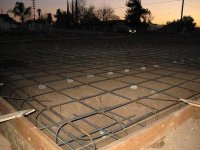
If you do decide to put down rebar or remesh, make sure it is on dobbies or plastic support chairs. I know it makes a pour more difficult on those doing the work, but I would not accept the contractor stating "we just pull up the rebar or remesh as we pour". To that I say BS, because if the rebar or remesh is still connected to an area being poured it will be step on and drive the rebar/remesh down to the bottom of the slab where it will do you no good.
 

slddnmatt

Well-known member
Joined
Apr 27, 2007
Messages
54
Location
riverside ca.
i had to have rebar every 16" in mine, the rebar couldnt touch the ground for inspection, i did everything myself with some help, witch was a big pain! my footings were severely overkill in my opinion but i dont think i have to worry about big cracks. i plan to but a 2 post lift in mine. the thickness is about 5" give or take with my expert leveling skills:) i have some very very small cracks that showed up but thats all that i see. i did put sawcuts in mine. i also did it as a mono pour and just kept it damp for a few days.
 

Attachments

  • garage pics 055.JPG
    garage pics 055.JPG
    66.3 KB · Views: 126
  • garage 008.jpg
    garage 008.jpg
    65.5 KB · Views: 114
OP
J

JOHNMAN

Well-known member
Joined
Aug 14, 2006
Messages
194
Location
Southwest Indiana
3,200 sqft without control joints IMO that is just asking for cracks. The control joints are like a sacrificial anodes they are there so the crack will hopefully crack in the control joint. Here in California we use a special trowel to put in the groves as we pour/finish, while most mid-west and eastern states cut them in after the pour is done.

If you do decide to put down rebar or remesh, make sure it is on dobbies or plastic support chairs. I know it makes a pour more difficult on those doing the work, but I would not accept the contractor stating "we just pull up the rebar or remesh as we pour". To that I say BS, because if the rebar or remesh is still connected to an area being poured it will be step on and drive the rebar/remesh down to the bottom of the slab where it will do you no good.


On what centers should the control joints be? Would 20'x20' areas still be too large? I really would rather have controlled cracks than random cracks.

I have seen some plants have the "control joints" cut with saws. (Yes I am in the Midwest.) I have then witnessed someone later filling the joint with some type of epoxy that is then scraped and made level with the remainder of the floor. Is that the right thing to do with "control joints", or should they remain open and allowed to collect dirt?

Do I really keep the pour covered with water for 7 days?

How?

How wet is wet enough?
 
OP
J

JOHNMAN

Well-known member
Joined
Aug 14, 2006
Messages
194
Location
Southwest Indiana
i had to have rebar every 16" in mine, the rebar couldnt touch the ground for inspection, i did everything myself with some help, witch was a big pain! my footings were severely overkill in my opinion but i dont think i have to worry about big cracks. i plan to but a 2 post lift in mine. the thickness is about 5" give or take with my expert leveling skills:) i have some very very small cracks that showed up but thats all that i see. i did put sawcuts in mine. i also did it as a mono pour and just kept it damp for a few days.

How big is that floor?

Is that poured right on dirt?

On my existing 36'x60' garage (built 12-13 years ago), there are some small cracks around the area of my 2-post lift. We made an area where the lift was to be installed about 5"-6" thicker in the "lift bay". The thickness where the anchors are is about 10"-12" thick. The rest of the floor is approximately 5"-6" thick.

My existing garage floor was a single pour and had no control joints cut. It was not kept wet intentionally. It was poured after the building was enclosed and it did stay fairly damp and humid for a few days, but we put no extra water on the surface. I do have a few areas in it where the surface is a bit crumbly near one of the overhead doors. I am assuming that it is either from salt dragged in on a vehicle or the concrete dried out too quickly when curing.

I would like to avoid pitfalls when I build a new building.
 

slddnmatt

Well-known member
Joined
Apr 27, 2007
Messages
54
Location
riverside ca.
my garage is 50 X 60 and im sitting on decomposed granite. my pad got to sit and weather a few seasons to compact and now its like a rock. for me to do any dirt work i have to wait until it rains for a few days then my little tractor will actually do something! my pops garage is 40 X 50 and was done as a mono pour too and it cracked big time around the main pillars, but they were 40" deep, also on DG but it didnt sit like mine so i think it compacted a little more and thats why it cracked so bad. i plan on putting a urethane sealant in my joints, i hate when dirt gets in there! here is a pic of it from sunday
 

Attachments

  • garage pics 059.JPG
    garage pics 059.JPG
    74.8 KB · Views: 60

2level

Well-known member
Joined
Apr 10, 2008
Messages
1,146
Location
Washington
On what centers should the control joints be? Would 20'x20' areas still be too large? I really would rather have controlled cracks than random cracks.

I have seen some plants have the "control joints" cut with saws. (Yes I am in the Midwest.) I have then witnessed someone later filling the joint with some type of epoxy that is then scraped and made level with the remainder of the floor. Is that the right thing to do with "control joints", or should they remain open and allowed to collect dirt?

Do I really keep the pour covered with water for 7 days?

How?

How wet is wet enough?

I tried to use control joints on a 20 X 20 grid using 4,000psi concrete w/ #3 rebar, but I got 3 long cracks between the joints that probably wouldn't be there if I had used a 12 X 12 grid. This is on a 1600 square foot L-shaped floating slab.
 
To avoid these ads, REGISTER NOW!

Kevin54

MEMBER EMERITUS
Joined
Jan 12, 2005
Messages
29,341
Location
Urbana, Ohio
I am in a lot of factories that have real nice smooth concrete floors (some sealed and some not), what do I ask for to get a nice smooth slick finish on the concrete?

Power trowel and burnish.
 

Bigger Hammer

Well-known member
Joined
Jun 26, 2007
Messages
173
20 x 20 is too big IMO. If it were mine I'd chop it up and caulk the joints afterward. Being inside I doubt it really neds to be a high dollar epoxy product although the epoxy would be a superior product. As for cut layout, 10 x 10 is pretty common but I'd go with something in the 8x8 ball park. And that is nothing more than my opinion based on my experience so like any internet advice, it's worth what you paid for it.

Your contractor can put the glass finish on it with a power trowel and use a clear sealer. I've actually "burned in" slabs to the point you could actually see the reflection of the horizon in the slab surface.

On the thickness issue, if you spec a 4" slab, I would suggest keeping a close eye on the grading process. In my experience a 4" slab turns into a 3.5" slab in a real hurry since it is easy to use a 2x4 for a form. At 4 inches on a 40x80 you should be right at about 40 yards but at a 3.5 inches it ends up about 35.5 yards. That doesn't sound like much but to your contractor that's probably about $400 extra in his pocket if he can get away with it which he most certainly has done and will do if no one is watching. If you can be around when they pour, just ask to see the last load ticket, it will have the yards on that load and the total yards for the pour. Keep in mind any thickened footings, or heavier areas of the slab for the lift as they will add up in the final yardage total. But on the other hand, you might find a contractor that has a crew that can't grade worth a damn and you'll get a bunch of extra yardage at his cost. I've seen it go both ways.

And about the lift. If you are unsure of what to do with the lift section but know where you want to put it, you can always form out an area that you know will be large enough for any lift you might be considering and pour it at a later date to what ever thickness you might require.
 

SUPERFORD

Well-known member
Joined
Jun 7, 2008
Messages
138
I'm no expert, but here are my opinions on concrete:.

1. a Monolithic pour is just ASKING for major cracks. with a normal footing/ wall/ slab foundation, the slab can actually "float" up or down slightly independently of the foundation walls. sounds crazy but it's true... the slab will move up or down depending on moisture or water conditions in the ground and obviously temperature extremes. on a monolithic pour, the slab cannot move independently without cracking first, so it will likely crack.

2. control joints or grooves should be cut or made in 10x10 squares. I work in a large shop and they cut joints every 20 feet. you can almost measure exactly halfway between each cut joint the concrete made another joint (crack) on it's own. they also have metal joints that can be installed that will reside just below the surface of the slab. they don't leave surface grooves so you don't see them after the pour, but if the concrete needs to crack, it should do so in a straight line directly above the metal joint. you can fill them with special joint caulk or epoxy later (after adequate curing time), they'll still do their job.

3. I would recommend using high psi concrete (especially since you will be using a lift). if you look into it the cost of stepping up from 3000 to 3500 or 4000 is VERY little.

4. ideally you'll have the concrete checked for "slump" on site at the time of the pour. this ensures that the concrete truck driver or the contractor doesn't add too much water. truck drivers are paid by the delivery, so they are notorious for jumping out of the driver seat and turning on the water hose and adding water to the mix. it pours faster and they can get back to get the next load faster. extra water makes the concrete easy to pour but makes the concrete weaker. repeat: TOO MUCH WATER IN THE MIX MAKES THE CONCRETE WEAKER! the workers like to have the concrete "nice and soupy" as it's easier to work with, however, when they are gone you have to keep the inferior slab. don't believe the "water will evaporate" ****. the correct amount of water is ESSENTIAL. The concrete needs the water during the curing process, but too much water will weaken the pour. some people will argue with this untill they are blue in the face, but they are WRONG. ex: lets say you are going to fill a box with concrete. the box is 1 foot wide, 1 foot tall, and 1 foot deep. now just start adding water to the box with the concrete mix. the problem is, the more water you add into the box, the less room there is for the actual concrete.

5. I'd recommend using fiberglass IN ADDITION to your rebar or mesh. The fiberglass adds strength (similar to rebar or mesh and harder/impossible for the workers to screw up). The concrete company will know what you mean, just ask for fiberglass in the mix and they will add it in for you.

6. depending on your climate and weather conditions at the time of the pour you may want to add a retardant or retarding agent to the mix. this will slow the curing time down. the longer concrete takes to cure, the stronger it is. BTW, providing it has access to some moisture, concrete will continue to cure, harden, and strengthen practically forever.

7. as someone else mentioned, have the mesh or rebar sitting on "chairs" to keep it a few inches off of the bottom of the pour. rebar or mesh sitting on the bottom of the slab is useless. it needs to be IN the slab.

8. make sure that they do a good job on the vapor barrier. (plastic sheeting between the gravel base and the poured concrete). the plastic poly sheeting is very cheap and it's impossible to "do over". just get it right the first time. tape any seams and do a second layer if desired. again, it's cheap stuff.

9. KEEP IT DAMP AFTER THE POUR. again, too much water at the time of the pour is a bad thing. However, after it starts to set up, the longer you keep it moist the better. Generally speaking it is recommended that you keep the slab moist about 7-10 days after the pour. the moisture will help SLOW the curing process which again will make the slab stronger. common techniques are to simply cover the slab with poly plastic or even burlap to help prevent moisture from evaporating. however both of these methods can leave cosmetic blemishes on the surface of the slab. some people use sprinklers, some people damn the perimeter of the slab and keep a thin coat of standing water on top. I simply wetted mine with a water hose several times a day. after it's wet enough to walk on keep it damp.

10. insulate in, under, around the slab and foundation now, it's cheap and can't be done later. also seriously decide if you want to install radiant heating in the slab, again something that can't be (easily or cheaply) done later.

11. when properly mixed and cured, 6" should be plenty thick for any automotive lift that I can think of. I don't believe that you need any special transition if you make a thicker area than the rest of your slab, althought it might be wise location for a control joint. Just make sure that it is thick in an adequate area around the lift. ex: for a rotary two post lift at least a 6'x6' "pad" of 6" thick concrete is suggested under each post of the lift. but consider the manufacturers specs as the minimum. a rotary 10,000lb lift actually only calls for a 4 1/4 inch slab, but when installing the lift "if the fastners don't tighten to spec", they recommend you cut out 6'x6' squares of the slab and repour 6" thick under the lift posts... I ask why not just do it 6"+ the first time around?

I think that's all I've got to say about concrete...

good luck!
:beer:
 
Last edited:

Charles (in GA)

Well-known member
Joined
Jan 11, 2006
Messages
12,489
Location
50 mi south of Atlanta
I have a 60x60 metal building in Georgia. It was erected in the fall of '99. The slab was a monolith pour about 4-1/2" thick and 2 ft wide by 16" deep around the edges and 4'x4'x16" deep at the column anchors. We keyed the slab with metal keyways, one down the middle and two across, making 20x30 "squares". After eight years I have a few very fine hairline cracks at the anchor bolt areas, and a couple of other spots, but you have to look close to see them. The keys should have been done on 20x20 or less squares, but I didn't know that at the time. Finish was a "slick" finish and while not perfect, I find it more than acceptable.

My main regrets are using reinforcing wire mesh, we should have used rebar throughout, supported, and eliminating the keys, and simply sawing the slab.

Every slab I've seen with the fiberglass in it was not a smooth finish and the fiberglass seems to wick oil and contaminates into the concrete. Around here its added by the bag full to the truck at the pour, and I see little benefit to it. Put your money in higher psi and more rebar.

Charles
 

SUPERFORD

Well-known member
Joined
Jun 7, 2008
Messages
138
Every slab I've seen with the fiberglass in it was not a smooth finish and the fiberglass seems to wick oil and contaminates into the concrete. Around here its added by the bag full to the truck at the pour, and I see little benefit to it. Put your money in higher psi and more rebar.

My slab has fiberglass and is smooth EXCEPT you can see a very small amount of fiber (if you look closely) only in the "broom swept" finished areas in front of each garage door (the apron). so I assume it depends on how you finish the surface.

Fiberglass strands help tie the concrete together, thus making it stronger. I believe it gives the concrete crystals something to form on as they grow and helps them to form in a linear fashion. (concrete forms crystals and produces heat as it cures).

I hadn't heard of the fiberglass being added on site, it doesn't seem as if it would mix as thouroughly in that short amount of time.

That may be a valid point about the fiberglass wicking contaminants into the slab more quickly. my floor will be epoxied, so it's a non issue. but may be something to consider if you plan to use bare floors.

I agree with higher psi and more rebar for sure, but the fiberglass doesn't cost much and it can't hurt IMHO.

good luck.
 

TXST8tj

Well-known member
Joined
Mar 4, 2008
Messages
101
Location
Fulshear, TX
i am in the ready mix concrete business and while a lot has already been said, and most all of it pretty accurate, i can at least confirm/elaborate/comment on some things mentioned.

3. I would recommend using high psi concrete (especially since you will be using a lift). if you look into it the cost of stepping up from 3000 to 3500 or 4000 is VERY little.
some GENERAL basics...3000psi is generally flatwork (sidewalks & residential driveways); 3500psi is residential slab mud or for somewhere there will be more weight (car lift in a garage, hot tub on a back patio, etc); 4000psi is generally commercial foundation mud. each contractor has a different idea of what should be used in which applications. we have some customers that only pour a 4000psi straight cement mix...no matter what they are doing..sidewalk, foundation, patio, etc. we have another customer that only pours a 3000psi mix...no matter what they are doing..sidewalk, foundation, patio, etc.

personally, for your application, i would be using a 3500psi mix. concrete pricing is different all across the country, but in our neck of the woods (central Texas), pricing is generally an additional $3 per psi grade..so basically a $6 difference between a 3000 and 4000 psi mix. the cost is worth it when it's necessary. in your case, you should be pouring a 3500psi. 3000 won't be strong enough and 4000 will be an unecessary overkill.

the mix designs set up for a ready mix company are basically designed to batch a 4" slump (to most people, this is pretty dry, but still very much workable). this can be changed during the batch process by holding back water or adding more resulting in a higher or lower slump. the mixes are setup on ratios. if you adjust one ingredient without the others, you compromise the integrity of the concrete product. mixers are prepared to add water because obviously, some water will evaporate between the plant and the jobsite. as mentioned, it is very common for contractors/workers/drivers to add too much water to make the mud flow better/faster. if the concrete is being pumped, it will be slumped up to at least a 5" before it is dropped in the hopper and sent through the pipes. i've not met a pump operator that will pump less than that. especially in these hot months, right or wrong, expect to see them adding a good amount of water once they reach the jobsite.

5. I'd recommend using fiberglass IN ADDITION to your rebar or mesh.
"Fibermesh" is not a bad idea, but as long as the rebar is done properly, it's not exactly necessary. it certainly won't hurt, but you probably won't need it. again, sometimes it just comes down to a simple cost issue. prices are different everywhere, but we charge $5 per bag of fibermesh and when using it, the ratio here is 1 bag per yard. our trucks haul 10 yard loads, so 10 bags of fiber = $50 per truck = $200 for a 40 yard pour.
oh, fibermesh should be added at the plant right after the truck is loaded. it does need time to break apart and mix.

6. depending on your climate and weather conditions at the time of the pour you may want to add a retardant or retarding agent to the mix.
definitely true, but it should already be added to the mix. the only time you might need to request an additional product would be with adding 'calcium', but that is only for very cold times of the year.


if you are concerned about the concrete being strong enough even with properly laid rebar (of course consult with your contractor), but perhaps inquire about running a 'straight cement' mix....as opposed to the mix having an additional product such as 'flyash'. running straight cement makes the mix very strong.
 
Last edited:

Pritch

Active member
Joined
Nov 30, 2007
Messages
33
If you go with an accelerator, ask for 'non-cloride' instead of calcium. The calcium is hard on rebar. Works fine with fiber-mesh, though. The only drawback with fiber is the slab looking like it needs a shave after. If your contractor uses a power trowell, it will burn off, otherwise after a few weeks or month or so, a light pass with a weedburner will get rid of them. I don't know how it is in other areas, but here in Utah, most engineered batches will contain some % of fly-ash. Flyash is a pozzalon, as is concrete, and will eventually get just as hard as a straight bag mix. 4000 psi is 4000 psi, no matter if you get there with a straight six bag or an engineered mix.
 
To avoid these ads, REGISTER NOW!
Top Bottom