

You are using an out of date browser. It may not display this or other websites correctly.
You should upgrade or use an alternative browser.
You should upgrade or use an alternative browser.
Quieting Air Compressor with Filter?
- Thread starter Beamer
- Start date
backupbeeper
Well-known member
- Joined
- Mar 21, 2023
- Messages
- 132
Most of the noise an air
Comp makes is through the intake manifold . A larger filter or perhaps more than one filter would help
Comp makes is through the intake manifold . A larger filter or perhaps more than one filter would help
flyingblind
Well-known member
I used these and now my old compressor make a quieter goose honking sound.
finn
Well-known member
You should be looking at Helmholtz resonators, like used on some small Diesel intake systems. They basically break up the reverse pressure waves, with no loss in performance.
Often used in high pressure / high speed hydraulics to control pressure waves also.
Often used in high pressure / high speed hydraulics to control pressure waves also.
I've got something (plastic) like that on there but have seen larger ones that (ie) Solberg makes. I didn't know if size made a difference other than flow capacity.I used these and now my old compressor make a quieter goose honking sound.
flyingblind
Well-known member
I would imagine larger is less noisy. My 60gal has 3 similar in size to the amazon one and it is pretty quiet. You could also rout the intake higher and away and see if it makes a difference. I find most noise comes from the pullies and motor.I've got something (plastic) like that on there but have seen larger ones that (ie) Solberg makes. I didn't know if size made a difference other than flow capacity.
Firebrick43
Well-known member
Will different replacement intake filters possibly help quiet a noisy air compressor?
If so, is bigger better?
Possibly but it depends on the speed of your pump. Many box store compressors use a much smaller pump run by a 3450 rpm motor opposed to others using a much larger pump and running it by a 1750 rpm motor. If you have one of these high rpm pumps its unlikely to get the compressor very quiet due to the high mechanical noise.
They are used on almost all cars intakes nowadays, gas and diesel. I cant recall a car that I have worked on that doesn't have one.You should be looking at Helmholtz resonators, like used on some small Diesel intake systems. They basically break up the reverse pressure waves, with no loss in performance.
Often used in high pressure / high speed hydraulics to control pressure waves also.
A Helmholtz should be pretty easy to construct and tune on a single rpm compressor.
https://www.calctool.org/waves/helmholtz-resonator
WIth an intake you can add a simple J pipe and use a well fitted long plug and simply insert the plug as the compressor is running to figure out exactly how long the pipe needs to be trimmed to cancel out the resonate frequency the compressors intake is running at.
I did this on a jeep exhaust to cancel out a bad drone at high way speeds.
csp
Well-known member
Don't expect much if you have a oilless compressor. Much of their noise resonates through the lack of material that makes up the pump itself.
finn
Well-known member
You’re talking about the oilless compressors of days gone by. The newer “silent” compressors popularized by California Air, but now available through many retailers from HF to Lowes sort of crush the “oilless compressors are inherently noisy “ myth.Don't expect much if you have a oilless compressor. Much of their noise resonates through the lack of material that makes up the pump itself.
They’re still consumer grade compressors, as far as I can tell, though.
csp
Well-known member
There are still plenty of cheapie oilless compressors available on the market today. Look at any home improvement center black Friday ad. The OP may have an older one as well.
Spareparts
Well-known member
I have a 80gal 5hp compressor in my shop, noisy as hell. Checked with the supplier North Central Air in Downs Ks.
he had a kit for $25, that was 8yrs ago. It had an 90% street elbow and a glasspack muffler and clamps, something you could
aquire at any parts store. Removed the air filter, screwed in the elbow,a short pipe ******, the muffler, then the original filter
You can talk on the phone standing next to it now. Your application may be different but that little smitty muffler sure
quitened it down. I belive the pipe fittings were 1 1/2" NPT but that was several yrs. ago and my memory isn's all that good
he had a kit for $25, that was 8yrs ago. It had an 90% street elbow and a glasspack muffler and clamps, something you could
aquire at any parts store. Removed the air filter, screwed in the elbow,a short pipe ******, the muffler, then the original filter
You can talk on the phone standing next to it now. Your application may be different but that little smitty muffler sure
quitened it down. I belive the pipe fittings were 1 1/2" NPT but that was several yrs. ago and my memory isn's all that good
Now there's a thought. A 6 ft piece of copper pipe, a couple brass fittings and the filter can be in the garage attic.I would imagine larger is less noisy. My 60gal has 3 similar in size to the amazon one and it is pretty quiet. You could also rout the intake higher and away and see if it makes a difference. I find most noise comes from the pullies and motor.
Nope, it's an oil type, twin tank contractor compressor that runs about as fast as a lawn mower engine.Don't expect much if you have a oilless compressor. Much of their noise resonates through the lack of material that makes up the pump itself.
In general, yes, a better filter housing can reduce noise levels. One way to get an idea how good you could get is to hold your hand over the air intake. Yes, that plugs the air intake but it gives you an idea how much noise is coming out the in. Figure with a better air intake that is how quiet the machine will be. It's interesting how much louder my CAT compressor is when I ran it without the intake filter housing (and it's little silly looking but functional rubber tube). For a portable compressor your best bet is probably to copy a CAT type intake. Odds are the compressor will still be loud but not as bad.
In general, yes, a better filter housing can reduce noise levels. One way to get an idea how good you could get is to hold your hand over the air intake. Yes, that plugs the air intake but it gives you an idea how much noise is coming out the in. Figure with a better air intake that is how quiet the machine will be. It's interesting how much louder my CAT compressor is when I ran it without the intake filter housing (and it's little silly looking but functional rubber tube). For a portable compressor your best bet is probably to copy a CAT type intake. Odds are the compressor will still be loud but not as bad.
Is this what it looks like?
This guy + a rubber tube that is inserted into the filter inlet.Is this what it looks like?

Air Compressor Accessories & Pneumatic Tool Accessories | Woodcraft
Shop air compressor accessories, attachments for your air compressor and pneumatic attachment upgrades at Woodcraft. We have the air tool accessories and pneumatic tool accessories you need.
 www.woodcraft.com
Looks a lot like the SolbergThis guy + a rubber tube that is inserted into the filter inlet.
Air Compressor Accessories & Pneumatic Tool Accessories | Woodcraft
Shop air compressor accessories, attachments for your air compressor and pneumatic attachment upgrades at Woodcraft. We have the air tool accessories and pneumatic tool accessories you need.

isb cornbinder
Well-known member
Your suggestion is the first correct answer. I have a large FLEETGUARD filter on my T30 and it barks like an angry big dog. I do not mind the sound.You should be looking at Helmholtz resonators, like used on some small Diesel intake systems. They basically break up the reverse pressure waves, with no loss in performance.
Often used in high pressure / high speed hydraulics to control pressure waves also.
Attachments

RaisedByWolves
Well-known member
I noticeably quieted down my 5gal with a #10 coffee can and filter foam.
The key is to limit the size of the air intake holes in the lid of the can to limit the amount of intake noise than can be transmitted into the air. I have 3 1/2" holes and the can is lightly packed with foam.
Its a little slower to fill, but mot nearly as loud.
The key is to limit the size of the air intake holes in the lid of the can to limit the amount of intake noise than can be transmitted into the air. I have 3 1/2" holes and the can is lightly packed with foam.
Its a little slower to fill, but mot nearly as loud.
Rockable
Well-known member
The best thing I ever did was move my 5HP I-R compressor outside and under a lean to.
ok, so I installed a Solberg as pictured above. It's much bigger and heavier build than the original and it changed the tone of the noise, a bit less offensive but not quiet.
I guess I'll try building a box.
What would be the most effective type of insulation?
Rigid, spongy foam like eggcrate, blankets like RockWool, or what?
I guess I'll try building a box.
What would be the most effective type of insulation?
Rigid, spongy foam like eggcrate, blankets like RockWool, or what?
Firebird Racer
New member
- Joined
- Dec 2, 2023
- Messages
- 3
Can you post a picture of what you did? I have my 5hp, 80 gal sitting on isolators in an insulated room with a door, and it's still too noisy. Like to quiet it down some more.I have a 80gal 5hp compressor in my shop, noisy as hell. Checked with the supplier North Central Air in Downs Ks.
he had a kit for $25, that was 8yrs ago. It had an 90% street elbow and a glasspack muffler and clamps, something you could
aquire at any parts store. Removed the air filter, screwed in the elbow,a short pipe ******, the muffler, then the original filter
You can talk on the phone standing next to it now. Your application may be different but that little smitty muffler sure
quitened it down. I belive the pipe fittings were 1 1/2" NPT but that was several yrs. ago and my memory isn's all that good
Spareparts
Well-known member
I just showed a friend that setup, I believe the pipe size is 1 1/4 npt the filter assy just screwed into the compressor head. Removed it and screwed the street ell into the compressor head, positioned the ell straight up, installed the muffler then the filter assembly, all done. This was a kit for that compressor. I got it from North Central Air in Downs Kansas they have a web page. If your compressor has pipe threads
on the intake port all the material can be sourced locally, The muffler is just a cherry bomb glass pack that has pips fittings welded on each end, short overall length is only about 18". I wish I could figure out how to post pictures, I am 77 and computers are not my strong suit.
on the intake port all the material can be sourced locally, The muffler is just a cherry bomb glass pack that has pips fittings welded on each end, short overall length is only about 18". I wish I could figure out how to post pictures, I am 77 and computers are not my strong suit.
Firebird Racer
New member
- Joined
- Dec 2, 2023
- Messages
- 3
I think I get the jist of the concept now. And 77 is young, I'm not that many years behind you. LOL! Thanks.I just showed a friend that setup, I believe the pipe size is 1 1/4 npt the filter assy just screwed into the compressor head. Removed it and screwed the street ell into the compressor head, positioned the ell straight up, installed the muffler then the filter assembly, all done. This was a kit for that compressor. I got it from North Central Air in Downs Kansas they have a web page. If your compressor has pipe threads
on the intake port all the material can be sourced locally, The muffler is just a cherry bomb glass pack that has pips fittings welded on each end, short overall length is only about 18". I wish I could figure out how to post pictures, I am 77 and computers are not my strong suit.
I'm glad my compressor lives in the shed. even tho it's a belt driven 2 cyl oiled head, it's still nicer not in the same building
Spareparts
Well-known member
Mine is in the shop because I shut the supply of air off every night and when I turn it back I always look at
the oil level and crack the drain valve, just habit I guess.
the oil level and crack the drain valve, just habit I guess.
rayra
Well-known member
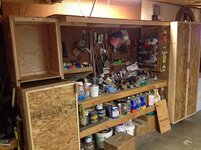
I put my oil-less compressor into an isolating cabinet, front door was storage for the tools, top surface and bottom edge skirts were pegboard for air intake and convection, walls and back were lined with egg-crate foam. It wasn't quiet. but it was no longer LOUD.
But this was occasional home use, not a lot of run time.
the cabinet at the far left held the 22gal upright Craftsman compressor.
But this was occasional home use, not a lot of run time.
the cabinet at the far left held the 22gal upright Craftsman compressor.
Attachments

cvairwerks
Well-known member
At one place I worked, we had a huge noise problem with our 25 hp Quincy. One thing we did to help quiet it down, was pipe the intakes to the outside of the shop. We used a large flex line to very large diameter tubing and ran that up the wall and out an unused duct hole to the outside. Made things way quieter.
I put my oil-less compressor into an isolating cabinet, front door was storage for the tools, top surface and bottom edge skirts were pegboard for air intake and convection, walls and back were lined with egg-crate foam. It wasn't quiet. but it was no longer LOUD.
But this was occasional home use, not a lot of run time.
the cabinet at the far left held the 22gal upright Craftsman compressor.
The picture on the left reminds me of my work bench and to not start any more new projects until I finish the old ones.
Do you think the eggcrate foam is the best insulation for the problem?
kaymccampbell
Well-known member
I piped mine into a dead space, and installed the filter behind a service hatch. It took a lot of the noise out of my 5hp. There's still the big machine noise.
ericm
Well-known member
The picture on the left reminds me of my work bench and to not start any more new projects until I finish the old ones.
Do you think the eggcrate foam is the best insulation for the problem?
A single lined box is probably not as effective as a multi chamber design. You're building a muffler. It doesn't matter that the flow is in the opposite direction from an exhaust muffler- it's the sound waves you're concerned about.
Car mufflers are tuned to primarily work at cruising speed, which is 2000-3000 rpm. The compressor runs at more like 850 or so. So your muffler features will need to be larger to muffle longer wave lengths.
The good thing is that unless you have unusual size constraints you can make your muffler big. Cars and motorcycles have packaging limitations. Mufflers can be small, quiet, or efficient: pick two. Check out the size of the muffler on this: https://www.aircompressorsdirect.com/EMAX-ES07V080V1-Air-Compressor/p18821.html
rayra
Well-known member
Best? Probably not. But a good value for the low cost. And it was effective. But just as with generator doghouses, it's a compromise solution between noise abatement and airflow. Any enclosure traps heat. Any enclosure should have enough headspace to allow hot air to rise away from the motor, mine didn't, space-constrained in a 2car garage. Things got a little warmish. If I was going to use air tools extensively I'd leave the door cracked open. But I ran it that way for years and that compressor is still with me in another home, going on 3yrs now. About to use it in a few minutes for airbrushing some Cerakote on some firearm parts. And despite being in a 3-car garage now, I haven't got around to enclosing it. Not using it enough for it to matter. And STILL space-constrained.The picture on the left reminds me of my work bench and to not start any more new projects until I finish the old ones.
Do you think the eggcrate foam is the best insulation for the problem?
The foam I used looked like this -


I also used that foam to quell much of the noise from the HVAC return, by lining the bottom and sides of that cavity with it. Lot of reflected HVAC noise bouncing off the floor slab and out the two large intake grills that were on two sides of the corner where the living room met the bedrooms hallway.
Last edited:
racecougar
Well-known member
Assuming your shop is conditioned space, putting the compressor outside or plumbing its intake outside is a step backwards with regard to removing moisture from the compressed air. It likely isn't a big deal in arid areas, but it makes a notable difference here in the Midwest.
I've found that these Solberg filter housings run rather quiet on mine.

I've found that these Solberg filter housings run rather quiet on mine.
garboui
Well-known member
After looking at Helmholtz designs and pondering the long avenue of tuning and still not getting all the other frequencies and harmonics, I decided on a brute force approach. Convoluted cambers. This resulted in a ~8.3dB reduction and is not unpleasant to be working 8ft away when its running. I was worried about restriction but the cycle times seem about the same. Inside the bottom cavities of the silencer are "tree" supports from teh print which probably help a bit more with the reduction. The filter is just a standard lawnmower filter which is the same one that was on teh compressor for comparison.
Much of the tingy tack tack tack tack, that's left seems like noise that is from teh output and resonating in the tank. This gives me an idea of an output muffler between the tank and compressor now!
Sound measurements were taken with phone and compressor in identical, unmoved locations.


Tree supports in lower cavities.

Before
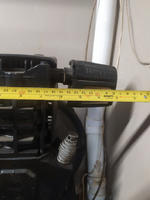

After
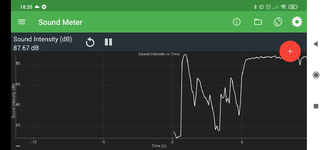
Much of the tingy tack tack tack tack, that's left seems like noise that is from teh output and resonating in the tank. This gives me an idea of an output muffler between the tank and compressor now!
Sound measurements were taken with phone and compressor in identical, unmoved locations.
Tree supports in lower cavities.
Before
After
Last edited:
Nutria
Well-known member
My experience as well.ok, so I installed a Solberg as pictured above. It's much bigger and heavier build than the original and it changed the tone of the noise, a bit less offensive but not quiet.
After looking at Helmholtz designs and pondering the long avenue of tuning and still not getting all the other frequencies and harmonics, I decided on a brute force approach. Convoluted cambers. This resulted in a ~8.3dB reduction and is not unpleasant to be working 8ft away when its running. I was worried about restriction but the cycle times seem about the same. Inside the bottom cavities of the silencer are "tree" supports from teh print which probably help a bit more with the reduction. The filter is just a standard lawnmower filter which is the same one that was on teh compressor for comparison.
Much of the tingy tack tack tack tack, that's left seems like noise that is from teh output and resonating in the tank. This gives me an idea of an output muffler between the tank and compressor now!
That's an interesting result. I think that is the same pump on my compressor. I got about the same 8db reduction when I switched from an open filter (basically just as loud as no filter) to using the current CH filter + about 1.5' of vinyl tubing that just fits over the snout of the air intake. This isn't the exact filter I have it is basically the same design.
https://www.amazon.com/Element-VH90...MP333200SJ/dp/B09LLWR93X?tag=atomicindus08-20
That filter + $2 worth of tubing worked really well.