To avoid these ads, REGISTER NOW!

Quincy 325 Compressor Makes Noise

Joelk

Well-known member
Joined
Feb 6, 2013
Messages
280
Location
Bedford PA
I have an OLD(Made in 1957) Quincy 325 ROC 4 Compressor that makes a clattering noise. I need help figuring out what is causing the noise.

I bought it and due to the noise, I decided to overhaul it and have done pretty much a complete overhaul on it. When I tore it down I found a worn High Pressure Piston Pin and Pin Bushing and installed new pin bushings, piston pin, new rod bearings, piston pin bushings, rings and have overhauled the head. I was expecting the worn piston pin/bushing to be the cause of the noise, but it sounds the same after the overhaul, as it did before.

When I first start it up, it runs pretty quiet for 15-20 seconds, but when it starts building pressure it starts clattering/knocking and keeps on clattering until it shuts off. It seems to compress air just fine, but the noise scares me. I suppose it could be a "normal noise" for this compressor to make, but it sounds too loud to me and I don't have a known good one to listen to, to see how a good one sounds.
 
To avoid these ads, REGISTER NOW!

koditten

Well-known member
Joined
Apr 10, 2008
Messages
5,528
Location
Midland, Michigan
I had an old Quincey that clattered as it coasted to a stop. Turns out the flywheel/pulled was not right on the crank. Tightened it up and all was good.....until the tank rusted out.

KO
 

Fixnair

Well-known member
Joined
Jan 5, 2013
Messages
476
Location
Sapulpa OK
Yes, I would check the flywheel for tightness. Also another source for the noise could be a discharge check valve. Sometimes they rattle.
You can check the efficiency of your compressor using a 0 to 60 PSI gauge attached to your inter cooler. While the compressor is pumping at least 100 PSI the inter cooler pressure should be about 35 PSI. If the pressure is low then the first stage valves are not working properly. If the pressure is high then your second stage valves are not functioning properly.
 
OP
J

Joelk

Well-known member
Joined
Feb 6, 2013
Messages
280
Location
Bedford PA
It does have an unloader, on the High Pressure Side and it seems to be working properly. It vents pressure when the compressor stops running.

When I start it, it is quiet until it "reloads" and then it clatters until it stops running.

The flywheel is tight and I feel certain it is NOT the source of noise.

How would I check the discharge check valve?

I have not yet tried putting a guage on the intercooler. If I do and find that it is significantly higher or lower than 35 PSI, would that suggest a particular component that might be making the noise, and if so, what?
 

Fixnair

Well-known member
Joined
Jan 5, 2013
Messages
476
Location
Sapulpa OK
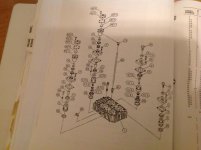
Probably a loose valve. You should have three 1 1/8" hex nuts on top of the valves and one unloader tower with a diaphragm on top of the fourth valve. If you look carefully you will notice the two pistons are different sizes. The large one is the low pressure piston and the smaller one (closest to the flywheel) is the high pressure piston. Each piston has two valves, one suction and one discharge. See picture. The picture is of a later model with two unloader towers. The unloaders will be on the suction valves.
If your inter cooler pressure is low then you need to look at the low pressure valves. If high then look at the high pressure valves.
Sorry for the quality of the pic.:pimpflash:
 

Attachments

  • image.jpg
    image.jpg
    140.8 KB · Views: 59
OP
J

Joelk

Well-known member
Joined
Feb 6, 2013
Messages
280
Location
Bedford PA
Thanks for the replies.

Mine is a really old model where the High Pressure and Low Pressure sides use completely different types of valves.

On the low pressure side I have 4 separate Allen Head Set Screws(instead of just one in the center like the newer models) to apply pressure to the tops of the valves. I did not use a torque wrench on these(I don't know the correct torque), but they are significantly more than snug(I would guess 15-20 FP).

On the high pressure side, the valves are held down by large screw in collars with a slot in the top. Again I don't know the recommended Torque, but they are more than snug, I would guess 30-40 FP.

All the threads were clean with never seize applied when I tightened them.

If they are to the torque that I have indicated above, is that loose enough to cause the clattering noise?

Any idea what the correct torque values are?

Do I need to disassemble beyond just these collars/set screws to correct for a loose valve? If so, what should I disassemble/adjust?

Thanks, Joel
 
OP
J

Joelk

Well-known member
Joined
Feb 6, 2013
Messages
280
Location
Bedford PA
Thanks for the Torque info. I will use that on my high pressure valves.

I have 4 setscrews per valve on the low pressure side.

The setscrews only have 3/8" threads so I don't think they would be intended to take 60 FP each.

Should I torque each of them to 15 FP?
 

Bob C

Well-known member
Joined
Jul 17, 2012
Messages
572
when you rebuilt the head, you did not tightened down the valves in the correct order, therefore your valve disc assemblies are ju,ping up off the seats in the dead causing your clattering. Also, I've never seen a 325 that was not pressure lubed.
 
To avoid these ads, REGISTER NOW!
OP
J

Joelk

Well-known member
Joined
Feb 6, 2013
Messages
280
Location
Bedford PA
Can you please elaborate on what the correct order is for tightening the valves? I would very much like to know what the correct procedure is.

Mine definitely is NOT pressure lubed(I wish it was). It has no oil pump and no oil passages in the crank. There is a "slinger ring" on the center of the crank and the rods have "dippers" on the bottom that go into cast-in "trays" in the block that hold oil.
 

GeorgiaHybrid

Well-known member
Joined
Sep 9, 2008
Messages
3,763
Location
Extreme NW Georgia
when you rebuilt the head, you did not tightened down the valves in the correct order, therefore your valve disc assemblies are ju,ping up off the seats in the dead causing your clattering. Also, I've never seen a 325 that was not pressure lubed.

Can you please elaborate on what the correct order is for tightening the valves? I would very much like to know what the correct procedure is.

Mine definitely is NOT pressure lubed(I wish it was). It has no oil pump and no oil passages in the crank. There is a "slinger ring" on the center of the crank and the rods have "dippers" on the bottom that go into cast-in "trays" in the block that hold oil.

Are you sure you have a 325? I'm with Bob on this as I have never seen a 325 without an oil pump. It does sound like a valve issue though.
 

Grounded Ken

Well-known member
Joined
Jun 3, 2011
Messages
106
Location
Greer, SC
The oil pump on Quincy compressors were an option, and still are. Most of the older units came with oil pumps because it didn't cost that much more, not the case these days.
The torque value I gave came right out of an original Quincy owners manual. The manual does not have an "official" tightening sequence. I snug all down, then go back and torque.
If you're interested in a new Quincy and have had your heart on a particular model, you better buck up and get it. Since Atlas Copco has bought Quincy I'm seeing models being dropped, some being absorbed into the Atlas line and some of the Atlas Chinese units being painted blue and sold as Quincy machine. The times are a changing!
 
OP
J

Joelk

Well-known member
Joined
Feb 6, 2013
Messages
280
Location
Bedford PA
I have no doubt that 60 FP Torque may very well be correct for the new model 325s, but they have a larger diameter single set screw in the middle of the valve covers. On my model there are 4 separate 3/8" thread set screws around the perimeter of each low pressure valve. If I attempt to torque them to 60 FP each, I will have 8 broken set screws.

I CLEARLY am not an expert on Quincy Compressors, but I have spoken with several parts suppliers who are, and I am fairly certain that pressure lubrication in NOT an option on the Quincy 325(it may be on other models) If it is a ROC 1 through 5 it is splash lubed. If it is ROC 6 or higher it is pressure lubed. The Oil filter may be optional on the pressure lubed models, but I don't think you get to choose if it is pressure lubed or not.

I have no interest in purchasing a new Quincy, but I sure would like to get mine working properly so that it will hopefully last another 60+ years.
 

Grounded Ken

Well-known member
Joined
Jun 3, 2011
Messages
106
Location
Greer, SC
OK, you got me on the oil pump on the later 325's. Only the very early ones were splashed lube.

Since you're so sure about the torque, I won't tell you to go to the Quincy home page,
click on the Brochures & Manuals, the type in the search "QR-25 Series Instruction Manual" take your choice, all the way back to 1950, which doesn't have torque specs.
You are apparently not talking to the correct parts suppliers.
I'll bet you can even get a copy of the parts book for your machine at the same place.

As far as the new compressors, it was an observation of the basterdasion of yet another US made compressor.

I'm on your side, just trying to help.
 
OP
J

Joelk

Well-known member
Joined
Feb 6, 2013
Messages
280
Location
Bedford PA
Ken, I do appreciate you efforts to help. Sorry if I have seemed argumentative.

I have read through a bunch of the docs at the Quincy website, but it has been quite a while since I did. I can find the torque specs for the later model 325s, but it is more of a challenge to find them for the ROC 1-5s. So far I have been unable to find the setscrew torque specs for an ROC 1-5.

I think if you saw my valve setscrews beside the later model 325 setscrews you would understand my reluctance to accept that 60FP is the correct torque for mine. The later model setscrews appear to be approx. 1/2" thread(at least 7/16" threads). Mine are 3/8-24 unf threads which is the same size as the connecting rod bolts. The connecting rod bolts call for 35 FP, but I suspect they may be a better grade of bolt so even that may be an excessive amount of torque for my setscrews.
 

Grounded Ken

Well-known member
Joined
Jun 3, 2011
Messages
106
Location
Greer, SC
It's alright, I'm going over to the shop today, I know G/D uses the same 3/8" setscrews on their small machines. I'll take a look at the torque spec. on them and let you know.
After all the compressor doesn't know who made them.
If it is not a loose valve I remember and old Quincy cogger told me the piston to pin fit should almost be a press fit, little to no clearance.
 

Jesus1110

Member
Joined
Jul 3, 2017
Messages
5
It's alright, I'm going over to the shop today, I know G/D uses the same 3/8" setscrews on their small machines. I'll take a look at the torque spec. on them and let you know.
After all the compressor doesn't know who made them.
If it is not a loose valve I remember and old Quincy cogger told me the piston to pin fit should almost be a press fit, little to no clearance.

Sorry for reviving this post. But did you ever figure out what was wrong? I have a 325 roc 4 and it makes a intermittent noise of almost two pieces of pipe banging. It runs fine and builds pressure fast.
 
OP
J

Joelk

Well-known member
Joined
Feb 6, 2013
Messages
280
Location
Bedford PA
On my compressor the piston pin and small end of rod(and/or bushing in end of rod) was badly worn. I bought a new piston pin and had machine shop enlarge small end of rod and make/install a bronze bushing to fit the pin.

Got rid of the noise and seems to be working fine since then.
 
Last edited:
To avoid these ads, REGISTER NOW!
Top Bottom