First, I would like to go over the basic scope of a Quincy 325 air compressor, and what options there are.
The Quincy 325 air compressor is considered by some the "Rolls Royce" of air compressors, they are capable of compressing up to 500PSI with optional equipment, but for the home shop user, and for the purpose of this thread, we will stick with the version that is rated for 200PSI or below.
RECORD OF CHANGE
(What version compressor do I have?)
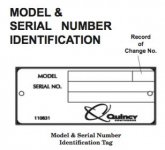
Quincy uses a system called "Record of Change" or ROC for short, which is the identifier on your compressor to determine what version you have, what updates have been performed, and assists you in ordering the correct parts. In terms of rebuilds, ROC 1-9 share common parts, while 9 and up share common parts: I.E. If you were to order a rebuild kit, there are essentially two available, one for ROC 1-9, and one for ROC 9-UP. Quincy is currently up to ROC 107 if I recall. The ROC number can be found in the upper right corner of the data plate (I say upper right corner, because most data plates have their words worn off, but the compressor model and ROC are stamped in).
It should be noted that there are reports of compressors off of Quincy packaged units (compressor, tank, motor), not having an ID plate, as the tank has one for the unit on it.
See below image for ID of ROC and compressor model number.
CONTROL VERSION
(Why does my compressor have two towers on top,
but others have one?)
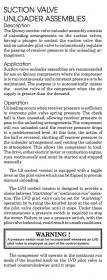
First off, the "Towers" on top are called unloaders. When air pressure is applied thru the supply line to the unloaders, it pushes on a diaphragm, which then pushes on the intake valve of either the high pressure or low pressure side of the compressor (or both if you have two towers), and essentially takes the 'load' off the compressor by holding the intake valves open constantly, thus not producing pressure.
The air is supplied to these unloaders when one of two conditions are met, low oil pressure (thus unloading the compressor to prevent more extensive damage), or pilot valve unloading (a pressure is set on the pilot valve, and when the receiver or air tank reaches said pressure, the compressor is unloaded). The different control groups Quincy offers combines one or both of these features depending on the application.
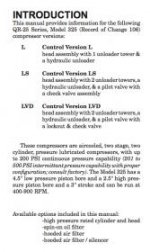
There are three control group styles that could be shipped on your Quincy 325. L, LS, and LVD.
TO ID YOUR CONTROL VERSION: L has one unloader tower, LS and LVD both have two towers, LS uses a toggle lever on the pilot valve, while LVD uses a knurled thumb screw.
Control version L
The control version L only has a hydraulic unloader, and one unloader tower. This would be designed for a start/stop application. When your air tank reaches it's desired pressure, and the motor is electronically shut off via a pressure switch, the compressor then stops spinning. Due to the loss of motion, no oil pressure is being supplied, so the hydraulic unloader opens up and unloads the compressor. The goal of this is to enable the compressor to start back up in an "unloaded" state, not already having pressure in the cylinders. This puts less wear on your motor, and compressor.
Control version LS
The control version LS has a hydraulic unloader, a three way check valve, and a pilot valve. This version also has two unloader towers. This version is designed for continuous run applications only. It maintains the features of the L version as to when there is a loss of oil pressure, it automatically unloads, but it adds a pilot valve, which is adjustable to a specific set point. When this set point is achieved, both unloaders are fed air pressure, so the compressor can freewheel and not create any more pressure, but stay running. This is mainly seen on units paired with a gas or diesel engine. It also has a toggle to allow you to bypass the unloader and "manually unload" the compressor (will not maintain pressure with the toggle, it will not create pressure until the toggle is re-enabled).
Control version LVD
This control version combines the features of the L and LS control versions. LVD enables you to use your compressor in a "start/stop" application, or a continuous run application, without changing any components. This version functions identically to the LS version, except instead of a toggle on the pilot valve, this version has a screw. With the screw turned clockwise, it allows for a start/stop application (functioning as control version L), with the screw turned all the way counter clockwise, it allows for a continuous run application (functioning as control version LS). The application for this version is generally on an electric driven compressor, which could allow for continuous run if more air volume is desired. For example, if you are sand blasting (a very air intensive job), the control can be switched to continuous run, thus allowing the compressor to run constant, and unload when max pressure is obtained. This function will keep you air pressure closest to max.
Below are a couple of excerpts out of Quincy's manual, explaining the control versions further.
OTHER FEATURES
There are other changes in Quincy 325 compressors, and the offerings, below is a brief overview of some of them.
Cooling fins
Some Quincy compressors have multiple vertical cooling fins, while some have less, horizontal ones. Generally speaking, the horizontal finned compressors are newer, or later models. This is also combined with the intercooler being pipe-threaded on the later models. The early models have a flanged intercooler. While some models have different style intercoolers, I have found that most "overhaul" gasket kits provide extra gaskets as to cover the different designs.
Oil filter
Quincy 325 compressors can be found with or without an oil filter housing. While all other parts of the compressor appear to be the same, the main difference is the front bearing carrier. This part does not allow for an oil filter housing, or filter to be installed in most cases. In order to convert your "non filtered" unit to a filtered one, this carrier must be changed. ALL 325 compressors are pressure lubricated, wether it has a filter or not, the filter just adds longevity to the compressor and oil change intervals. To my knowledge, all new 325 units ship with filter housings.
Air filter
There are many air filter options, and Quincy even offers different ones. There are hooded air filter housings, where the air is sucked from underneath the "umbrella", and there are open ones. This is pretty self explanatory, if your compressor is open to the elements, use a hooded housing, if it is indoors, you could use either. There are also paper or cotton mesh filters available. The paper filters can ONLY be used for start/stop applications, and they are not reusable. The cotton mesh filters are reusable (similar to a K&N filter), and can be used in a continuous run application. Continuous run applications create back pressure thru the intake while unloaded and running, so this would destroy a paper filter fairly quickly, as the cotton mesh ones can stand up to the abuse.
QUICK REFERENCE
Below are commonly needed tidbits of information.
Find your service manual:
https://www.quincycompressor.com/resources/support/
Torque Specs (the ones that are important):
These are for a later model compressor, most should be similar, but refer to your ROC specific manual for exact specs.
Flywheel Sheave (pinch) bolts: 90 ft lbs
Rod nuts: 35 ft lbs
Head bolts: 50 ft lbs
Valve cover bolts: 50 ft lbs
Valve jam bolt/nut: 60 ft lbs for bolt, 50 ft lbs for jam nut
Unloader valve jam "screw": 70 ft lbs
Unloader tower: 75 ft lbs
Lubrication recommendations:
Obviously Quincy recommends to use their brand, but generally speaking, 10, 20, or 30 weight NON DETERGENT engine oil is what is used. I run 30 weight all year. Lighter viscosities are good for cold climate/outdoor use.
Lubrication capacity:
Current models call for 1 quart and 16 oz without filter, and add 10 oz for use with filter. Check your ROC specific manual for exact measurements, but they should be fairly close.
YOUR FLYWHEEL IS 16'' diameter. This can be used to help calculate what size pulley you would like to run on the motor. Remember, all 325 compressors must run at least 400 RPM, but no greater than 900 RPM. You have to decide how to pair your compressor with what motor, lower horse motors cannot run the compressor at high RPMs combined with high pressures. A 5 HP motor should be sufficient to run the compressor at near 900 RPM and achieving a max pressure of 175 PSI. To calculate your needed pulley, use this link:
https://www.blocklayer.com/pulley-belteng.aspx
For parts, you can find them used, new, OEM, or aftermarket. For gasket kits for general rebuilds, I recommend Pacific Air Compressors. They have an eBay store as well, but their service is unbeatable. I have had issues and they have taken care of me.
https://www.pacificaircompressors.com/shop/products/










 I phoned Quincy and spoke with CS and the gentleman stated that they no longer include the tag...really? He stated they can pull all the pump info from the main info tag. I am still doubting that his info is correct, as once the pump is pulled from the tank, you would have lost any information associated with the pump.

