To avoid these ads, REGISTER NOW!

Quincy Compressor

JHForman

Well-known member
Joined
Jul 30, 2019
Messages
111
Location
Floyds Knobs
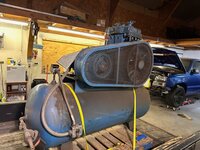
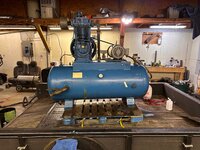
Ok guys im lookign for a little help here. I bought this MONSTER compressor, its currently 10HP 3PH. I need to change the motor to something single phase. I can get a 10HP single or a 7.5 single. I havent found a chart showing what the CFM will be or is when using the 10HP or the 7.5. Can anyone help? I am looking to run a sand blast cabinet i picked up. the cabinet needs 25CFM@80
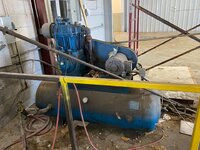
IMG_5921 (1).JPG
 
To avoid these ads, REGISTER NOW!

Cruzan80

Well-known member
Joined
Jul 22, 2015
Messages
4,167
Location
Denver, CO
What is the pump model no? That will determine CFM. 1ph vs 3ph HP is the same oomph, just more amps needed (and thicker wires).
 

CallumRD1

Well-known member
Joined
Jul 7, 2017
Messages
339
Location
Colorado
If the pump is designed around a 10 hp motor of a specific RPM, running it on a lower power motor at the same RPM could likely result in the motor failing to start the compressor and/or not being able to sustain the load while running. You'd want to change pulley sizes to reduce the piston speed if you decrease the motor power.
 
OP
J

JHForman

Well-known member
Joined
Jul 30, 2019
Messages
111
Location
Floyds Knobs
I have a phase converter we took out of a machine that was powering some 10hp fans. Can send more specs if interested
very much interested. im looking at all options. I only gave 500 for this compressor so even spending 1100 on a 10HP motor im pretty far ahead.
 
OP
J

JHForman

Well-known member
Joined
Jul 30, 2019
Messages
111
Location
Floyds Knobs
The other advantage of the phase converter is that it sets you up for other 3 phase machines which normally you can steal for a lot less money than single phase.
Thats how I ended up with this thing lol it was cheap and works. im pretty sure its more than adequate for whatever I want to do!
 

Junkman

Well-known member
Joined
Dec 18, 2006
Messages
6,598
Location
Northeastern CT
If you contact Quincy and give them the serial number, they will give you all the specifications on the unit, and tell you when it went into service, and a good chance that they will also have more history on it than you will ever want or need. I bought a Quincy that had a 3 HP 3-phase motor on it and learned from the factory that it was shipped out without a motor on it to the distributor. They told me what the correct motor should have, the diameter of the pulleys, etc.
 
OP
J

JHForman

Well-known member
Joined
Jul 30, 2019
Messages
111
Location
Floyds Knobs
so digging into this more and reading about rotary phase converters. It looks like I need to source a 15HP 3PH motor to make the other leg to run the 10HP 3PH motor at full power? is this correct?
 
OP
J

JHForman

Well-known member
Joined
Jul 30, 2019
Messages
111
Location
Floyds Knobs
Going to be cheaper in the long run to get a 7.5 hp single phase motor and adjust the pulley size than go with a phase converter. A 7.5 hp motor runs about 700$.

Is there a pulley/HP chart anywhere out there to show what the CFM will be with a 7.5? Also if I got a 7.5 that ran at the same speed as the 10hp would I need to change the pulley at all? If it’s the same speed couldn’t I expect the same CFM as the 10hp?
 

cvairwerks

Well-known member
Joined
Aug 12, 2016
Messages
7,187
Location
Within hearing distance of Texas Motor Speedway
The book on what compressor head you have should tell you output vs speed for the hp motor. Just need to select a motor and pulley combination that falls within the requirements for your needs.

In your case, assuming the motor is not at some weird rpm, and not running the head at max rpm, you should be able to swap to a 7.5 of the same rpm and pulley size and get the same output.

I've got a shear that has a 3p motor on that I can't swap due to rpms....it's a 505 rpm motor and it would cost thousands to get a single phase wound for that speed.
 
OP
J

JHForman

Well-known member
Joined
Jul 30, 2019
Messages
111
Location
Floyds Knobs
The book on what compressor head you have should tell you output vs speed for the hp motor. Just need to select a motor and pulley combination that falls within the requirements for your needs.

In your case, assuming the motor is not at some weird rpm, and not running the head at max rpm, you should be able to swap to a 7.5 of the same rpm and pulley size and get the same output.

I've got a shear that has a 3p motor on that I can't swap due to rpms....it's a 505 rpm motor and it would cost thousands to get a single phase wound for that speed.

where would I find this book you speak of? I can find all the sales brochures etc but nothing about pulley and motor sizes etc.
 
To avoid these ads, REGISTER NOW!

cvairwerks

Well-known member
Joined
Aug 12, 2016
Messages
7,187
Location
Within hearing distance of Texas Motor Speedway
You'll have to use the datasheet you have and the parts catalog for the particular head you have. Verify from the catalog that there is only one pulley size for the head. Use the rpm from the 3p motor and then select the same rpm 1p if it's available. If not, then the nearest rpm larger and adjust the motor pulley size to get the head rpm within the required numbers. If you have to change motor rpm's, it's going to take a little calculating on your part for the new drive pulley size.

My big IR T-30 book gives various motor sizes and pulley combinations for each series, and the cfm outputs.
 

CallumRD1

Well-known member
Joined
Jul 7, 2017
Messages
339
Location
Colorado
Is there a pulley/HP chart anywhere out there to show what the CFM will be with a 7.5? Also if I got a 7.5 that ran at the same speed as the 10hp would I need to change the pulley at all? If it’s the same speed couldn’t I expect the same CFM as the 10hp?
To paraphrase my previous response:

If the pump is designed around a 10 hp motor of a specific RPM, running it on a lower power motor at the same RPM could likely result in the motor failing to start the compressor and/or not being able to sustain the load while running. You'd want to change pulley sizes to reduce the piston speed if you decrease the motor power. You can't expect to reduce the power of the motor, change nothing else, and maintain the same output.
 
OP
J

JHForman

Well-known member
Joined
Jul 30, 2019
Messages
111
Location
Floyds Knobs
To paraphrase my previous response:

If the pump is designed around a 10 hp motor of a specific RPM, running it on a lower power motor at the same RPM could likely result in the motor failing to start the compressor and/or not being able to sustain the load while running. You'd want to change pulley sizes to reduce the piston speed if you decrease the motor power. You can't expect to reduce the power of the motor, change nothing else, and maintain the same output.
ok so that brings me to my question and I cant find the answer/data im looking for. is there a document out there that shows: this compressor head with this RPM motor with this size pulley makes this CFM ? I cant seem to find any document that shows that the CFM on the current setup/pulley sizes are.
 

bb29510

Well-known member
Joined
Dec 27, 2022
Messages
1,216
you need to get info off the motor, motor frame, hp and rpm, and the go from there. also there a lot of salavage houses where you can buy used motors
 

Cruzan80

Well-known member
Joined
Jul 22, 2015
Messages
4,167
Location
Denver, CO
ok so that brings me to my question and I cant find the answer/data im looking for. is there a document out there that shows: this compressor head with this RPM motor with this size pulley makes this CFM ? I cant seem to find any document that shows that the CFM on the current setup/pulley sizes are.

Math. You know the motor pulley is spinning at 1725 (says so on the motor). What is the diameter of the motor pulley, and the compressor pulley? This teels you RPM at the compressor. Based off your post #5, it looks pretty linear. 400rpm at the compressor generates 15.6 CFM, and 940 RPM generates 36.6 CFM (both are 235% of the first value). So how fast is the 10hp motor spinning the compressor? If you go down to a 7.5hp motor, it will probably need to spin it slower, meaning less CFM, as it will have less power.
 
OP
J

JHForman

Well-known member
Joined
Jul 30, 2019
Messages
111
Location
Floyds Knobs
Math. You know the motor pulley is spinning at 1725 (says so on the motor). What is the diameter of the motor pulley, and the compressor pulley? This teels you RPM at the compressor. Based off your post #5, it looks pretty linear. 400rpm at the compressor generates 15.6 CFM, and 940 RPM generates 36.6 CFM (both are 235% of the first value). So how fast is the 10hp motor spinning the compressor? If you go down to a 7.5hp motor, it will probably need to spin it slower, meaning less CFM, as it will have less power.

Thank you I figured it was a math thing and not chart thing. Ill measure the pulleys next time im at the shop.
 

Cruzan80

Well-known member
Joined
Jul 22, 2015
Messages
4,167
Location
Denver, CO
Keep in mind too, the CFM in your post is at 175psi, not 80psi. So that is full pressure output. Someone else smarter than me could probably tell you the conversion, based off the size of the tank, etc.

Even without the pump running, there is some amount of time you could get 20CFM@80psi (just off the initial pressure of 175, slowly dropping to 80psi). Probably not a ton of time, but it also means you don't need to do the full 20CFM @175psi (about 513rpm). Up to you though.
 
OP
J

JHForman

Well-known member
Joined
Jul 30, 2019
Messages
111
Location
Floyds Knobs
Keep in mind too, the CFM in your post is at 175psi, not 80psi. So that is full pressure output. Someone else smarter than me could probably tell you the conversion, based off the size of the tank, etc.

Even without the pump running, there is some amount of time you could get 20CFM@80psi (just off the initial pressure of 175, slowly dropping to 80psi). Probably not a ton of time, but it also means you don't need to do the full 20CFM @175psi (about 513rpm). Up to you though.

the blasting cabinet will need 25@80 so thats what im trying to work around. I wont be blasting all day etc but dont wanna have a pressure cabinet and constantly have to wait either.
 

yatg

Well-known member
Joined
Aug 16, 2019
Messages
2,749
Location
Southern Oregon
go here

search for:
50217-018

that's the pump manual, which is useful but doesn't say a whole lot.

ok so that brings me to my question and I cant find the answer/data im looking for. is there a document out there that shows: this compressor head with this RPM motor with this size pulley makes this CFM ? I cant seem to find any document that shows that the CFM on the current setup/pulley sizes are.
You're not going to find that laid out for you, but you posted the info you need to figure it out in post #5.

The relationship between RPM and CFM is pretty constant, about 3.9 cfm @ 175 psi per 100 RPM.

Pure guess is that a 5HP motor is used on the low end 400 RPM and a 15HP on the high end 940 RPM. Assuming a linear relationship between motor HP and max RPMs, a 7.5HP motor would work at 600 RPM, 23.4 cfm @ 175psi.

That may be enough since your cabinet only requires 25 cfm @ 80psi.

pulley calculator
 
OP
J

JHForman

Well-known member
Joined
Jul 30, 2019
Messages
111
Location
Floyds Knobs
go here

search for:
50217-018

that's the pump manual, which is useful but doesn't say a whole lot.


You're not going to find that laid out for you, but you posted the info you need to figure it out in post #5.

The relationship between RPM and CFM is pretty constant, about 3.9 cfm @ 175 psi per 100 RPM.

Pure guess is that a 5HP motor is used on the low end 400 RPM and a 15HP on the high end 940 RPM. Assuming a linear relationship between motor HP and max RPMs, a 7.5HP motor would work at 600 RPM, 23.4 cfm @ 175psi.

That may be enough since your cabinet only requires 25 cfm @ 80psi.

pulley calculator


Thank you for the manual!

also I have that pulley calc bookmarked lol.
 

Cruzan80

Well-known member
Joined
Jul 22, 2015
Messages
4,167
Location
Denver, CO
the blasting cabinet will need 25@80 so thats what im trying to work around. I wont be blasting all day etc but dont wanna have a pressure cabinet and constantly have to wait either.
Gotcha. Misread, thought it was 20CFM. Agreed about not wanting to wait, but wanted to make sure you realized CFM @175 is going to be less than CFM@80PSI (pump has to "work" harder at the higher pressure).

The other issue you will run into is power requirements. For a comparison point, your 10hp 3ph says 33A, so 33*1.7 (sqrt 3) is 56.1A. A 10HP 1ph motor will probably need around a 60A breaker and wire rated for those amps, direct connected from the panel to the motor.
 
OP
J

JHForman

Well-known member
Joined
Jul 30, 2019
Messages
111
Location
Floyds Knobs
Gotcha. Misread, thought it was 20CFM. Agreed about not wanting to wait, but wanted to make sure you realized CFM @175 is going to be less than CFM@80PSI (pump has to "work" harder at the higher pressure).

The other issue you will run into is power requirements. For a comparison point, your 10hp 3ph says 33A, so 33*1.7 (sqrt 3) is 56.1A. A 10HP 1ph motor will probably need around a 60A breaker and wire rated for those amps, direct connected from the panel to the motor.
Im not going to mess with the 10HP single, Im pretty sure the 7.5HP single phase is going to be more than enough for what im wanting to do.
 

CallumRD1

Well-known member
Joined
Jul 7, 2017
Messages
339
Location
Colorado
Gotcha. Misread, thought it was 20CFM. Agreed about not wanting to wait, but wanted to make sure you realized CFM @175 is going to be less than CFM@80PSI (pump has to "work" harder at the higher pressure).

The other issue you will run into is power requirements. For a comparison point, your 10hp 3ph says 33A, so 33*1.7 (sqrt 3) is 56.1A. A 10HP 1ph motor will probably need around a 60A breaker and wire rated for those amps, direct connected from the panel to the motor.
Caveat: that motor is rated at 200V. A motor running off 230V will pull about 15% less current for the same power.
 

PoorUB

Well-known member
Joined
Mar 29, 2021
Messages
11,620
Location
Fargo, ND
I have always wondered, if you don't need 175 PSI, how abut running the pump a bit faster and set the PSI switch for maybe 125 PSI.

For the sake of arguement, could you run the 10 HP pulleys with a 7.5 HP motor and run the tank pressure to 125 PSI??
 
OP
J

JHForman

Well-known member
Joined
Jul 30, 2019
Messages
111
Location
Floyds Knobs
I have always wondered, if you don't need 175 PSI, how abut running the pump a bit faster and set the PSI switch for maybe 125 PSI.

For the sake of arguement, could you run the 10 HP pulleys with a 7.5 HP motor and run the tank pressure to 125 PSI??

thats kinda my wonder too, both the 10HP and the 7.5 spin around the same RPM, so if you used the pulley off the 10HP wouldnt it basically be the same? but it doesnt sound like it would be.
 

PoorUB

Well-known member
Joined
Mar 29, 2021
Messages
11,620
Location
Fargo, ND
thats kinda my wonder too, both the 10HP and the 7.5 spin around the same RPM, so if you used the pulley off the 10HP wouldnt it basically be the same? but it doesnt sound like it would be.
Did you look at the link in my one post? 7.5 HP spins 640 RPM, 10 HP spins 859 RPM.

If the shaft size on the two motors is the same I would be tempted to try it, but need to check amp draw at what ever you set for a cut out pressure.
 
OP
J

JHForman

Well-known member
Joined
Jul 30, 2019
Messages
111
Location
Floyds Knobs
Did you look at the link in my one post? 7.5 HP spins 640 RPM, 10 HP spins 859 RPM.

If the shaft size on the two motors is the same I would be tempted to try it, but need to check amp draw at what ever you set for a cut out pressure.
I did! that link shows me exactly what I wanted to know. 25.2 @ 175 psi with the 7.5 is gonna cover what I need! Im probably gonna set cutout at 140-150?
 
To avoid these ads, REGISTER NOW!
Top Bottom