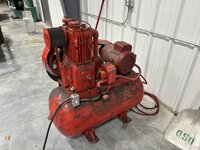
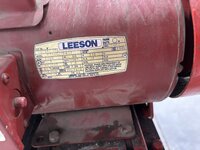
Agree with Walta. It's a great compressor Assuming it works, there's hope for yet.
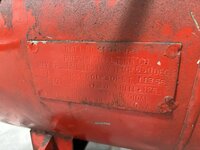
That "welded patch" is not a tank patch, rather it's the tank manufacturer's data plate spot welded on, with a lot of good info about the tank, such as tank working pressure and temperature (125 psi and 650 degrees), shell and head thicknesses (.125" and .140"), as well as manufacture date; as pointed out at 1952. I'm not sure yet what H.S.B and P.S.T. represent. IIRC, I think the U-69 might be tank volume, but you can plug the dimensions into an air compressor tank volume calculator online to check.
As a minimum, I'd pull the tank plug(s) on the ends and shine some light or a fiber optic scope to inspect the insides. It's hard to tell how it lived for its 70 plus years. If you see oily and light rusting, probably ok. Pitting and flaking less good.
I recently retired a 1944 era Ingersoll Rand compressor that came with my house. It developed a couple pinhole leaks along the tank bottom, due to corrosion. I turned it into a smoker.
When I cut it open, I found a fair amount of pitting along the tank bottom as the tank drain line, which actually exited at the 3 o'clock position on the tank shell, had an internal tube which left about 3/4" of the tank bottom undrained. I've since found a donor tank, of much newer vintage and much better shape visually, and it's on my to do list to mate them up, as the compressor itself is a tank and it still supported for parts.
That all said, I think the typical failure of old age tanks is corrosion, manifesting in pinhole leakage, vice catastrophic failure. From what I've seen and heard, it's usually home weld repairs or dubious history or failed over presssure relief issues that cause the 'boom.' A hydro test might alleviate your concerns, but if there's a lot of pitting and flaking, a donor or new tank might be a better option.
Hopefully you paid something reasonable with potential for tank replacement a consideration.