To avoid these ads, REGISTER NOW!

Quincy ID and integrity question

calandrod

Well-known member
Joined
Jul 2, 2020
Messages
324
Location
Kansas
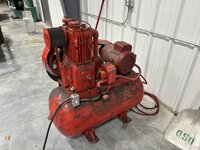
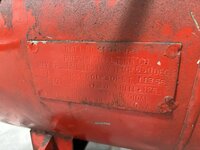
I bought this Quincy. Trying to find any information on it if someone knows anything. Pictures show data plates. I’d appreciate it.

Also take a look at that word welded patch on bottom. At ideas why? I’m worried it might affect integrity and that I should buy a new tank for this. Any thoughts? I’ve heard horrer stories of tanks blowing up.
 

Attachments

  • IMG_5801.jpeg
    IMG_5801.jpeg
    807.1 KB · Views: 46
  • IMG_5804.jpeg
    IMG_5804.jpeg
    484 KB · Views: 46
  • IMG_5805.jpeg
    IMG_5805.jpeg
    600.4 KB · Views: 36
  • IMG_5807.jpeg
    IMG_5807.jpeg
    725.5 KB · Views: 46
To avoid these ads, REGISTER NOW!

walta

Well-known member
Joined
Jan 13, 2017
Messages
2,312
Location
Dutzow Missouri
Great compressor!

You did notice the tank was made in 1952.

I would want to hydro test any tank that old.

I did not see any parches in your photos. The data plate was welded on when it was manufactured.

Walta
 

Gutman

Well-known member
Joined
Jan 10, 2019
Messages
295
Location
ENC
Agree with Walta. It's a great compressor Assuming it works, there's hope for yet.

That "welded patch" is not a tank patch, rather it's the tank manufacturer's data plate spot welded on, with a lot of good info about the tank, such as tank working pressure and temperature (125 psi and 650 degrees), shell and head thicknesses (.125" and .140"), as well as manufacture date; as pointed out at 1952. I'm not sure yet what H.S.B and P.S.T. represent. IIRC, I think the U-69 might be tank volume, but you can plug the dimensions into an air compressor tank volume calculator online to check.

As a minimum, I'd pull the tank plug(s) on the ends and shine some light or a fiber optic scope to inspect the insides. It's hard to tell how it lived for its 70 plus years. If you see oily and light rusting, probably ok. Pitting and flaking less good.

I recently retired a 1944 era Ingersoll Rand compressor that came with my house. It developed a couple pinhole leaks along the tank bottom, due to corrosion. I turned it into a smoker.

When I cut it open, I found a fair amount of pitting along the tank bottom as the tank drain line, which actually exited at the 3 o'clock position on the tank shell, had an internal tube which left about 3/4" of the tank bottom undrained. I've since found a donor tank, of much newer vintage and much better shape visually, and it's on my to do list to mate them up, as the compressor itself is a tank and it still supported for parts.

That all said, I think the typical failure of old age tanks is corrosion, manifesting in pinhole leakage, vice catastrophic failure. From what I've seen and heard, it's usually home weld repairs or dubious history or failed over presssure relief issues that cause the 'boom.' A hydro test might alleviate your concerns, but if there's a lot of pitting and flaking, a donor or new tank might be a better option.

Hopefully you paid something reasonable with potential for tank replacement a consideration.
 
To avoid these ads, REGISTER NOW!

john.k

Well-known member
Joined
Jun 4, 2024
Messages
1,137
Just go over it with a small ball peen hammer .........if the ball dents the tank in ,its too thin..............Ive bought and sold hundreds of old compressors .......never a tank fail,plenty of old motor fails .............As mentioned ,usually the tell tale sign is a pool of oily water under the tank..............the old tanks were made of proper boiler plate ,import stuff is thin hard steel and rusts out in a couple of years .......these are the ones that explode .
 

MShaw

Well-known member
Joined
Mar 2, 2015
Messages
1,014
Location
York, Pa.
Since the tank is a pressure vessel I would suspect that the U-69 is the manufacturer's code U for unfired and 69 as his stamp number
 

TeenagerThatLikesFloorjac

Well-known member
Joined
Dec 30, 2020
Messages
81
Location
QC
One thing to note, the model 230 is a single stage compressor. Quincy claims a max continuous pressure of 100psi. You can likely get away with more but just thought i'd share.

Also, it is probably a good idea to ditch that chamber between the tank and output of the compressor. I believe they have a tendency to explode...
 
To avoid these ads, REGISTER NOW!
Top Bottom