To avoid these ads, REGISTER NOW!

Radiant Floor Heat - Pex A vs Pex B

Shoester

Well-known member
Joined
Jan 9, 2014
Messages
318
Location
Kansas City
Getting ready to buy the pex for my new shop, ~3,000sf with ~3,300lf of tubing per the design from Menards. They also call for their SiouxChief brand of Pex B. After researching Pex types over the last few days I’m conflicted on if I go with the Pex B or upgrade to Pex A…looks like a roughly $1k difference in price, so not exactly chump change!

What’s the general consensus…is the Pex A worth the premium?
 
To avoid these ads, REGISTER NOW!

Firebrick43

Well-known member
Joined
May 12, 2015
Messages
14,201
Location
West central Indiana
Yes, Pex A flows better and will save money in pumping cost or you have to go up a size in pex B

Kinks can be worked out of A with a heat gun, B requires a splice.

And while the tool is expensive, the Milwaukee m12 pex expander is so much better than using a crimper. Sell it after you’re done and I doubt you will have more than a 100-150$ in it.
 

rlitman

Well-known member
Joined
Oct 18, 2010
Messages
24,662
Location
Long Island
...Pex A flows better...
No, it doesn't. IF you choose to use expansion fittings with PEX A (and nowadays there are some brands of PEX B that allow expansion fittings too*), then the expansion fittings do flow better than standard PEX fittings, but I doubt you'd notice a difference so long as you're not using plastic fittings and stick with brass. Good PEX design minimizes the use of fittings anyway.

*For the OP, "Note: Sioux Chief recommends all ASTM F1960 expansion joints using PowerPEX Type-B tubing be made with a self-rotating, power expansion tool to avoid improper expansion."

PEX A wins out in making bends much easier. If your layout calls for tight radius bends, go with the A. For example, if you're trying to loop up and back on a stair tread, A will do it and B might not.
 

Mr onetwo

Well-known member
Joined
Apr 6, 2011
Messages
2,010
Location
Coastal Maine
I have used Rehau Pex A with their fittings for many years.Pex A is superior in every way.Went to the Menards site and they don't list 1/2" Pex A at all.To be honest I wouldn't use Menard's to design a dog house.
 

Attachments

  • Capture.JPG
    Capture.JPG
    140.3 KB · Views: 15

Firebrick43

Well-known member
Joined
May 12, 2015
Messages
14,201
Location
West central Indiana
No, it doesn't. IF you choose to use expansion fittings with PEX A (and nowadays there are some brands of PEX B that allow expansion fittings too*), then the expansion fittings do flow better than standard PEX fittings, but I doubt you'd notice a difference so long as you're not using plastic fittings and stick with brass. Good PEX design minimizes the use of fittings anyway.

*For the OP, "Note: Sioux Chief recommends all ASTM F1960 expansion joints using PowerPEX Type-B tubing be made with a self-rotating, power expansion tool to avoid improper expansion."

PEX A wins out in making bends much easier. If your layout calls for tight radius bends, go with the A. For example, if you're trying to loop up and back on a stair tread, A will do it and B might not.

I didn’t realize there was one brand of Pex B that now uses expansion fittings.

As far a crimp type fittings, even brass crimp fittings are significantly smaller diameter than the pipe

An expansion fitting has very close to pipe diameter inside, brass crimp F1807 fitting has 22% less flow, hardly insignificant and there are still at least 2 on every pipe.

And if you had to splice a pipe in the concrete during a pour a F2159 crimp plastic fitting would have 67 percent less flow than an expansion type fitting.
 

jack stand

Well-known member
Joined
Feb 29, 2012
Messages
3,354
Location
Lakes Region Maine
It's been 15 years since I did my radiant heat and the only choices I was aware of was back then was with or without an oxygen barrier. That was required for use with a boiler.
 
OP
S

Shoester

Well-known member
Joined
Jan 9, 2014
Messages
318
Location
Kansas City
I have used Rehau Pex A with their fittings for many years.Pex A is superior in every way.Went to the Menards site and they don't list 1/2" Pex A at all.To be honest I wouldn't use Menard's to design a dog house.

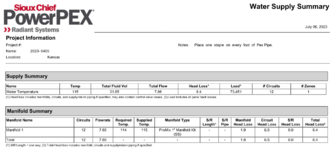
Interesting! Maybe you'll see some obvious WTF thing with their design:

pic1.PNGpic2.PNGpic3.PNG
 

Firebrick43

Well-known member
Joined
May 12, 2015
Messages
14,201
Location
West central Indiana
Interesting! Maybe you'll see some obvious WTF thing with their design:

pic1.PNGpic2.PNGpic3.PNG
Doesn't appear that Menards designed it, Sioux Chief did or their software did. Very common to have the suppliers engineers of the products in lumber yards to do design work.

I would probably loose a loop and give some space to around the perimeter, and leave a spot for a lift in the future. I really don't see the need for exceeding the rule of thumb of 1' of tubing per square foot of floor. Unless your planning on poorly insulating it?
 

Jackfre

Well-known member
Joined
Dec 26, 2010
Messages
4,414
Location
N CA
It is going to be buried in the slab. I cannot see a rational to use less than the best. FB43 is spot on in recommending the Milwaukee Expander but I think wrong in suggesting that you sell it afterwards;) It makes handling the pex so much easier.
 

TRWham

Well-known member
Joined
Aug 11, 2017
Messages
1,970
Location
East Cobb County, Georgia
I didn’t realize there was one brand of Pex B that now uses expansion fittings.

As far a crimp type fittings, even brass crimp fittings are significantly smaller diameter than the pipe

An expansion fitting has very close to pipe diameter inside, brass crimp F1807 fitting has 22% less flow, hardly insignificant and there are still at least 2 on every pipe.

And if you had to splice a pipe in the concrete during a pour a F2159 crimp plastic fitting would have 67 percent less flow than an expansion type fitting.
There's not just one brand. For non-barrier PEX, many current production PEX pipe suppliers support both expansion and crimp fittings. The pipe will be marked with the ASTM standard(s) for compatible connection types. F1960 for expansion and F1807 for crimp are common. I do not know how this applies to oxygen barrier PEX, if at all.
 

Firebrick43

Well-known member
Joined
May 12, 2015
Messages
14,201
Location
West central Indiana
It is going to be buried in the slab. I cannot see a rational to use less than the best. FB43 is spot on in recommending the Milwaukee Expander but I think wrong in suggesting that you sell it afterwards;) It makes handling the pex so much easier.
I did keep mine, it is handy. Used it a few weeks ago to put a condensate line on the water heater
 
To avoid these ads, REGISTER NOW!

Mr onetwo

Well-known member
Joined
Apr 6, 2011
Messages
2,010
Location
Coastal Maine
300ft per loop max...250ft is preferred for 1/2" pex.This is determined by the pipe manufacturer and is pretty standard. If you have a too small pump pumping against too high head pressure it will not operate correctly.Also, too much resistance or velocity causes a noisy system and can cause erosion within components of the system over time.All these systems are based on minimum gpm flow and too high a velocity is just as bad as too little flow.A lot of times when a system does not operate correctly it is due to the pumps not being sized for the conditions. In the past on non-engineered systems I always had the pumps sized by my supplier.This is why I like Grundfos Alpha2 variable pumps...takes a lot of the guess work out of it.
 
Last edited:

fitter30

Well-known member
Joined
Jun 23, 2019
Messages
2,992
Location
Peace Valley,mo
Doesn't matter with most modern boilers.
Really so it doesn't matter if there's oxygen entering to a closed loop heating system. I want all your info on this. And what is modern, condensing educate me please. One little piece of iron will be toast.
 

Sumboodie

Well-known member
Joined
Mar 20, 2021
Messages
10,742
Location
AK
Really so it doesn't matter if there's oxygen entering to a closed loop heating system. I want all your info on this. And what is modern, condensing educate me please. One little piece of iron will be toast.

The heating system in my place.
 

Sumboodie

Well-known member
Joined
Mar 20, 2021
Messages
10,742
Location
AK
Really so it doesn't matter if there's oxygen entering to a closed loop heating system. I want all your info on this. And what is modern, condensing educate me please. One little piece of iron will be toast.
Do water systems rot away from oxygen?

How about open loop heat systems?
 

rlitman

Well-known member
Joined
Oct 18, 2010
Messages
24,662
Location
Long Island
Do water systems rot away from oxygen?

How about open loop heat systems?
Both require using stainless or bronze pumps (or perhaps even monel if the water is corrosive such as lake sourced). Oxygen barrier allows you to use steel pipes, etc. Now if you're using a glycol filled system that has corrosion inhibitors, I suppose the barrier isn't necessary, but it still won't hurt, and it doesn't cost much anyway.
 

Sumboodie

Well-known member
Joined
Mar 20, 2021
Messages
10,742
Location
AK
Both require using stainless or bronze pumps (or perhaps even monel if the water is corrosive such as lake sourced). Oxygen barrier allows you to use steel pipes, etc. Now if you're using a glycol filled system that has corrosion inhibitors, I suppose the barrier isn't necessary, but it still won't hurt, and it doesn't cost much anyway.
Wood boilers don't have stainless pumps, most are steel as well (some are stainless).

This oxygen thing is something perpetuated by old wives tales through the years.
Should be flushing the water every few years anyhow.

How many house water pipes are steel? They last what, 50, 60, 100 years? The oxygen isn't eating those up in months.

Just the same as the utter bull all over the internet about needing "special" glycol in heating systems. Have to use our "special" blend that's $40 a gallon.
A automotive coolant system is pretty much a boiler and heat exchanger. It runs much hotter, tons more heat cycles, more mixes of alloys and materials.
Failure can cost 20,30k+ on big engines.

Aside that EG is poisonous if you decide to drink it, there's no reason it won't work fine.
 
Last edited:

rlitman

Well-known member
Joined
Oct 18, 2010
Messages
24,662
Location
Long Island
...How many house water pipes are steel? They last what, 50, 60, 100 years? The oxygen isn't eating those up in months...
That's GALVANIZED steel for starters. Boilers use untreated steel. And no, galvanized steel cold water lines don't last 100 years. 50, sure. 60 if you're lucky. 70 and you've got a time bomb on your hands. But that's a lifetime for COLD water lines. Hot water lines survive at best half that long. I've seen plenty of moderately old houses that still have galvanized cold lines (all starting to fail in random places), but none that have any galvanized hot pipes. A ****** running into a water heater tank maybe, but even that won't last any longer than the tank itself (MAYBE 20 years), and is also somewhat cathodically protected by the tank's anode.

But in a boiler, the water temperature is far hotter than found in DHW, and corrosion accelerates exponentially with temperature.
 

fitter30

Well-known member
Joined
Jun 23, 2019
Messages
2,992
Location
Peace Valley,mo
Wood boilers don't have stainless pumps, most are steel as well (some are stainless).

This oxygen thing is something perpetuated by old wives tales through the years.
Should be flushing the water every few years anyhow.

How many house water pipes are steel? They last what, 50, 60, 100 years? The oxygen isn't eating those up in months.

Just the same as the utter bull all over the internet about needing "special" glycol in heating systems. Have to use our "special" blend that's $40 a gallon.
A automotive coolant system is pretty much a boiler and heat exchanger. It runs much hotter, tons more heat cycles, more mixes of alloys and materials.
Failure can cost 20,30k+ on big engines.

Aside that EG is poisonous if you decide to drink it, there's no reason it won't work fine.
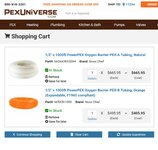
Sorry your wrong about automotive glycol. Propylene glycol base is the same difference is the inhibitor package. Automotive is normally ethylene and is toxic also contains silicates when it goes bad after a will gel up and clog control valves and loses its freeze protection. Boiler / chiller glycol has to be a minimum concentration of 30% for the inhibitor package to work also the protection doesn't have to be for hard freeze just has to be just to slurry. The manufacturer will give you that info in their charts.
 
To avoid these ads, REGISTER NOW!
Top Bottom