This is a very old thread, but it's still a relevant topic.
I do not agree that overhead heat is just as effective. My wife's uncle has a shop near here that uses overhead radiant heat, and invariably, I'm too hot on the side being radiated on, and cold elsewhere, when I'm working in his shop. Based on that (and on his recommendation), we installed radiant floor heat, and I have not a whit of remorse--it's just been perfect.
Our system is all electric, which is not the best solution for radiant floor heating, but gas wasn't an option for us (and with propane prices where they are now, I'm glad we didn't go that way). These systems use an on-demand boiler rather than a water heater, and the boiler's heating elements are monsters. They have to raise water 20-30 degrees in the short time it takes to pass 6.5 gallons through the boiler tank. My 40x60 shop is well-insulated with two inches of sprayed closed-cell foam and a 4-inch later of structural styrofoam under the slab. The boiler draws 94 amps at 240 VAC when the system is running. But even on the coldest days, it does that for a couple of minutes every couple of hours.
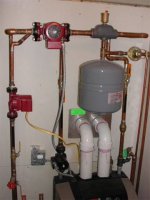
We bought the system as a kit from a company in Vermont, who shipped us everything in a crate. By "everything", I mean we got the oxygen-barrier Pex (2700 feet of it), zip ties for installing the Pex in the floor before the concrete was poured, the pre-assembled control manifold, the pump, the tubing manifolds (to and from the floor), the expansion tank, the water/air separator, all the valves both for control and for draining/filling, mounting hardware, and even a couple of special tools. What we did not get is the basic plumbing to connect the manifolds together and to connect the boiler to the manifolds. Cost including the boiler was about $7000 with me doing the installation.
It is a closed system, but it runs at low pressure (about 10 psi) and that means that just a little added water is all one needs to bring it up to pressure, if the expansion tank is properly charged (to also 10 psi). I had to top it off half a dozen times over about a week before the air separator finally bled off all the air. The system holds about 30 gallons total and I put 15 gallons of hydronic-system anti-freeze in it.
If it was an open system permanently connected to water, or if it used a water header also for potable water, it would need a mixing valve including a backup preventer to keep the heating system out of the drinking system. A closed system does not need that.
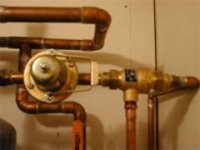
The circuit for mine starts at the boiler, goes through fitted iron pipe (the boiler fittings are iron and I don't like mixing metals) to a dielectric break union for the transition to copper. From there it goes through an outflow hose bib, a master valve, a filling hose bib, a pressure gauge, the Watts air separator, a pop-off valve, a drain valve (which I used with a shrader valve for pressure testing with air), the input pump isolation valve, the pump, the output pump isolation valve, and then the long run to the manifold with 9 valves for the 9 300-foot Pex circuits in the floor. Returning from those circuits, goes through a manifold with another 9 valves, and then past a master drain valve and into the input of the boiler. The boiler has a separate fitting to go to a pop-off valve, and I put the expansion tank in that route. The control system wires to the boiler, a floor temperature sensor, power, and a thermostat. The boiler requires two 60-amp branches and a 30-amp branch, and the control systems runs on a 20-amp branch.
Filling requires a hose from the utility sink I installed in the shot, plus a washing-machine host that has a female hose connection on both ends. I would crack the faucet open, and let the hose fill to just overflowing when held at hose-bib height before screwing it home--no sense in topping off water during the initial bleed if doing so adds a bunch of air. Getting the air out of the system was the only scary part for me--it too more topping off than I expected by a factor of three or four. The only other hard thing was soldering to the solid brass ring of the dielectric union and writing the check. Everything else was just elbow grease.

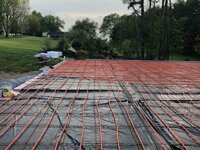

Now, every time I step into the shop, it's comfortable. Working at floor level is comfortable, it's comfortable in the shade under a car on jack stands, it's comfortable standing at the vise, it's comfortable sitting in a chair. If the wife opens the big door to pull her car in, it's comfortable again in five minutes, simply because of all that thermal mass in the floor. There's no condensation, no clammy feeling--humidity is neither low nor high enough to notice. I wish I had the same system in my house.
Rick "learned a lot about the topic in the process" Denney