To avoid these ads, REGISTER NOW!

Radient floor heat

capo72

Member
Joined
Feb 3, 2005
Messages
15
Location
Northern IL
I'm in the planning stages of building another garage, and i'm dead set on radient floor heat. One question I have is, do you need a water source near by to top off the system from time to time? We have a closed circut water chilling system at work, and it occasionally needs topping off, just wondering if a floor heat unit is the same. I don't know if i'll be able to have water service in the garage, and it's a long run for the garden hose!
 
To avoid these ads, REGISTER NOW!

Double Venom

Well-known member
Joined
Jan 31, 2005
Messages
96
Location
Pentwater, Mi
Capo,
My system was just installed and yes it needs additional water over time. Mine is hooked up to our main water supply with a one-way valve. Meaning it will not letter the floor water feed back to the main. (A really good thing when you have to use anti=freeze in the boiler. It also has a pecial valve that will automatically open when/if the system needs more water.

DV..now 27 degrees outside, my shop floor temp is anywhere from 87 to 99 degrees :)
 

OI812

Well-known member
Joined
Jan 8, 2005
Messages
202
Double Venom said:
Capo,
My system was just installed and yes it needs additional water over time. Mine is hooked up to our main water supply with a one-way valve. Meaning it will not letter the floor water feed back to the main. (A really good thing when you have to use anti=freeze in the boiler. It also has a pecial valve that will automatically open when/if the system needs more water.

DV..now 27 degrees outside, my shop floor temp is anywhere from 87 to 99 degrees :)


DV is 100% correct. Depending on the system you can top it off with a garden hose. Just remember most of these systems run at low pressure. In a closed system when you heat water you increase the pressure. DV do you have a pressure gauge on your line pressure? If so what is it set at?

My guess on the one way valve is either a check valve or more likely a backflow preventer. My guess is the valve is a Watts 9-D. The automatic fill valve is probably a combination fill/pressure reducing valve. These are just my best guess, DV could probably tell us more about them.
 

Double Venom

Well-known member
Joined
Jan 31, 2005
Messages
96
Location
Pentwater, Mi
01812,
Damnnn your good! That is the terminology my plumber used! Backflow preventer AND a Watts 9D valve.

I just took some pictures. I'll see if I can't get them to load up. One is the face of the boiler, the "3/160" indicates that (3) is in high firing mode, the 160 indicates the boiler temp. - heading to a set timp. of 170. The dial on the right shows the analog temp of the boiler (matching the digital 160), below it shows the actual water pressure coming into the boiler... 15 psi.

Oh, the other blurry photo shows the floor temperature of my office now :) Sorry, I'm new to this camera and doing it one handed in "micro" mode is a little tough ;)

Cass...as of today, I hung up all my creepers! With this slippery finish I have on the floor, I just lie down and slide all over the place!

DV
PS edited for better pictures
 

Attachments

  • Boiler valves.JPG
    Boiler valves.JPG
    6.4 KB · Views: 201
  • floor temp 2-9.JPG
    floor temp 2-9.JPG
    3.1 KB · Views: 193
  • Boiler 2-1-05.jpg
    Boiler 2-1-05.jpg
    21.9 KB · Views: 199
  • Boiler panel.jpg
    Boiler panel.jpg
    22.2 KB · Views: 201

OI812

Well-known member
Joined
Jan 8, 2005
Messages
202
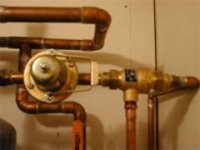
The valve on the right with the 1/2" line going to the floor is the watts 9-D (backflow preventor). The valve to the left with the dome top is actually a pressure reducing valve. It takes the pressure from line down to in your case 15 psi. I have seen some boilers set up at 30 psi. I don't do any installs, just know the principles.

If your going to install a system find out what backflow prevention is legal in your area. Some areas require a reduced principal backflow preventor(RPBP). Those cost alot more than a 9-D.

Hope this helps

Like the setup DV, what temp is the water exiting the boiler going to the tubing? I was told the water should not exceed 110 degrees, because it can exploded the concrete. Temp might have been 120, but I know it was some where around there.
 

Double Venom

Well-known member
Joined
Jan 31, 2005
Messages
96
Location
Pentwater, Mi
01812,
Your not going to let me miss a thing! :thumbup:

The boiler temperature is set at 170, just until it brings the water temperature up over the entire floor. Once the floor balances out, then I am to reset the target boiler temperature to 130!

Let me take aim on the in/out temepratures right now...... Both outs are 144
Zone 1 return 79, zone 2 (the shorter 'loop') 94.

It's a 'Weil-McLain' boiler and it has a RPBP valve of some type built in..so they tell me.
DV
PS. only two zones-shop is 40-42--dont let anyone tell you to put in only two zones! Now I've found out three would have been ok, 4 would have been better!
 

OI812

Well-known member
Joined
Jan 8, 2005
Messages
202
If I could figure out how to work my photoshop program I would list all the compents for everyone to see. That might be a weekend project. Nice looking setup, I like it.
 

avsfan733

Well-known member
Joined
Jan 22, 2005
Messages
65
Location
Rochester
anyyone ever used the electrical systems? When i was an electrician we used to install a fair number of those in high end homes...granted your not pouring concrete around it but methinks that if you do a concrete slab and are putting some covering such as tile down they would work. Used to be they went down right before the tile guys would come int, basically a resistance heating coil but a lot longer
 

Ken Greene

Well-known member
Joined
Feb 3, 2005
Messages
119
Location
Halfmoon NY
to my knowlege the electric systems are floor warmers.... make the tile in the bathroom toasty for the toes. not a good heat sorce for heating a large space such as a garage. but i may be mistaken.... i installed radiant heat in my home last fall, it keeps the first floor nice and toasty. but its maxium heat output for 1000' feat of tubing was 32000 BTUH. thats alot of heat for an electric grid to produce and not make the meter spin off like a top.
 

avsfan733

Well-known member
Joined
Jan 22, 2005
Messages
65
Location
Rochester
Double Venom said:
I went into thermal shock when I read 'afsvan' post :) Do they make electric meters that big? :evil:

More than one of the houses that we wired had TWO electric meters your talking about houses with two main panels of circuits packed full and usually a third subpanel hidden somewhere else. We did a 8 bedroom 6.5 bath house (actually three half baths, one on the main floor and two (mens and womens) in the basement next to the dancefloor and the bar! i only wish i could afford to like have a house the size of his bar room....
 

Double Venom

Well-known member
Joined
Jan 31, 2005
Messages
96
Location
Pentwater, Mi
avsfan.
Wouldn't it be nice just to be able to pay the electic bill every month for that? And not think twice about it!

Wish you were here, I'd have you check my 'main' on my shop. The garage is unattached, garage main is buried, runs about 20' to the house. Comes up to the disconnect on the house and then wired / hooked up to the bottom (pre-meter) on the same two lugs. All of it is in conduit but running two 'feeds' to the one set of lugs is pretty tight. Just not sure there isn't a better way? Did I do a bad thing?

Ken sent me a great picture of DV II- This is it. I promise :lol2:

DV
 

Attachments

  • DVII at London.jpg
    DVII at London.jpg
    22.7 KB · Views: 118

avsfan733

Well-known member
Joined
Jan 22, 2005
Messages
65
Location
Rochester
lol the deal I have with my fionace that when we build our house there will be a seperate meter for the garage...we have a deal that we are gonna continue to live in the tiny *** place we have until we both graduate and can afford to build a house the right way, only do it once...i get up to 35% of whatever sqft the house ends up being to do a garge (meaning 35% in addition to the house)...the tradeoff is she gets free reign on interior decorating we shall see what happens in the future
 

kbs2244

Well-known member
Joined
Nov 11, 2006
Messages
14,065
I realise that heated floors are the current fad

But I feel they are too complex for the benefit

Overhead radiant heaters are far simpler and provide a comfortable space
 
To avoid these ads, REGISTER NOW!

rdenney

Well-known member
Joined
Mar 30, 2022
Messages
142
This is a very old thread, but it's still a relevant topic.

I do not agree that overhead heat is just as effective. My wife's uncle has a shop near here that uses overhead radiant heat, and invariably, I'm too hot on the side being radiated on, and cold elsewhere, when I'm working in his shop. Based on that (and on his recommendation), we installed radiant floor heat, and I have not a whit of remorse--it's just been perfect.

Our system is all electric, which is not the best solution for radiant floor heating, but gas wasn't an option for us (and with propane prices where they are now, I'm glad we didn't go that way). These systems use an on-demand boiler rather than a water heater, and the boiler's heating elements are monsters. They have to raise water 20-30 degrees in the short time it takes to pass 6.5 gallons through the boiler tank. My 40x60 shop is well-insulated with two inches of sprayed closed-cell foam and a 4-inch later of structural styrofoam under the slab. The boiler draws 94 amps at 240 VAC when the system is running. But even on the coldest days, it does that for a couple of minutes every couple of hours.

We bought the system as a kit from a company in Vermont, who shipped us everything in a crate. By "everything", I mean we got the oxygen-barrier Pex (2700 feet of it), zip ties for installing the Pex in the floor before the concrete was poured, the pre-assembled control manifold, the pump, the tubing manifolds (to and from the floor), the expansion tank, the water/air separator, all the valves both for control and for draining/filling, mounting hardware, and even a couple of special tools. What we did not get is the basic plumbing to connect the manifolds together and to connect the boiler to the manifolds. Cost including the boiler was about $7000 with me doing the installation.

It is a closed system, but it runs at low pressure (about 10 psi) and that means that just a little added water is all one needs to bring it up to pressure, if the expansion tank is properly charged (to also 10 psi). I had to top it off half a dozen times over about a week before the air separator finally bled off all the air. The system holds about 30 gallons total and I put 15 gallons of hydronic-system anti-freeze in it.

If it was an open system permanently connected to water, or if it used a water header also for potable water, it would need a mixing valve including a backup preventer to keep the heating system out of the drinking system. A closed system does not need that.

The circuit for mine starts at the boiler, goes through fitted iron pipe (the boiler fittings are iron and I don't like mixing metals) to a dielectric break union for the transition to copper. From there it goes through an outflow hose bib, a master valve, a filling hose bib, a pressure gauge, the Watts air separator, a pop-off valve, a drain valve (which I used with a shrader valve for pressure testing with air), the input pump isolation valve, the pump, the output pump isolation valve, and then the long run to the manifold with 9 valves for the 9 300-foot Pex circuits in the floor. Returning from those circuits, goes through a manifold with another 9 valves, and then past a master drain valve and into the input of the boiler. The boiler has a separate fitting to go to a pop-off valve, and I put the expansion tank in that route. The control system wires to the boiler, a floor temperature sensor, power, and a thermostat. The boiler requires two 60-amp branches and a 30-amp branch, and the control systems runs on a 20-amp branch.

Filling requires a hose from the utility sink I installed in the shot, plus a washing-machine host that has a female hose connection on both ends. I would crack the faucet open, and let the hose fill to just overflowing when held at hose-bib height before screwing it home--no sense in topping off water during the initial bleed if doing so adds a bunch of air. Getting the air out of the system was the only scary part for me--it too more topping off than I expected by a factor of three or four. The only other hard thing was soldering to the solid brass ring of the dielectric union and writing the check. Everything else was just elbow grease.

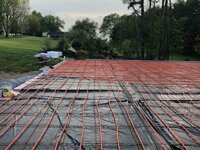
IMG_8108-dsqz.jpg

IMG_7680-dsqz.jpg

IMG_7678-dsqz.jpg

Now, every time I step into the shop, it's comfortable. Working at floor level is comfortable, it's comfortable in the shade under a car on jack stands, it's comfortable standing at the vise, it's comfortable sitting in a chair. If the wife opens the big door to pull her car in, it's comfortable again in five minutes, simply because of all that thermal mass in the floor. There's no condensation, no clammy feeling--humidity is neither low nor high enough to notice. I wish I had the same system in my house.

Rick "learned a lot about the topic in the process" Denney
 
Last edited:

finn

Well-known member
Joined
Mar 27, 2005
Messages
16,185
Location
The UP, God's country
My system includes a propane boiler and is connected to my well system. I heat the building all winter, but I shut the well off for the six months I am gone in the winter.

There’s, I recall, a low water level sensor (Ashcroft valve) in the system that protects the boiler in the event the system looses fluid.

We monitor building temperature with an internet connected thermostat (Nest)
 

Rc_Guy

Well-known member
Joined
Apr 14, 2013
Messages
4,415
Location
Minnesota
I realise that heated floors are the current fad

But I feel they are too complex for the benefit

Overhead radiant heaters are far simpler and provide a comfortable space
How is radiant more comfortable? I have infloor heat in the house and the garage, 68° in the garage all winter, most of the snow melting before it gets to the drain, don't know if overhead would melt that quick.
 

kbs2244

Well-known member
Joined
Nov 11, 2006
Messages
14,065
it is a cost/comfort/complexity decision
rdenney's sixth paragraph make my argument re:complexity
a radiant system, left on, will heat the floor and all the equipment in the room
they will re-radiant to your body
the problems rdenney had with his system comes from turning it on only when you are in the room
that will work and you will save money but you lose the summer time comfort


Rc_Guy

Well-known member
Joined
Apr 14, 2013
Messages
4,415
Location
Minnesota
it is a cost/comfort/complexity decision
rdenney's sixth paragraph make my argument re:complexity
a radiant system, left on, will heat the floor and all the equipment in the room
they will re-radiant to your body
the problems rdenney had with his system comes from turning it on only when you are in the room
that will work and you will save money but you lose the summer time comfort


I don't think a heated floor should be turned on and off, we turn it on for the winter and off for the summer.

We have a mini split for fall and spring that will help the house warm and cool, we don't turn on the infloor until it is going to stay cold outside

think a heated floor also warms up everything in the room.

After having heated floors for six winters now I would never go back to anything else.
 

rdenney

Well-known member
Joined
Mar 30, 2022
Messages
142
I turned mine on last September after getting the system into operation and it's still on. Getting it bled was just the initial ordeal--since then it's been completely hands-off. I leave it on--the thermal mass of that slab is easier to sustain than it is to heat from nothing.

In the summer, it turns itself off just because it's never cold enough to demand heat. It's driven by air temperature, not slab temperature, so if the slab loses heat to the ground in the summer, it will be cooler than the air, which is a good thing. The slab temperature is used only to prevent a runaway in case someone leaves a big door open on a really cold day and the heating system can't satisfy the thermostat. The floor could get really hot (not boiling but well over 150 degrees), and if that happens it will expand and destroy the building (yes, literally). I guard against that in two ways. One is the slab sensor, which the control system will not heat above 80 degrees. And the second is the maximum vessel temperature in the boiler, which I've set to around 114 degrees. It will shut itself off no matter what the control system is requesting if the temp goes higher than that--that's the court of last resort. Of course, 114 degrees in the boiler vessel will be a LOT less in the floor if someone left a big door open on a really cold day. I don't worry about the system when I'm not around. I keep the thermostat on 64, which is more comfortable in the shop than 70 is with the hybrid heat system in the house.

But I do look at the system from time to time to check the pressure. I have a pressure gauge on the manifold and another one on the vessel (provided by the boiler manufacturer). They are always in agreement. Starving the pump for input pressure will cause it to cavitate, though, and that is destructive to pumps, so I look every once in a while.

The complexity is an illusion--it's actually quite a bit less complex than most heating systems. It's just that it wears what complexity it has on its sleeve--you have to deal with it during installation. Once operating properly, though, it's all done. The kit we received came with all those manifolds preassembled--installation was a lot easier than bending sheet metal for a forced-air system, and it's much more effective than an overhead radiant system.

But if I still lived in Texas, I'd never consider it. It doesn't take much heat to keep a building tolerable over the winder in Houston where I grew up. There, one spends the money on air conditioning, but that is more difficult by far than the heating system I installed. Remember that my building is 40x60 with a 14-foot ceiling and a 16x60 attic. Cooling that in Houston heat and humidity would spin the meter a lot faster than my heating system :)

Rick "pondering a mini-split for the attic room when we enclose it" Denney
 

fitter30

Well-known member
Joined
Jun 23, 2019
Messages
2,960
Location
Peace Valley,mo
Could use a pressure switch that is adjustable 0-5 lbs normally open either use it for a low pressure alarm or with a relay a alarm and system shut off. Then add antifreeze mixture by a what ever pump u used to fill the system.

Tecmark Spa 3902 Series Universal Pressure Switch 1 Amp w/out Brass Fittings 3902​


rdenney

Well-known member
Joined
Mar 30, 2022
Messages
142
Could use a pressure switch that is adjustable 0-5 lbs normally open either use it for a low pressure alarm or with a relay a alarm and system shut off. Then add antifreeze mixture by a what ever pump u used to fill the system.

Tecmark Spa 3902 Series Universal Pressure Switch 1 Amp w/out Brass Fittings 3902​

Yes, a low-pressure cutoff switch would be sensible. That's the one thing not in this kit.

I added 15 gallons of hydronic antifreeze, but I couldn't use the pump that filled the system (which was the well pump). I did buy a cheapie HF pump that worked just fine, however.

Rick "antifreeze is expensive" Denney
 

fitter30

Well-known member
Joined
Jun 23, 2019
Messages
2,960
Location
Peace Valley,mo
No, overhead radiant is NOT the same, period.

If you think radiant floor is too complex, you just don't understand, and probably never will.
Really capo 72 is looking for a suggestion how to add antifreeze solution to a system that doesn't have a water supply. With a pressure switch it will give him the protection the system will need before a low water boiler control shuts the boiler off. If its piped with a primary/ secondary loop pump doesn't have low water protection. If a system is overhead radiate or other heat emitters just pipe a switch in at the top of riser. Do it all the time on energy management systems.
 

tdkkart

Well-known member
Joined
Jun 17, 2006
Messages
6,887
Location
Eastern Iowa
Really capo 72 is looking for a suggestion how to add antifreeze solution to a system that doesn't have a water supply. With a pressure switch it will give him the protection the system will need before a low water boiler control shuts the boiler off. If its piped with a primary/ secondary loop pump doesn't have low water protection. If a system is overhead radiate or other heat emitters just pipe a switch in at the top of riser. Do it all the time on energy management systems.
It's even easier than that. My system loses a bit of pressure over time due to some very small leaks that I haven't bothered to fix. I keep a pump and a bucket of water nearby, when the pressure drops a bit I pump more water in. I like 20psi, when it drops below 15 I bump it up.
 

rdenney

Well-known member
Joined
Mar 30, 2022
Messages
142
Really capo 72 is looking for a suggestion how to add antifreeze solution to a system that doesn't have a water supply. With a pressure switch it will give him the protection the system will need before a low water boiler control shuts the boiler off. If its piped with a primary/ secondary loop pump doesn't have low water protection. If a system is overhead radiate or other heat emitters just pipe a switch in at the top of riser. Do it all the time on energy management systems.
You fill it with plain water and bleed it as best you can. Pressurize it and check for leaks. (Do that with air first, to maybe 50 psi--much higher than you'll see in heating operation). Once you are sure there are no leaks (because antifreeze is expensive)--use a cheapie Harbor Freight pump, connect it to the input valve, turn on the pump, open the output valve until the antifreeze is all in, close the output valve, close the input valve, and then turn off the pump. The pump has a sump that I dropped right into the bottom of the 5-gallon buckets. But it should be filled and bled before you add the antifreeze, and you can do that with a hose from your house. The same pump will, of course, fill the system, if you bring enough of those buckets.

This is for a closed system with no continuous water supply. I'm not sure you can put antifreeze into an open system.

Rick "been there, done that" Denney
 

fitter30

Well-known member
Joined
Jun 23, 2019
Messages
2,960
Location
Peace Valley,mo
You fill it with plain water and bleed it as best you can. Pressurize it and check for leaks. (Do that with air first, to maybe 50 psi--much higher than you'll see in heating operation). Once you are sure there are no leaks (because antifreeze is expensive)--use a cheapie Harbor Freight pump, connect it to the input valve, turn on the pump, open the output valve until the antifreeze is all in, close the output valve, close the input valve, and then turn off the pump. The pump has a sump that I dropped right into the bottom of the 5-gallon buckets. But it should be filled and bled before you add the antifreeze, and you can do that with a hose from your house. The same pump will, of course, fill the system, if you bring enough of those buckets.

This is for a closed system with no continuous water supply. I'm not sure you can put antifreeze into an open system.

Rick "been there, done that" Denney
Open system is usually a system that would heat a radiate floor a would supply dhw which isn't acceptable with water laying in the radiate floor not moving in the non heating months. Bringing in oxygen ( fresh water) in a boiler system is detrimental to the boiler.
 
To avoid these ads, REGISTER NOW!
Top Bottom