To avoid these ads, REGISTER NOW!

Raising garage ceiling questions

MikeC55

Well-known member
Joined
Nov 1, 2020
Messages
418
Location
CT
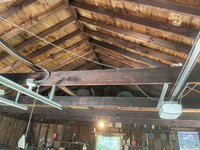
The house I recently bought in central CT (snow loads) has a 2 car detached garage built in early 60s that I plan to make shop-ready, meaning wiring/outlets, insulation and raising the 8 foot ceiling for a 2 post lift. It's about 23' x 23 inside, 2 x 4 walls (16" oc), 2 x 6 rafter roof (16" oc) with 2 x 8 bottom tie beams, 48" oc. The ridge board is a 2 x 10 (I think) but is not one continuous beam (It has a joint around 6 ft from back wall), so I'm not sure it would be classified as a structural ridge beam. The garage doors are on the gable end. Roof pitch is 6:12 so I think I should be able to gain about 2' of interior height, in the area of the lift) by moving the rafter ties up 1/3 the total rafter height (and tying them at every rafter). The un-altered rafters that had no tie would all have one added. These sketches show the basic plan. What is the best way to attach the new bottom ties to the old, hard, rafters? Are screws ok? Lag bolts? Trying to nail into old lumber is usually difficult. Would glue at the joint also be recommended?

Eventually, I would also like to replace the 2 separate garage doors with a single large door (the lift will be centered in the garage). The existing doors are 9' wide, with separate 2 x 10 headers. I'd like to install an 18' wide door and so the header must span about 19'. Since it's a gable end, I believe the loads are low and am hoping I can do this with 2 x 10 LVLs.
 

Attachments

  • Front elev.jpg
    Front elev.jpg
    84.3 KB · Views: 152
  • Side elev.jpg
    Side elev.jpg
    86.1 KB · Views: 159
Last edited:
To avoid these ads, REGISTER NOW!

Chris705

Well-known member
Joined
Nov 1, 2012
Messages
834
Location
The Finger Lakes of NY
GRK-RSS screws will work well for your alterations on moving the rafter-ties up. Also make sure the rafter to top plate connection is solid. Probably currently just toe-nails, I’d recommend adding some Simpson connectors.

Your OH door header may need something a bit deeper to span 18’…. The sizing guides for the various lvl manufacturers should be helpful.
 

jack stand

Well-known member
Joined
Feb 29, 2012
Messages
3,308
Location
Lakes Region Maine
I'd go with a single 12'w door centered. This will give you a generous bay and wall space on either side for benches or tool boxes and some floor space. Chris has your framing answers above. 👍
In most cases the gable end is self supported and little support is needed for a 12' door. You'd have roughly 6' available on each side and an opportunity for a man door on one side if necessary.
 

billconner

Well-known member
Joined
Jul 20, 2021
Messages
6,934
Location
Thousand Islands NYS
I hate to be a Debby downer, but I think your rafters will be way undersized. When you raise the rafter ties 1/3, you also reduce the allowable span of the rafter about a third. Adding a ceiling and insulation substantially increases your dead loaf. Last, the ceiling will probably require a deflection of L/240 or greater, whereas the existing structure is fine with minimum L/180.

I know span (11'-6") and spacing -16" oc - but don't know ground snow load or species and grade, nor intended ceiling and insulation. If knew those, I could tell you what code says for the rafters.

It's all doable, but you may have to sister your rafters.
 
Last edited:

CombatNinja

Well-known member
Joined
Aug 24, 2013
Messages
1,456
I'm thinking you might be sistering. Almost to the point of ripping it all off and rebuilding the whole roof structure the way you want it, especially if it needs a new roof anyway.
 
OP
M

MikeC55

Well-known member
Joined
Nov 1, 2020
Messages
418
Location
CT
For insulation I was planning fiberglass batts R30 and wall covering of the raised part doesn't have to be sheet rock. I could use something lighter if need be. But if sistering is needed, would it need to be the full rafter length? It does have a fairly new roof.
 
OP
M

MikeC55

Well-known member
Joined
Nov 1, 2020
Messages
418
Location
CT
I think the 12' door is a good idea since I will want a man door.
 

Chris705

Well-known member
Joined
Nov 1, 2012
Messages
834
Location
The Finger Lakes of NY
Mike - Rafter span tables do not take into account where the rafter ties land. Rafters if sized properly for the ties down at top of wall will be fine for raising ties the 2’ as you are planning on.

The Simpson connector you linked is what I was thinking… or simple angle brackets, but that maybe difficult to fasten with the roof in place due to limited space above the wall plate.

OH door width on the gable end isn’t really a snow load issue, more of a wind load concern. Going smaller than 18’ will allow additional studs to foundation to deal with the lateral wind load.
 

billconner

Well-known member
Joined
Jul 20, 2021
Messages
6,934
Location
Thousand Islands NYS
Rafter span tables do not take into account where the rafter ties land.
The ones in the code (IRC) do.

  1. a.The tabulated rafter spans assume that ceiling joists are located at the bottom of the attic space or that some other method of resisting the outward push of the rafters on the bearing walls, such as rafter ties, is provided at that location. Where ceiling joists or rafter ties are located higher in the attic space, the rafter spans shall be multiplied by the following factors:
    HC/HRRafter Span Adjustment Factor
    1/3​
    0.67​
    1/4​
    0.76​
    1/5​
    0.83​
    1/6​
    0.90​
    1/7.5 or less​
    1.00​
    where:
    HC = Height of ceiling joists or rafter ties measured vertically above the top of the rafter support walls.
    HR = Height of roof ridge measured vertically above the top of the rafter support walls.
 

CombatNinja

Well-known member
Joined
Aug 24, 2013
Messages
1,456
Oh yeah. Definitely need to consider that adjustment factor with snow loads in CT. I had a cousin completely disregard this in a 1960s detached garage he wanted to fix up. Looked great until the first big snow that winter. Whole thing collapsed on his GTO.
 

JohnX14

Well-known member
Joined
Jun 2, 2014
Messages
550
Location
Boston 'burbs
You might want to just go talk to the Building Dept. in the town. Tell them what you have and what you propose, and see what they say. We can give you today's codes, in which case the existing 2x6 rafters probably don't meet the span tables (I didn't look it up). But what you are proposing will be fine. It won't go anywhere. I'd use 2-3/4" ledger locks to fasten the rafter ties to the rafters, after nailing them in with a framing nailer. If you want or are required to meet today's codes, you might as well just rip off the old roof and reframe it. You could add a structural ridge, but then the header for the overhead door will have to be sized to support that load too. And then you have shear wall considerations. That's why I'd see the building dept. And don't offer too much info in your questioning. Just present your proposal. I've found that if you press the questions with a lot of info on today's codes, you'll get the answers as they apply today. Post up a few pics.
 
OP
M

MikeC55

Well-known member
Joined
Nov 1, 2020
Messages
418
Location
CT
The thing that worries me about asking questions at the local building dept is they will surely ask why I want to raise the ceiling in the garage and I don't really want to mention I'm installing a lift if I can avoid it. I haven't tested the concrete yet for thickness but am assuming it's no more than 4" and so I do plan to cut out a good 5' x 13' section to pour a 12" thick, keyed-in slab with rebar (and epoxy anchors), just like I have in my current shop. I'm leery of an inspector throwing in all kinds of additional requirements because of the lift.

Keep in mind that this garage has been standing since the early 60s and only has rafter ties ever 48" with no obvious sag of the rafters or bowing of the walls (and we used to get heavier snow fall in those days). I will be changing this so every rafter has a tie. I'm not averse to doubling up (sistering) rafters in the raised area but unless I build a whole new garage (or add flying butresses) there's nothing I can do about improving the wall's resistance to bowing out.

Looking at the rafter adjustment table, it looks like I would be in the 1/3 range if moving the ties up 24". But how to interpret what the 0.67 factor means on an existing structure? I can't reduce the rafter length to 67% of its current value. I can sister on rafters but I realize this doesn't double the rafter resistance to bending (i.e. making it behave like a 2 x 8 or 2 x 10)
 

Innovate1

Well-known member
Joined
Jul 28, 2014
Messages
4,280
Location
Illinois near St. Louis, Missouri
The thing that worries me about asking questions at the local building dept is they will surely ask why I want to raise the ceiling in the garage and I don't really want to mention I'm installing a lift if I can avoid it. I haven't tested the concrete yet for thickness but am assuming it's no more than 4" and so I do plan to cut out a good 5' x 13' section to pour a 12" thick, keyed-in slab with rebar (and epoxy anchors), just like I have in my current shop. I'm leery of an inspector throwing in all kinds of additional requirements because of the lift.

Keep in mind that this garage has been standing since the early 60s and only has rafter ties ever 48" with no obvious sag of the rafters or bowing of the walls (and we used to get heavier snow fall in those days). I will be changing this so every rafter has a tie. I'm not averse to doubling up (sistering) rafters in the raised area but unless I build a whole new garage (or add flying butresses) there's nothing I can do about improving the wall's resistance to bowing out.

Looking at the rafter adjustment table, it looks like I would be in the 1/3 range if moving the ties up 24". But how to interpret what the 0.67 factor means on an existing structure? I can't reduce the rafter length to 67% of its current value. I can sister on rafters but I realize this doesn't double the rafter resistance to bending (i.e. making it behave like a 2 x 8 or 2 x 10)
Yes, if you ask about the requirements and you don't pull a permit they may catch you. Or if you do pull a permit they may make you do more than you want to do. That's the way it is. Only you can decide how you want to play it.

For the rafter adjustment table it's not 67% of what you have now. It's 67% of the span allowed today for a given size board and spacing from tables that weren't included. Depends on location and snow load so that may be something you could get from the local AHJ. If you need bigger rafters then the existing ones then you need to sister them to what you have. The larger rafter will carry the majority of the load since it will be a lot stiffer. The simple way is just to use the currently required size. You could determine what additional rafter in combination with the existing one could carry the same load by looking at what they both carry at the same deflection.
 
OP
M

MikeC55

Well-known member
Joined
Nov 1, 2020
Messages
418
Location
CT
Spent some time looking through the IRC (2021 version) and it seems R802.4.1(4), Snow load 30 psf, dead load 20 psf (ceiling attached to rafters) applies to my location. For 16" rafter spacing, 2 x 6 rafters, depending on wood species, the rafters are ok except that IRC requires a rafter tie for each rafter (iiuc). So there is no question I should be adding ties to the rafters that have none at present. What I'm not understanding is what would sistering additional lumber to the raised tie rafters buy me other than decreased deflection? If I'm comfortable with the deflection as-is, it would seem money would be better spent on increasing the lumber size of the tie to decrease the tendency for bottom of the (smaller) triangle spreading out (bowing out the walls). Am I missing something?
 

Attachments

  • image (2).jpg
    image (2).jpg
    445.6 KB · Views: 146
  • image.jpg
    image.jpg
    435.2 KB · Views: 141

NUTTSGT

Super Moderator
Staff member
Joined
Sep 14, 2009
Messages
50,864
Location
Northern Central Ohio
What's the roof look like and does it need new shingles ? Is the structure solid ? If you put the lift in the center, you're basically wanting a 1 car shop, correct ? What's your skill set ? Are you capable of doing construction/DIY work ?

I'd consider all the information and think this one out. Have you thought about raising the structure and laying up 3 courses of block to gain the extra ceiling height ? You're already talking about changing out the O/H door, so this will be a moot point of reframing it. Raise the structure, you can basically leave the roof alone, if it's stood the test of time for 50 plus years, why mess with it ?
 

Innovate1

Well-known member
Joined
Jul 28, 2014
Messages
4,280
Location
Illinois near St. Louis, Missouri
Your ceiling won't be directly attached to the rafters so table R802.4.1(3) would seem to apply. You will have to make some estimate of what wood is there. SPF is pretty common and one of the lower strength (not lowest) that would probably be conservative (estimate less strength than actual). Older lumber was generally better so you might want to use the line for a better wood. But using SPF #2 the allowed span is 11' 11" which just makes it. But you then apply the 67% so it is good for about 8'. I am assuming the span is just the horizontal distance and not the longer length along the rafter - not sure if that is correct. For your span of 12' (again assuming you are to use the horizontal distance would require a member that could span 12'/.67 = 17.9'
In a 2 x 6 only select Douglas fir or southern pine will meet the table and I seriously doubt you have that.
Even a 2 x 8 in most common species and grades won't make it so you would likely need a 2 x 10 to do it per the tables. The raising of the ties puts a lot more load on the rafters.
 

Chris705

Well-known member
Joined
Nov 1, 2012
Messages
834
Location
The Finger Lakes of NY
I don’t think your missing anything. How ever are you thinking of increasing rafter tie size so more weight could be added…are you trying to increase dead load or live storage load?
I see Connecticut follows the 2015 IRC. Not sure when the deduction for rafter size/rafter spans & height of rafter ties was added. But as has been stated the codes/sizing charts for many years have never accounted for this. I am not saying to disregard (I hadn’t known when this was even added) but taken with a measure of common sense you may still be fine. I think if we can understand the ridge board height and wall height we can help make sure the rafters can still safety span with the proposed raised rafter ties.
 

Innovate1

Well-known member
Joined
Jul 28, 2014
Messages
4,280
Location
Illinois near St. Louis, Missouri
I see above the table it states spans are measured horizontally so I got that right.

If the ceiling is attached to the rafters is not completely clear to me. In the case of the raised ties it clearly is but I think they mean if it is directly attached. Which it is below the tie. I didn't look for clarification on that...
 

Innovate1

Well-known member
Joined
Jul 28, 2014
Messages
4,280
Location
Illinois near St. Louis, Missouri
I don’t think your missing anything. How ever are you thinking of increasing rafter tie size so more weight could be added…are you trying to increase dead load or live storage load?
I see Connecticut follows the 2015 IRC. Not sure when the deduction for rafter size/rafter spans & height of rafter ties was added. But as has been stated the codes/sizing charts for many years have never accounted for this. I am not saying to disregard (I hadn’t known when this was even added) but taken with a measure of common sense you may still be fine. I think if we can understand the ridge board height and wall height we can help make sure the rafters can still safety span with the proposed raised rafter ties.
2015 also has the derating for raised ties.
 
To avoid these ads, REGISTER NOW!

Chris705

Well-known member
Joined
Nov 1, 2012
Messages
834
Location
The Finger Lakes of NY
I wouldn’t discount the use of a southern yellow pine or Douglas Fir in a 60’s built garage….wood was of much better quality than today’s ****.
 

Innovate1

Well-known member
Joined
Jul 28, 2014
Messages
4,280
Location
Illinois near St. Louis, Missouri
Making the tie bigger doesn't help make the structure stronger if the limiting factor is the size of the rafters. Might be easier/cheaper to do something like a scissor truss where the bottom cord is raised in the center where the lift is and then runs down to the top of the wall at the end. But that's just a swag on my part.
 

Innovate1

Well-known member
Joined
Jul 28, 2014
Messages
4,280
Location
Illinois near St. Louis, Missouri
I wouldn’t discount the use of a southern yellow pine or Douglas Fir in a 60’s built garage….wood was of much better quality than today’s ****.
Possible I suppose but not likely IMHO. Much more likely they used local timber but perhaps better quality. Just looking at the pictures you can see substantial knots so I would guess #2 grade.
 
OP
M

MikeC55

Well-known member
Joined
Nov 1, 2020
Messages
418
Location
CT
I am wanting a 1 car shop with more room for tools like my (metal) lathe and (someday) milling machine and room to work around the car. I also MIG Weld and have an oxy-propane torch I use for bending steel. I also do some woodworking and so have a large table saw, planer, etc. I've helped a couple of friends build houses and have done interior work (removing load bearing wall) so I do plan to do whatever it is myself.

The scissors truss idea is interesting but I can't find much on converting existing rafters to a scissors design. The other thing that occurred to me is how will I get rafter ties in there for the ones that don't have them? 16" OC means I won't have enough room to angle them in place (assuming they will need to be 3.5 x 2 longer than dimension between walls. Can I get them to bend enough to sneak them in flat-wise? (these are 2 x 8").
 
OP
M

MikeC55

Well-known member
Joined
Nov 1, 2020
Messages
418
Location
CT
Any idea what it would cost to raise the structure by adding to block foundation? I like the idea for its simplicity. But that isn't something I would try myself. The current foundation is block and is in good shape (the land slopes down toward back and left side of garage so about 5 - 7 courses of block are exposed). I'll get some photos but it also looks like the foundation walls were built and then slab poured after as you can see the top course of block sticking up about 1.5" above slab.
 

billconner

Well-known member
Joined
Jul 20, 2021
Messages
6,934
Location
Thousand Islands NYS
I was at holiday activities yesterday so just catching up. I haven't run the numbers but my instinct says sistering rafters with 2x8's might do it in combination with existing 2x6s. Sister both sides of every other rafter and use the 12" on center tables. Really need snow load numbers to know it's comfortable, even if not quite code.

You may be able to get away with a L/180 of deflection if using something like t&g boards for ceiling, something that won't crack when it deflects.

Not sure I understand rafter tie/ceiling joist install problem - they'd only be 16' if raised.

I like the idea of raising building but adding ceiling and insulation probably adds enough load you still have to do something with rafter/rafter ties. The existing 24' ties - even doubled assuming you can find 24' lumber - are unlikely to support a ceiling and insulation.

Some how just sistering rafters and raising collar ties seems simplest. Also draws less attention. Around here, if heating this, building department would require meeting energy codes, and insulating the existing slab would not be simple unless replacing it.
 

CraigStu

Well-known member
Joined
May 22, 2014
Messages
4,013
Location
Blacksburg, Va
As you investigate designs and look into gov regulations remember that you will sell this house at some point. So you may get away w/o permits now but could get caught out when you sell. If a buyer/home inspector finds out that something isn't to code, both realtors will know that. So even if that buyer backs away, they must disclose the info to any subsequent buyers.
 

Innovate1

Well-known member
Joined
Jul 28, 2014
Messages
4,280
Location
Illinois near St. Louis, Missouri
I am wanting a 1 car shop with more room for tools like my (metal) lathe and (someday) milling machine and room to work around the car. I also MIG Weld and have an oxy-propane torch I use for bending steel. I also do some woodworking and so have a large table saw, planer, etc. I've helped a couple of friends build houses and have done interior work (removing load bearing wall) so I do plan to do whatever it is myself.

The scissors truss idea is interesting but I can't find much on converting existing rafters to a scissors design. The other thing that occurred to me is how will I get rafter ties in there for the ones that don't have them? 16" OC means I won't have enough room to angle them in place (assuming they will need to be 3.5 x 2 longer than dimension between walls. Can I get them to bend enough to sneak them in flat-wise? (these are 2 x 8").
You cut a taper on both ends. Then slip one end as far in as it will go with the board laying flat to get the other end in and then move it back a few inches and tip it up. You end up with limited overlap with the rafters. Usually you can get enough but it looks like your roof deck may be right on the outside top of the wall. If the roof is raised a bit that provides for ventilation of the attic space and also a little extra room to slide the end out farther when getting the other end in place. For a 24' board you may be able to bend them some to get a little more room but that might take some blocking - maybe two long boards on edge on each side of the flat joist with blocking at the ends and then jack the middle up. If you bow the board up in the middle that will give you the max insertion on the end. No idea how well this would work...
 
OP
M

MikeC55

Well-known member
Joined
Nov 1, 2020
Messages
418
Location
CT
Hi Bill, the rafter tie/ceiling joist problem is only for the non-raised areas (see the blue rectangles in the side elevation). Right now, the garage only has ties every 48". I guess that was to code at the time. I too was wondering if 24' decent quality boards are available. I guess it would be easier to use cable ties but then I'd have to do something else to support a ceiling. I'm not interested in a pretty, perfectly smooth ceiling; just something to hold up the insulation. I would just as soon skip drywall and taping. I know there are lighter options.
I suspect sistering in 2 x 8 to the rafters that will have raised ties will be the most DIY-friendly approach. But why "sister both sides of every other rafter" instead of sistering one side of each rafter?
I understand there is risk in doing this without a permit (from a future sale POV) but I don't expect to be moving again in this lifetime. As long as it holds up for the next 20 years, I'll let my son worry about that...
As for heating, I initially will use the kerosne torpedo but would eventually like to do something with propane maybe (it won't be heated when I'm not in there). But that is the kind of thing I don't want to get into with building dept.
 

billconner

Well-known member
Joined
Jul 20, 2021
Messages
6,934
Location
Thousand Islands NYS
Sistering one side with a 2x10 is probably fine. Could be a 2x12 every 2' is even more economical. Little details like how much space above top plate and what I can lift would factor in for me.

If you only need max height in center of width, turning each existing rafter into the top chord of an inverted truss might be most economical and easiest. 2 pc 2x4 and a king post, with node on new raised rafter tie.

Understand only a portion of ties are raised - apologies if I missed that (blue barely noticable on my phone) - causes me to wonder if there is another way - but probably not as simple.

Sure, metal liner panel ceilings with loose fill should help minimize load. Maybe those can span 4' so fewer rafter ties.

I would not worry about garage and resale value myself. When we sold our first house, I had renovated it - 100 years old - but never got to garage - just 50 years old - and said in listing it was a tear down.
 

Innovate1

Well-known member
Joined
Jul 28, 2014
Messages
4,280
Location
Illinois near St. Louis, Missouri
I was at holiday activities yesterday so just catching up. I haven't run the numbers but my instinct says sistering rafters with 2x8's might do it in combination with existing 2x6s. Sister both sides of every other rafter and use the 12" on center tables. Really need snow load numbers to know it's comfortable, even if not quite code.

You may be able to get away with a L/180 of deflection if using something like t&g boards for ceiling, something that won't crack when it deflects.

Not sure I understand rafter tie/ceiling joist install problem - they'd only be 16' if raised.

I like the idea of raising building but adding ceiling and insulation probably adds enough load you still have to do something with rafter/rafter ties. The existing 24' ties - even doubled assuming you can find 24' lumber - are unlikely to support a ceiling and insulation.

Some how just sistering rafters and raising collar ties seems simplest. Also draws less attention. Around here, if heating this, building department would require meeting energy codes, and insulating the existing slab would not be simple unless replacing it.
That makes no sense. Better to sister every rafter. That spreads the load instead of having every other rafter very stiff and the others much less stiff. And the guess of 12" spacing doesn't make sense either. Sounds like something done to make the numbers come out the way you want (saying it's ok).
 

billconner

Well-known member
Joined
Jul 20, 2021
Messages
6,934
Location
Thousand Islands NYS
The sheathing between rafters is not the week point. I said I wasn't sure 2x8 on 12" centers would work but alternating double 2x8 and single 2x8 on 16" centers is same as singles 12" on center. And the existing 2x6s add some strength.

If you really want to get tricky, just skin the 2x6s with ply to make a stressed skin panel. Easy to get it to calc as strong enough. Some work to get splices to work.

Still don't know design snow load.
 
OP
M

MikeC55

Well-known member
Joined
Nov 1, 2020
Messages
418
Location
CT
Yes, now it makes more sense. The inverted truss idea is interesting. I'll sketch something up and see if I understand it correctly. It would certainly cut down the cost too. I was think of plywood as a stressed skin too but as you mentioned, I'm not sure how to fasten it to get the full benefit. The snow load, according to this site is 30 psf. https://up.codes/viewer/connecticut...design-categories-and-ground-snow-loads#new_R
 

Innovate1

Well-known member
Joined
Jul 28, 2014
Messages
4,280
Location
Illinois near St. Louis, Missouri
Yes, now it makes more sense. The inverted truss idea is interesting. I'll sketch something up and see if I understand it correctly. It would certainly cut down the cost too. I was think of plywood as a stressed skin too but as you mentioned, I'm not sure how to fasten it to get the full benefit. The snow load, according to this site is 30 psf. https://up.codes/viewer/connecticut...design-categories-and-ground-snow-loads#new_R
Fastening? A zillion nails and/or glue. Not stressed skin but similar issues with fastening plywood to lumber - Long ago I helped my dad make trusses for a pole barn using half inch plywood for gussets and nails every 2 inches in each direction based on plans from the extension service. No glue. Still standing today.

Not seeing how an inverted truss would fit with this situation...
 

billconner

Well-known member
Joined
Jul 20, 2021
Messages
6,934
Location
Thousand Islands NYS
Not seeing how an inverted truss would fit with this situation...
Yeah - needs a drawing - not where I can do that. But unlike a regular truss that lands on both top plates, each individual rafter is a truss. A concept.

I built a lot of stressed skin platforms in grad school, and have specified many in the 40+ years since. Requires care and focus but not difficult. Dependent on adhesive, not fasteners, but not sure existing rafters are good candidates. Plus the price of good ply probably makes it not an economical solution.

My concern or interest in the 2x8 versus 2x10 is how it is trimmed to sit on top plate.

Another off beat idea - if the 2x6s work with ceiling and insulation, just beef up rafter ties at either end and stiffen up wall top plates in high bay with a horizontal beam or truss. You'd have a bit of a "soffit" at edges of high bay but should be fine for lift in center. Maybe foam and very light paneling on the high bay sloped ceiling section. I think I could figure out how strong the existing rafter ties are in tension and use that to select the horizontal beam.
 

Innovate1

Well-known member
Joined
Jul 28, 2014
Messages
4,280
Location
Illinois near St. Louis, Missouri
I see what you mean by inverted truss now. But when you put two together with a raised center you get some form of scissor truss so why not just call it that? Although to get a flat portion in the middle you could do a cambered truss. Either could be done with the existing 2 x 6 rafters and would likely be stronger than what exists now.
 

billconner

Well-known member
Joined
Jul 20, 2021
Messages
6,934
Location
Thousand Islands NYS
It's rafter truss versus a roof truss in another way of describing it. Without drawing, I can't say if there is more or less room than a scissors truss. I'm just stiffening the rafters. Could do it with a rod or cable on each rafter with turnbuckle and standoffs on rafter. Look at a truss rod flat car for an example. Could look cool.
 
OP
M

MikeC55

Well-known member
Joined
Nov 1, 2020
Messages
418
Location
CT
This is what I was thinking for an inverted truss. I drew it with 2 x 4 but it could just as easily be 2 x 6. The trick would be properly tying the members together. I think you would need a metal plate to bolt the pieces together. I think this would need an engineer and maybe a truss company to build them
 

Attachments

  • Inv truss.jpg
    Inv truss.jpg
    63.9 KB · Views: 131

billconner

Well-known member
Joined
Jul 20, 2021
Messages
6,934
Location
Thousand Islands NYS
Yeah, but I think you still need rafter tie, and thought the node would be at the intersection of a king post perpendicular to centerline of rafter and the raised rafter tie.

An engineer would be the good route but I'd be tempted to build one and test it. Empiracle engineering. Plywood gussets and adhesive is probably best choice but thought about bolts and washers and GM Lue on overlapped joints. Check some extension service plans perhaps. It won't take much to get a 2x6 to perform like a 2x10.
 
To avoid these ads, REGISTER NOW!
Top Bottom