To avoid these ads, REGISTER NOW!

RapidAir "MaxLine" installation

soj

Well-known member
Joined
Dec 3, 2007
Messages
729
Location
North Georgia
After reading every thread here (and elsewhere) on what is best for permanent air lines, I finally decided on the MaxLine system.

Copper would be nice, and I can sweat fittings, but I have a steel building with the plastic lined insulation. I knew I would melt holes or spend a lot of time avoiding it. Using the WAG method, I figured it would cost about the same for copper as what I spent for two 3/4" MaxLine master kits plus what I plan to use for the drops.

I didn't figure a price for black or galvanized. I plumbed the shop for five LP heaters last fall, I have the threading dies to do it, but it is a lot of trouble.

I did NOT consider PVC. I hope that is the only time it is mentioned in this thread. Please, let's not waste our time arguing about PVC for air lines, it's been done to death.

I liked the ease of bending instead of elbows for corners and fewer joints/connections with the MaxLine. So I ordered two 3/4" master kits from AutoBodyToolMart.com, $199 each, shipping included. I didn't see the need for 3/4" line for the drops, like the MaxLine drawings show, so I am using 1/2" nylon tube for the drops. The flexibility of the nylon will allow me to point the tee's up and loop down with the tubing. Again, fewer joints and fittings.

I got started today on the install. What I have learned so far:

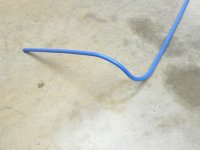
I have read where others using MaxLine were not happy with how it unrolled. Most said to forget about getting it straight. They are pretty much right. I screwed a scrap of 2X2 to a workbench leg, just high enough off the floor to slide the end of the tubing under. With that scrap of wood holding the tubing to the floor, I rolled the roll across the floor, leaving the tube flat on the floor. It springs back some, so you wind up with an arched piece. After cutting to length I worked it by hand and got the arch out pretty well. I am satisfied with how straight it is, but it is not perfect. I don't think I will notice it at 10' off the floor.

I cut a piece for a corner of the shop. I bent it to 90* with a 3/4" conduit bender. Fits perfect in the bender, bends easy. I only used about a 12" pipe for a handle on the bender, you could probably bend it without a handle, it is really soft.

My shop is 40' X 45', I am running a loop all around the perimeter. Because of the slope of the roof, an exhaust fan and the central I-beam in the way, half of the loop will be sloped back to the compressor, the other half to the opposite corner of the shop where I will put a drain valve.

I am using 1/2" thin wall EMT to make hangers to mount the plastic clips that came in the kit.

Sorry, kindofa long post, if any one is interested in more details or pics, let me know.
jp
 
Last edited:
To avoid these ads, REGISTER NOW!

akdiesel

Well-known member
Joined
Aug 8, 2008
Messages
2,617
Location
Wasilla, AK
The conduit bender may create irregular bends inside the tubing where the aluminum is. Soft tubing on those benders tend to distort. It may not be an issue with the 3/4" line but something to keep in mind.
 
OP
S

soj

Well-known member
Joined
Dec 3, 2007
Messages
729
Location
North Georgia
The conduit bender may create irregular bends inside the tubing where the aluminum is. Soft tubing on those benders tend to distort. It may not be an issue with the 3/4" line but something to keep in mind.

I have only made one bend so far, and it feels smooth on the outside, but I will keep an eye out for distortion. Thanks.
jp
 
OP
S

soj

Well-known member
Joined
Dec 3, 2007
Messages
729
Location
North Georgia
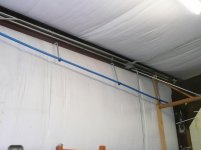
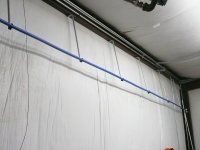
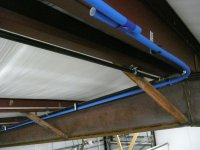
This is what I have done so far.

P1020849.jpg
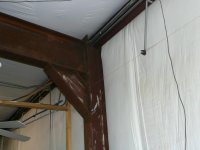
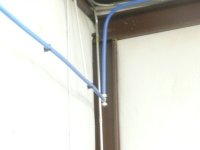
This is the first bend with the conduit bender:

P1020850.jpg
The slope in this area is back to the compressor.

P1020851.jpg
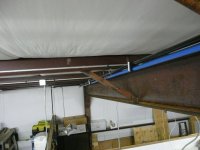
The degree of slope was dictated by the opening under the corner of the beam and above the angle brace. I started with the high point at the bend in the first pic and aimed for this opening.

P1020861.jpg
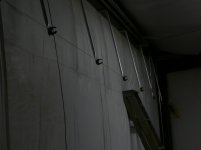
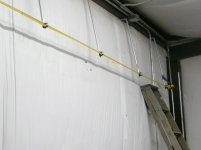
I used a mason's string to set the position of the pipe clips on the end of my 1/2" EMT supports.

P1020866.jpg
Working alone, so I hung the tape measure in the clips to get the length for the cut.

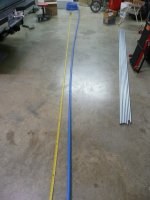
Pipe on floor.jpg
This is after rolling it out as I described in the first post, then "massaging" it by hand to get the arch out.

Just taking a break, going back out now to hang that piece in the last pic.
jp
 

camnick

Well-known member
Joined
Jan 2, 2011
Messages
78
Location
Central Indiana
I installed Rapidair Maxline through my entire barn behind the walls. 3/4" as a main run down both sides and 1/2" dropdowns. The system is easy to install and has worked flawlessly. I needed a few extra pieces nobody carried so I contacted Rapiair. They are extremely helpful. They emailed me after I recieved the part to ask how the install was going. I would definately recommend them.
 

Attachments

  • photo.jpg
    photo.jpg
    138.7 KB · Views: 1,103
OP
S

soj

Well-known member
Joined
Dec 3, 2007
Messages
729
Location
North Georgia
Got two more pieces hung since my last post. Each about 18-20 feet long. That is about as long a piece as I feel like I can handle by myself. More than that and it might fold under it's own weight.

This is the piece that was on the floor in the last post:

P1020871.jpg
I haven't snapped it into all the brackets yet, and you can see the sag.

P1020872.jpg
Once I snapped it into the brackets, it is fairly straight. I put the brackets closer than the recommended 5', hoping that would help to take some of the kinks out.

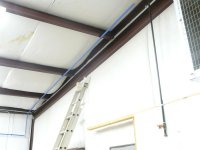
P1020877.jpg
Here you can see the opening in the frame that I routed through. If it looks like the pitch changed after the pipe came through the hole, it's because it did. I went from the high point to the hole, then changed to 1/4" inch per foot.

P1020890.jpg
I rolled out the next piece. This is the arch I get after rolling it out against the floor.

P1020891.jpg
Same piece, after working the arch out by hand.

P1020893.jpg
It gets an almost 90* bend to meet up with the previous piece.

P1020894.jpg
The completed corner. The leg of the tee pointing down will go through the wall to the compressor, outside in a yet to be built shed.
 

alberto

Well-known member
Joined
May 28, 2007
Messages
756
I'm thinking of going this route. Did you leave the tubing out in the sun for a while? It supposedly makes it easier to straighten it out.
 
OP
S

soj

Well-known member
Joined
Dec 3, 2007
Messages
729
Location
North Georgia
I'm thinking of going this route. Did you leave the tubing out in the sun for a while? It supposedly makes it easier to straighten it out.

No sun-soak, I am working inside with the doors closed, A/C running. It is not hard to bend, the tubing is very soft. The problem is bending it just enough, but not too much. After three 18-20' pieces I have about got the hang of it.
jp
 
OP
S

soj

Well-known member
Joined
Dec 3, 2007
Messages
729
Location
North Georgia
Here are some pics of the fittings and tools that come in the kit.

P1020858.jpg
This is the pipe bevel tool. The first hump reshapes the distortion from cutting the pipe, the second hump is a tighter fit, then the metal cutter in the corner reams a bevel to let the o-rings on the fitting slide inside the pipe. There is an identical cutter on the other side.

P1020883.jpg
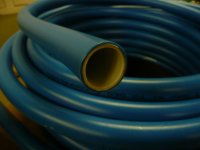
A fresh-cut pipe end, before beveling. Sorry about the yellow color, the liner is really pure white. Must be the warm white florescent light.

P1020885.jpg
You can see the shaving created by the reamer.

P1020889.jpg
After reaming. You can see the taper at the end of the pipe.

P1020859.jpg
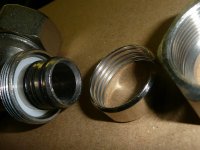
A fitting with the compression nut and ring removed. The white plastic at the base of the socket is to keep the aluminum pipe from touching the metal of the fitting. Otherwise, galvanic corrosion.
jp
 
Last edited:

dipan

Well-known member
Joined
May 24, 2012
Messages
178
Location
South Texas
Nice job documenting this. What are the pros and cons over black pipe or copper? And why not go straight to the compressor with this instead of your short black pipe drop? This seems reasonably priced ... A quick search shows a 100ft 3/4" piping kit at a couple hundred dollars. Very reasonable...
 
OP
S

soj

Well-known member
Joined
Dec 3, 2007
Messages
729
Location
North Georgia
Thanks for posting the detailed progress photos - they are very interesting. Great attention to detail.

Great job!

I'm definitely jealous.
Thanks for posting the detailed pictures.

Nice job documenting this. What are the pros and cons over black pipe or copper? And why not go straight to the compressor with this instead of your short black pipe drop? This seems reasonably priced ... A quick search shows a 100ft 3/4" piping kit at a couple hundred dollars. Very reasonable...

Thanks guys, I will keep this going, but I will have to break from it for a day or two. Parts came in yesterday for a project vehicle in the shop, so I will be working on that again. Also waiting for fittings ordered from RapidAir.

Besides what I mentioned in the first post, there are several considerations in choosing your material for air lines. One of the big ones seems to be personal preference. If you are familiar and comfortable with sweating copper, that will probably be your first choice. The plastic lined insulation in my shop swayed me away from copper. It is one thing to heat-shield to keep from scorching wood framing, but I wasn't sure I could keep from burning (or at least melting) holes in the plastic. I have sweated copper close to wood, and a piece of sheet metal between the flame and the wood will prevent scorching or burning the wood, even if the metal touches the wood. But if the metal touches the thin plastic insulation liner, I am sure it would melt. I am working alone and just rigging a way to hold the heat shield in place would be a pita. Copper is good, and I think would be about the same price range as the MaxLine, so it is a matter of do you have the tools and what your building construction is.

Steel pipe (black or galvanized) would be the best for separating water out of the air. I have the tools to cut and thread up to 2" pipe. But every change in direction requires a fitting (leak potential). And to do a loop system like I wanted to do requires a union, which some say is hard to get leak-free with air. Dunno, never tried it. I ran black pipe for LP gas in this shop, so I guess I was just ready to try something new, with fewer fittings. Now I can say for sure, a quick bend with a conduit bender is much quicker and easier than threading two pipe ends, putting on thread sealer and screwing it all together. Nothing wrong with steel pipe for air, again it comes down to personal preference. As for the black vs. galvanized argument (flakes coming off of the inside of galvanized, getting in your tools or paint), every outlet should have a filter/separator, so the flakes should never get to the hose.

For lots more pros and cons on air line materials, just search for "air lines" or "airlines" on this site (or Google) and be prepared to read till your eyes glaze over.

dipan, where did I say anything about a "short black pipe drop" to the compressor? :dunno: I can't find it, so you must have read my mind.:eyecrazy: Freaky! I do plan a vertical run of 2" black pipe to help catch moisture. The large diameter lets the air flow slowly through that section, allowing moisture to condense on the walls and run back down the pipe. From the bottom of that pipe I will use a rubber hose (for vibration isolation) back to a ball valve at the tank outlet.
 
OP
S

soj

Well-known member
Joined
Dec 3, 2007
Messages
729
Location
North Georgia
Looking good, what type of compressor?:thumbup:

Thanks.

My compressor is a 7.5 HP BelAire. I have had it for about 6 years with no problems. I have this automatic tank drain on it. I have only had the automatic drain for about a year. I wish I had bought it long ago. I didn't because of the price. All I found started at $175.00 and went to about $300.00. Then I found that one on Amazon. And, it is USA made, well, at least the brass valve is. The timer portion is from China. Better some than none. I have it set to drain for 1/2 second every 45 min. I never see any moisture on the floor after it drains unless I have been sandblasting for quite a while. It is the way to go, esp. if your compressor is in an out-of-the way location
jp
 
OP
S

soj

Well-known member
Joined
Dec 3, 2007
Messages
729
Location
North Georgia
I ran out of parts on the vehicle project late this afternoon, so I started back on the airlines. After some careful measuring, (measure twice, cut once) I came up with this double bend.

P1020897.jpg
This is to go up as high as I can, at the peak of the roof, then turn and start the portion of the pipe that pitches away from the compressor. The line will pitch down until it reaches the opposite corner from where the compressor will be. I will put a drain in that corner.

That is all I accomplished on it today, will hang this piece tomorrow.
jp
 

79mudbugg

Well-known member
Joined
Mar 13, 2011
Messages
72
Location
nc
so 1 ques. does the slope of the pipe have to be at such an aggresive angle, i didnt think it would being that big of a deal if im planning on placing a filter/sep. at every drop
 
To avoid these ads, REGISTER NOW!
OP
S

soj

Well-known member
Joined
Dec 3, 2007
Messages
729
Location
North Georgia
so 1 ques. does the slope of the pipe have to be at such an aggresive angle, i didnt think it would being that big of a deal if im planning on placing a filter/sep. at every drop

I don't think it has to as steep a slope as I did in the first section. That was dictated by going from the bottom of the roof framing member to the hole in the central I-beam. The second section looks as steep in the pictures as the first, but it is not. I used a plumbers string level and set it at 1/4" per foot. Now that it is up there, it looks like 1/8" per foot would be enough. But I don't think you can have two much slope, but you could have too little, esp. with this flexible line. If you have a slight sag (which is easy to do) in an almost level line you could have a moisture pocket. With rigid pipe it wouldn't be so critical because you could support it in a straight line.
jp
 
OP
S

soj

Well-known member
Joined
Dec 3, 2007
Messages
729
Location
North Georgia
Today I hung the "double bend" piece shown in the last pic I posted.

P1020898.jpg
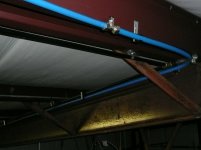
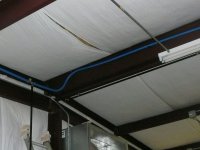
This shows how the bends got the line from the bottom edge of the roof framing to the top, all the way against the insulation, then turns to the right, and starts to pitch down. That high point is at the ridge of the roof, so the line will pitch down from there all the way to the corner opposite of where the compressor will be.

P1020903.jpg
Here is the other end of the same pipe, it is now at the bottom of the same frame member. This is in the approximate center of the shop. I will try to make a drawing to show why I did not follow the outside walls of the building in this corner.

P1020930.jpg
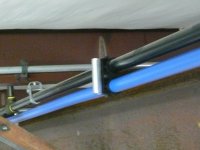
This is the next piece, going from the center of the building to the outside wall. The overlap is where a tee for a drop will go. This piece will follow an existing 3/4" gas line.

P1020917.jpg
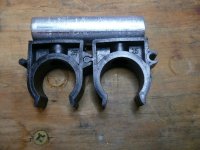
The plastic clips that come in the kit have a sort of "tongue and groove" feature to help mount them side by side. I didn't need to mount air line side by side, but it came in handy to hang the air line under an existing gas pipe.

P1020919.jpg
I mounted two clips side by side on a short piece of 1/2" EMT (my favorite low cost metal for fabricating all sorts of "stuff"). They might have worked without anything but the tongue and groove holding them together, but I was afraid they might pull apart.


P1020928.jpg P1020929.jpg
Here you can see how the clip pairs hang under the gas pipe. The opening of the clips are facing the camera on the first one, the next one the openings are facing away from the camera. I alternated from side to side as I snapped them on, hoping that would help them hang straight. Not sure it mattered, but I am not going back up just to put them all on from the same side. It is hot up there.

More to come, jp
 
Last edited:
OP
S

soj

Well-known member
Joined
Dec 3, 2007
Messages
729
Location
North Georgia
This is what I mean by "hot up there" in the last post.


P1020910.jpg
The 79* on the left is at eye level, the 96* on the right is from the remote sensor just under the roof. I knew I was sweating every time I went up the ladder, I just wanted to see how hot it was up there.

P1020926.jpg P1020927.jpg
Another couple of views of the last piece i hung.


Some more details of the kit components:

P1020918.jpg
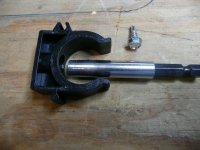
The plastic clips mounting hole is just the right size for a #8 self-drilling screw, which has a 1/4" hex head. A 1/4" socket will fit in the hole, but I wanted to use a magnetic bit driver to better hold the screw. The bit driver wouldn't go in the hole, but it fit perfect after a short visit to the bench grinder. I used a 1/2" long screw.

P1020916.jpg
The pipe has foot markings every 5 feet. It starts at 100 on the outside of the roll, so as you roll it out from the outside, you can tell how much is left on the roll.


M8078.jpg
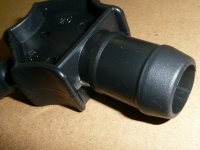
They don't come in the kit, so I ordered tee's with a 1/2" female pipe thread on the side leg. This is to mate up to the fitting for the 1/2" nylon tube I will use for the drops. They are part # M8078.

P1020904.jpg
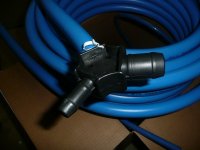
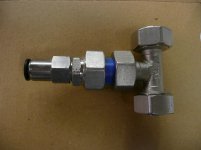
The kit only comes with 3/4"X3/4"X3/4" compression tees. I put this conglomeration together before I decided to order the threaded tees. It would work, but each kit only has two tees. I am using one at the compressor, and one at the opposite corner drain, so I only had two left for drops. So I ordered enough threaded tees for all my drops.
jp
 

79mudbugg

Well-known member
Joined
Mar 13, 2011
Messages
72
Location
nc
i do plan a vertical run of 2" black pipe to help catch moisture. The large diameter lets the air flow slowly through that section, allowing moisture to condense on the walls and run back down the pipe. From the bottom of that pipe I will use a rubber hose (for vibration isolation) back to a ball valve at the tank outlet.

can u post pics when you do this curious to see how this will be done
 
OP
S

soj

Well-known member
Joined
Dec 3, 2007
Messages
729
Location
North Georgia
can u post pics when you do this curious to see how this will be done

Will do, but not sure how soon. When I am finished inside with the loop and some of the drops I have to go outside and pour a small slab and build an enclosure for the compressor. I haven't decided yet if the 2" pipe will be inside or out in the compressor shed.

I sure hope it cools off some by the time I am ready for the outside work.
jp
 
OP
S

soj

Well-known member
Joined
Dec 3, 2007
Messages
729
Location
North Georgia
Not much time today to work on the airlines, but I did put in some of the 1/2" threaded tees that came in yesterday.

P1020938.jpg P1020944.jpg
Pointed up to carry out less (hopefully no) water.

P1020930.jpg
This is the lapped joint from yesterday...

P1020942.jpg
And now with the fitting in place.

P1020934.jpg
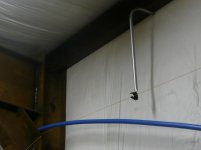
I only completed one drop. This shows an advantage of the nylon tube for the drop, The tee doesn't have to be exactly over where you want to mount the filter/regulator.

P1020931.jpg
At the top...

P1020933.jpg
And down to the filter/regulator.

I really like the nylon tube, it is much easier to work with than the aluminum. But I don't think I would want to use it for horizontal runs, I think it would sag without lots of mounting clips. Every sag would be a potential water pocket.
jp
 
OP
S

soj

Well-known member
Joined
Dec 3, 2007
Messages
729
Location
North Georgia
anything goin on with this project???

Nothing since the last post. I got started on this when I ran out of parts on a vehicle I was working on. Parts started coming in and I have been back and forth from one project to the other. The vehicle goes to the upholstery shop soon, then the airlines will be the priority.
jp
 
OP
S

soj

Well-known member
Joined
Dec 3, 2007
Messages
729
Location
North Georgia
Minor progress on this today.

P1020975.jpg
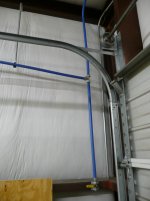
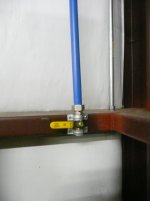
This is the end of the line mounted under the gas pipe. It ends at a tee, then the next piece turns down, then to the right and through the steel beam, just like on the other side of the shop.

P1020976.jpg P1020872.jpg
I only got one bracket made and mounted today. I decided to bend them with the conduit bender, looks much better than the ones on the other wall that I bent in the vice.

P1020977.jpg P1020972.jpg
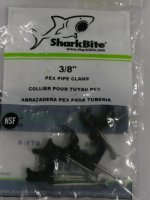
I found these at HD. They are for 3/8" PEX but fit the 1/2" nylon tube I am using for drops. I suppose any clip for 3/8" PEX will work. They come with nails but I will probably use #4 X 1" screws since I will be mounting usually in metal. Even in wood the screws will be easier to get out if I need to move a line.

That's all I got done today, hopefully will have a full day to spend on it tomorrow.
jp
 
OP
S

soj

Well-known member
Joined
Dec 3, 2007
Messages
729
Location
North Georgia
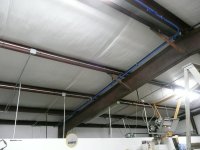
The "loop" is finished. I completed the 3/4" pipe all around the shop today.

P1020978.jpg
This piece is ready to go up into the clips.

P1020979.jpg
And snapped into the clips. You can see that even though the pipe isn't straight in the first pic, once you put it in the clips it straightens out pretty well. It only needs a little hand straightening as you clip it into place.

P1020980.jpg
It's hard to see the pipe here, but it meets up with the one in the last pic, over in the corner.

P1020983.jpg
This corner is diagonally across from the compressor...

P1020982.jpg P1020985.jpg
..and provides the drain valve for that half of the pipe.

Overall I am pleased with how easy this stuff is to work with. Bends really well with a conduit bender, and if you bend it in the wrong place it straightens back out fine. It flattens just a bit when cutting it, but the reamer tool straightens it back out as you push it into the end of the tube. Depending on how much it flattens from the cut, it can be easier to put the nut and compression ring on after using the reamer tool. The compression nut is a 1 7/16" hex, or use a big adj. wrench or channellock type pliers. All goes together very easily.
jp
 

bizkit10

Member
Joined
Jan 19, 2012
Messages
21
Keep the updates coming. I would also like to see how you tie it all into the compressor. Within the next month I will be installing my maxline kit from rapid air or as soon as I get finished with my garage addition and install a new quincy air compressor. Thanks
 

legs64

New member
Joined
Aug 19, 2012
Messages
3
Location
Texas
Getting ready to install a 1/2" Rapidair kit in my garage/shop. Having fits getting those clips (not included in the kit), but they're finally on the way.

soj: Really appreciate you documenting you project for us.
 
OP
S

soj

Well-known member
Joined
Dec 3, 2007
Messages
729
Location
North Georgia
Getting ready to install a 1/2" Rapidair kit in my garage/shop. Having fits getting those clips (not included in the kit), but they're finally on the way.

soj: Really appreciate you documenting you project for us.

That maxline is actualy cheaper than black pipe.

Keep the updates coming. I would also like to see how you tie it all into the compressor. Within the next month I will be installing my maxline kit from rapid air or as soon as I get finished with my garage addition and install a new quincy air compressor. Thanks

Thanks guys. All I did today was install the 1/2" nylon for the drops. I am out of fittings for connecting the nylon to the filter/regulators, but they are supposed to be here tomorrow. Once I have everything sealed off the plan is to do a temporary hookup to the compressor and check for leaks. Then this project will be temporarily abandoned until I finish the current vehicle project. Carpet and headliner material came in today and I am taking the seats to be recovered. As soon as that is finished and back together I will pour a small slab and build an enclosure for the compressor. Also have to run wiring.

Soon as I can put pressure on it I will let you know how the leak test comes out.
jp
 
OP
S

soj

Well-known member
Joined
Dec 3, 2007
Messages
729
Location
North Georgia
Some info on what I am using for the drops.

I found a good selection of push to connect fittings for 1/2" nylon tubing at automationdirect.com. This is the tubing I am using. It is rated at 240 psi at 70*F, 720 psi burst. It is made in USA, the fittings are made in Korea. The fittings have nickel plated brass bodies, with a teflon coating on the threads. Everything I could find locally was all plastic, not sure of the pressure rating, these are rated at 150psi.

Also some thoughts on the kit vs. individual parts. I bought two kits since I wasn't sure exactly how I would plumb everything up, other than I knew I wanted a loop system with 1/2", not 3/4" drops. I thought I might could adapt the compression tees to use for my 1/2" drops. After I got the kits I decided to order the tees with 1/2" female thread on the side leg. Those are 16.99 ea. So I spent a total of 518.91 for two kits and 7 tees. And I will have fittings left over that I won't use. Also not sure I will use any of the aluminum outlets from the kit. When using a filter/regulator there is no need for them. I could have bought all the parts I actually used for 506.83. Not a big savings, but no left over parts. And, the plastic clips from Rapidair are 1.50 ea, so I could have saved more by buying clamps for less than a dollar ea. I probably overdid it with 7 drops in a 40 X 42 building, but if I had only put one on each wall I would have only saved 50.97. It all depends on how you plan to run your main line (loop or straight run), 3/4" drops or smaller, filter/regulators or the outlets in the kit. If you are sure of your layout, figure it both ways BEFORE you order, not AFTER, like I did. My problem is that I sorta designed as I went, a bad habit of mine.

The above prices don't include any shipping or anything for the drops.
jp
 
Last edited:
OP
S

soj

Well-known member
Joined
Dec 3, 2007
Messages
729
Location
North Georgia
Soon as I can put pressure on it I will let you know how the leak test comes out.
jp

The other fittings for the 1/2" nylon came in this afternoon so I was able to seal everything up and pressurize it. No leaks at any of the MaxLine or nylon push to connect fittings!:D

I did have some minor leaks on some of the fittings on the filter/regulators. These were pre-assembled in the box, and I don't see any sign of thread sealer on them. I will take those apart tomorrow and get everything sealed up so I can do a leak-down test overnight.
jp
 

bizkit10

Member
Joined
Jan 19, 2012
Messages
21
Good job, I still need to paint and run electrical. Then I will be running my air line. Is there an advantage to running a loop system as to a straight run?
 
OP
S

soj

Well-known member
Joined
Dec 3, 2007
Messages
729
Location
North Georgia
Good job, I still need to paint and run electrical. Then I will be running my air line. Is there an advantage to running a loop system as to a straight run?

The real advantage of a loop is less restriction and higher volume because of air delivered from both sides of the drop in use. This advantage is lost in a one-man shop as it only comes into play when more than one drop is in use at a time. The average home shop isn't big enough for a 3/4" straight run to experience pressure drop. I mostly chose to run a loop so I would have air available anywhere on all exterior walls, making it easier to add drops later. I admit it is overkill for a one-man home shop.
jp
 

akdiesel

Well-known member
Joined
Aug 8, 2008
Messages
2,617
Location
Wasilla, AK
The real advantage of a loop is less restriction and higher volume because of air delivered from both sides of the drop in use. This advantage is lost in a one-man shop as it only comes into play when more than one drop is in use at a time. The average home shop isn't big enough for a 3/4" straight run to experience pressure drop. I mostly chose to run a loop so I would have air available anywhere on all exterior walls, making it easier to add drops later. I admit it is overkill for a one-man home shop.
jp

Another advantage for the loop is the air will cool sooner when using higher demand air equipment.
Very nice and detailed setup. I admire over kill. A little extra money and work means longevity and care free.
 
OP
S

soj

Well-known member
Joined
Dec 3, 2007
Messages
729
Location
North Georgia
Another advantage for the loop is the air will cool sooner when using higher demand air equipment.
Very nice and detailed setup. I admire over kill. A little extra money and work means longevity and care free.

Right about the air cooling, which pulls the moisture out of the air and onto the pipe walls. Another reason to use 3/4". It is not needed for flow capacity, but the air will be moving slower in the pipe, giving more time for cooling. And air in a loop system will be moving even slower, as it is coming into the drop pipe from two directions.
jp
 
To avoid these ads, REGISTER NOW!
Top Bottom